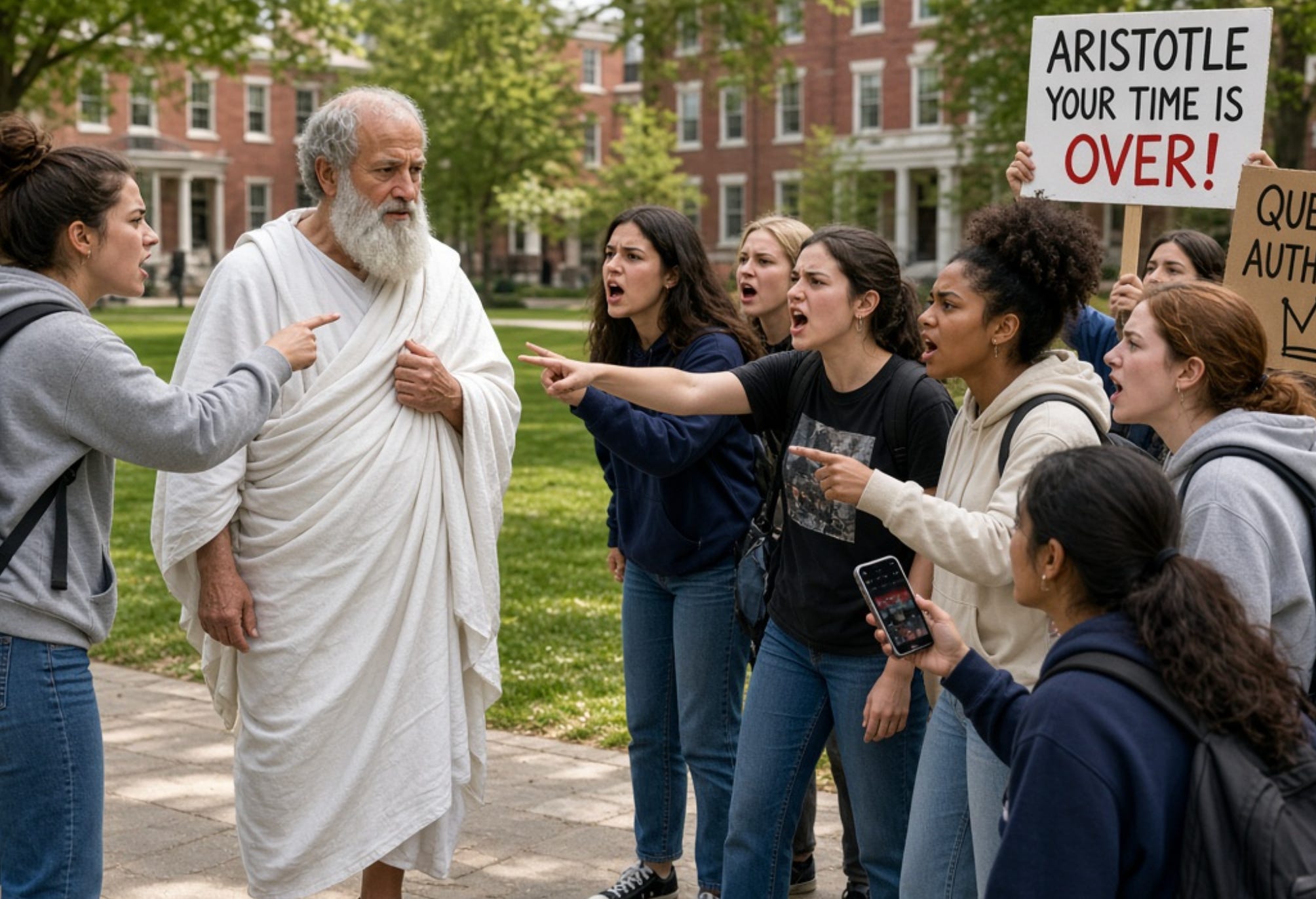
The other day a college professor friend phoned me to vent. Two (white) female undergraduates had complained to him that they didn’t want to study Aristotle because he was a “bigot” — by which they meant that the Greek philosopher of the 4th century BC had nothing worthwhile to say, because he did not share 21st century ideas about the place of women in society.
What upset my friend so much is that it was impossible to reason with these young women. He wasn’t asking them to agree with Aristotle; he was asking them to engage with Aristotle’s ideas, to think about them. They refused. Said Aristotle had nothing to teach them, because of his bigotry. When he pushed back, one of the women accused him of trying to “deconstruct” her Christian faith (this happened at a Christian university).
These women felt that Aristotle was sexist (well, true, by contemporary standards), and because of that, they felt that he was not worth taking seriously. For their teacher to challenge that stance, they felt, was to attack their dignity as women. One even threatened to “turn him in” for defending the value of reading Aristotle. In a university — a Christian university — in 2026. I asked Grok what the politics of that particular university’s student body are, and it said campus polling makes it one of the most conservative in America. Think about that.
The professor added: “I can take ignorance and immaturity. I can’t handle misplaced arrogance and a false sense of virtue.”
I forgot to mention to him how shocked I was a decade ago, having delivered a talk about Dante, at the comment made by a female student during the Q&A, that she didn’t understand why we should pay a bit of attention to Dante, because he was, yes, a “bigot”. I thought she was making a joke. She was not. A college professor told me after the talk that this kind of thing was common on campus. Wokeness was just then coming into full public consciousness, but the professors had been dealing with it for years by then.
Last night, I sent a new Freddie deBoer essay to my Aristotle-loving professor friend. DeBoer is a Marxist, but anti-woke (he believes politics should be about material concerns). The title of the essay — “The Politics Of Fantasy And Entitlement Are Driving Everyone Insane” — says it all. Actually, no, you need to read the essay. But Freddie makes an argument that this conservative entirely agrees with. He says we have made ourselves insane by accepting the belief that if you are not able to have or do what you feel you should have or do, then the reason can only be because someone is oppressing you. We have created a culture in which any limits at all are seen as metaphysically unjust. You really need to read the whole essay, but this is at its heart:
…the sense that any limitation on our desires is a matter of injustice has fully metastasized. And the people who are most caught up in those feelings will inevitably pay the price. Entitlement is a funny thing; its most obvious destructive effects afflict those around us, but oftentimes the most pernicious outcomes are for ourselves. A failure to properly understand what we can and can’t reasonably expect is a truly debilitating personal weakness. It makes every realistic success into a failure to live up to fantasy. As Liu says, “A general anti-humanism disguises a contempt for ordinary language and ordinary people” - and the ordinary is what we all have to learn to accept.
The reason why this problem is so hard to shake is not due to any inherent gender dynamics, but because of the other reality I mentioned, commerce. There’s a book that’s become very popular, it’s got a title like
Adult Children of Shitty Parentsor something. Bestseller. And its message is that if you have a bad relationship with your parents, good news - it’s their fault and not yours. This exonerative service has become the financial engine of almost all of the meager number of nonfiction books that are still financially successful. You’ll note that there are no examples of the obverse. There is no NYT bestseller titledActually, Your Relationship with Your Parent is Bad Because You Are a Toxic and Selfish Person.And that is a function of an incredibly unhealthy dynamic in contemporary culture. You can’t get rich telling people that, in fact, they’re single and unhappy because they keep cheating on their partners and they keep cheating because they’re bad people. But speaking as someone who has spent a lot of time in the “recovery community,” I assure you that that is the kind of talk most people really need.
Freddie — who, I remind you, is a self-described Marxist — cites a new essay in The Cut, an online vertical of* New York* magazine, then says:
It’s as if the essay, the essayist, and the publication are unable to embrace the simple reality that as adults we must learn to leave the imaginary behind and embrace the real.
I have no idea how any of this gets fixed. No piece like the one I’m writing now could ever be published in a mainstream publication; the disingenuous allegations of misogyny (or any other convenient bigotry) write themselves. But I do know that we can’t go on like this. The collective misery, the rage at the real, the absolute and utter refusal to accept that this is just what life is and that disappointment is unavoidable… it can’t continue forever. The trouble is that you can’t convince a junkie to stop being a junkie. Not with reason and certainly not while protecting their feelings. As Ortiz writes, “Addicts do tend to rationalize their addictions.” Yes, they do - and when it comes to insisting that living anything short of your ideal fantasy life is a form of social injustice, our whole culture is an enabler.
I was having a conversation the other day with a Christian pastor friend. We were talking about the problem of young men and young women who seem unable to find partners. I mentioned data showing that large numbers of young women have completely unrealistic ideals of the kind of men they are willing to date. They will not accept any man who falls short of their ideal. For his part, he was telling me about young men he counsels who are completely unrealistic about how they ought to behave in order to attract women. We’re talking about things as basic as hygiene. He told me a story about one young man in his twenties in his congregation who had to be told (by him) to start bathing regularly.
Is it the case that we are becoming a people who believe we are entitled to have everything we want, without limits, and anything short of that must be Somebody’s Fault, Not Our Own? It seems so. Now, imagine how people with that mindset will adapt to a culture dominated by AI. The technology, which seems superficially capable of delivering whatever one wants, immediately, will supercharge this sense of entitlement. People will feel both omnipotent and helpless. How does one even practice ordinary politics in such a society? How do we live together?
For years I’ve been working with a friend whose wife has a severe case of one of the Cluster B personality disorders. He’s trying hard to avoid divorce, for the sake of the kids, but the wife regards any disagreement, no matter how petty, as him assaulting her sense of self. She is bona fide mentally ill, but really, how far is her stance from the one Freddie de Boer writes about? How far is her stance from the female undergraduates who refuse to take Aristotle seriously because the views of a 2500-year-old Greek philosopher offend their sense of personhood, and make them feel anxious? This is what Chris Rufo means by “the Cluster B Society”.
If this is where we are, and where we are going, then liberal democracy is done for. Politics becomes a matter not of negotiation, but of tribal psychodrama. Such a society will surrender to a strong authority that delivers “compassionate” outcomes through illiberal means. That means suppressing the Bad People (meaning, those who disagree). The way some universities were governed during Wokeness (and still are) becomes nationalized.
Alternatively, we surrender to a Caesar who suppresses the hysterics, and creates a “reality-based” governing order. To me, this sounds better, but when I see how so many Zoomer right-wing white men are giving in to the politics of victimization, a generation after the Left did, I am not confident. Last week, I posted something about this new far-right Zoomer book American History Z, which attempts to explain and justify the anti-democratic radicalization ow white males in their twenties. The book concludes by calling for a Caesar. This line on the book’s opening page — “All we have is feeling. But the feeling is all we need” — is absolutely key. They too have surrendered to politics as emotivist pathocracy.
See, this is what the philosopher Max Picard meant when he said Germans in the Weimar period made themselves vulnerable to Nazism because they had lost the logos. By that he meant a principle of underlying order that gave people living within German society a sense of connectedness, not only to each other, but to their past, and to transcendent meaning. Without shared belief in logos, reason becomes impossible. Control in a post-logos society goes to whoever shouts the loudest, and provokes and harnesses the greatest feeling.
This is where we are headed. Germany of the 1920s had been badly fragmented by the terrible events of losing World War I, hyperinflation of 1923, and the collapse of trust in institutions, as well as the shredding of a sense of community. Amid this “disjointedness” (Picard’s word, in transation), logos evaporated. Picard said that Weimar Germany’s condition was really the modern condition, expressed most acutely.
This is how you get from well-to-do American undergraduate women bitching that Aristotle should not be listened to because he makes them feel demeaned as women, to totalitarianism. It’s not a straight path (and for the record, Freddie de Boer said young men obsessed with sports betting are part of the same process of rebellion against limits), but it ends up in the same place, unless somehow it is stopped. I’m hoping * Weimar America *can wake up enough people to recognize the crisis and take action to head off the loss of democracy and the coming of authoritarianism or totalitarianism (be it of the Left, of the Right, or something altogether different, like some sort of AI Technocracy). History is not fated. But people who are asleep can’t do anything to save themselves, you know.
(Today’s newsletter continues below for paid subscribers. Why not become one? There’s a new newsletter every weekday.)