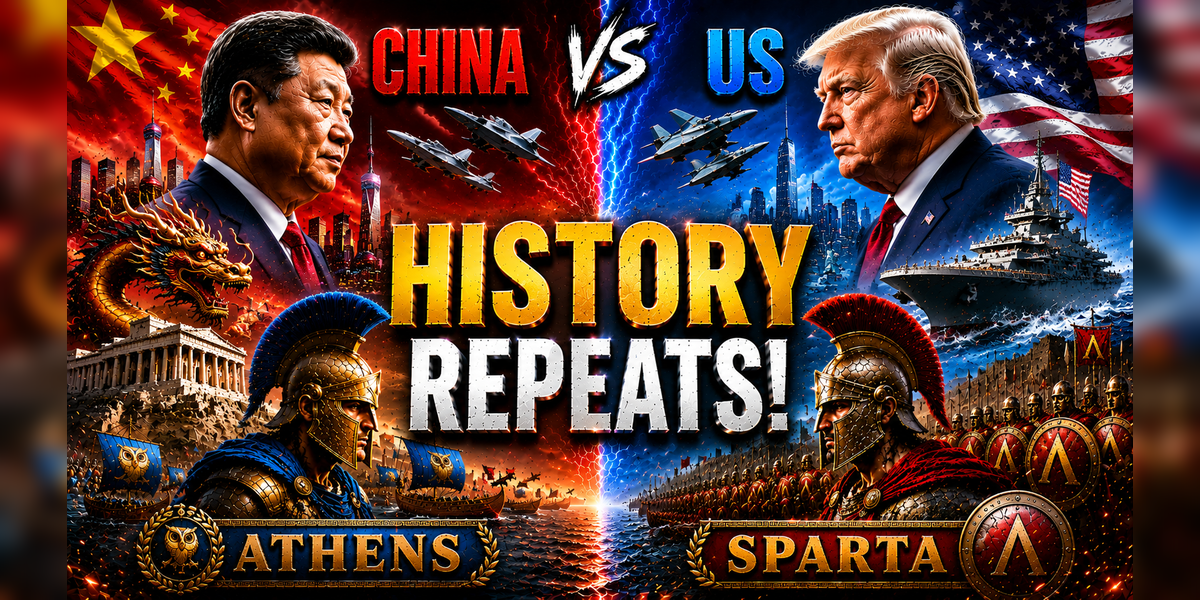
Why America and China Can’t Just “Get Along” — And Why They Build Power So Differently
Some patterns are too old to notice. This one is too dangerous to ignore.
For readers who want the core intelligence before the full file opens.
One half of this story is a 2,500-year-old psychological trap that two Greek city-states fell into first. The other half is a hidden divide between two completely different operating systems for running a civilization. Put them together, and almost every confusing headline about the US-China rivalry suddenly makes sense.
Twenty-five centuries ago, two Greek city-states went to war — not because they hated each other, but because the older, stronger one got scared of the younger, faster-rising one. A historian named Thucydides wrote down exactly why. Today, foreign policy scholars call this the Thucydides Trap, and it lines up almost perfectly with how Washington has started watching Beijing.
That fear doesn’t stay locked inside think tanks. It leaks into real decisions — including military operations that look like they’re about one country but are quietly addressed to a much bigger audience watching from the sidelines.
But there’s a second layer underneath all of this, one most coverage skips entirely. America and China aren’t just two governments competing for the top spot. They are two fundamentally different machines for getting things done — one built by people trained to argue in courtrooms, the other built by people trained to solve equations. That divide explains why one country has laid enough high-speed track in two decades to circle the entire planet, while the other is still arguing over the first 171 miles of a single line it promised to build seventeen years ago.
Two forces. One ancient fear, one structural divide. Together, they’re quietly running the world.
Now — let’s open the full file.
What could a war fought before the invention of the compass possibly tell us about satellites, semiconductors, and aircraft carriers?
No drones. No bond markets. No supply chains stretching across oceans. Just spear-armed infantry, wooden hulls, and stone fortifications.
So why dig that far back?
Because old conflicts don’t actually disappear when the fighting stops. They leave behind something less visible than a treaty — a kind of inherited instinct for how powerful groups behave once they sense the ground shifting underneath them.
Strip away the titles, the flags, and the technology, and the decision-making instinct inside a modern superpower isn’t actually all that different from the one inside an ancient city-state. Same dread of being overtaken. Same impulse to defend something decades in the making. Same unease watching a rival close the distance, season after season, without a single villain anywhere in the story.
That instinct is still active right now, inside rooms full of people who would never describe themselves as superstitious.
Here’s the part that’s easy to miss: the brain running a modern superpower is the same brain that ran an ancient city-state. The tools changed beyond recognition — the borders, the currencies, the satellites, the warheads — but the underlying wiring didn’t get an update. The dread of being overtaken. The instinct to guard what took decades to build. The unease of watching a rival get stronger, year after year, without a single act of aggression to point to.
That wiring is still running, mostly out of sight, inside the decisions of people who would never describe themselves as old-fashioned.
We’re going to dig that instinct up today. Once you’ve seen its shape, the news starts reading differently.
Forget today’s borders and flags for a moment.
Ancient Greece wasn’t one country. It was a cluster of fiercely independent city-states, each running its own government, fielding its own army, and watching its neighbors the way people with shared walls always do — closely, and a little nervously. Picture a tightly packed patchwork of micro-nations, each with its own sense of itself, each with everything to lose.
Two of those city-states would go on to shape the next two and a half millennia of political thinking.
Sparta.
Athens.
And between them, something started that felt almost too ordinary to notice at the time.
Competition.
Hold onto that thread, because the shape of that competition is still playing out today — not “something like it.” The exact same structure. Different uniforms.
Before we get to armies and warships, picture something smaller and more familiar. Something most of us have lived through ourselves.
There’s an office. One department has been run for fifteen years by the same person — let’s call her the department head. Nobody has seriously challenged her position in all that time. She’s not loud about her authority; she doesn’t need to be. Decisions route through her out of habit, out of precedent, out of the simple fact that she has always been the one in the room when it mattered. Her position isn’t a title on a business card. It’s a gravity that has organized everything around it.
Now look three offices down the hall.
There’s someone else there — newer, much further down the org chart, with no claim on the department head’s territory at all. But colleagues have started noticing something: this person is sharp. Sharper than anyone expected. Taking on projects nobody assigned her, picking up skills faster than anyone budgeted for, quietly becoming the person clients ask for by name.
This newer colleague isn’t maneuvering against the department head. There’s no campaign, no whispered ambition, no plan to take anyone’s chair. She’s simply doing what talented people do — working hard, getting better, for her own sake, one quarter at a time.
And here’s the uncomfortable truth: that’s already enough.
The newer colleague doesn’t have to want the department head’s job. She only has to have become capable enough that the possibility now exists. In the psychology of status, potential does almost all the damage — you don’t need an actual rival standing in front of you. You only need someone who could plausibly become one. The suspicion alone rewires everything.
Improvement, even when it is completely well-meant, almost never reads as harmless to the person standing still.
The department head doesn’t need an insult thrown her way. She just needs to watch this colleague get better, quarter after quarter, until a question takes shape that she can’t quite say out loud: What happens if this keeps going?
Once that question lodges itself, the relationship stops being neutral. Friction stops being a maybe. It becomes close to inevitable.
And when it finally surfaces, it won’t be calm — because by then, it’s no longer about who’s better at the job. It’s about something older and more primal: who stays at the top, and who gets moved aside.
Hold that feeling. We’re about to watch the identical shape play out with navies instead of office politics, and the future of an entire civilization sitting on the table.
In the true version of events, Sparta wore the champion’s belt.
Generations of brutal, ritualized military training had made it the single most feared land power anyone in the region could remember. Nobody had seriously tested that reputation in living memory. The gap between Sparta and everyone else had been stable long enough that people had quietly stopped treating it as a gap at all — it simply felt like the natural order of things.
Then Athens did exactly what the rising colleague in our office story did.
Across decades, patiently, it turned a modest fleet of fishing and trading vessels into the most capable navy the Aegean had ever seen — strong enough, eventually, to reach coastlines Sparta had never once worried about defending. It closed a discipline gap that Spartan commanders had long assumed was simply permanent. And it stitched together a widening web of allied cities, one region at a time, without ever issuing a single threat in the process.
None of it was a declaration aimed at Sparta. Athens was simply doing what any capable, ambitious power does on its own behalf — getting stronger, for its own sake, because it could.
But compounding growth doesn’t announce itself. It moves slowly enough to be almost invisible week to week — right up until someone finally measures the distance and realizes a gap that used to feel unbridgeable no longer is.
To Sparta, watching from across the map, none of that read as simple progress.
It read as a countdown with no visible clock face.
Eventually, the pressure broke. It erupted into one of the most consequential conflicts of the ancient world: the Peloponnesian War.
Wars happen constantly throughout history. Most fade from memory within a few generations. This one didn’t — and the reason has almost nothing to do with the fighting itself.
It’s because of who studied it afterward.
A historian named Thucydides examined the war in remarkable depth, and what he found cut directly against the easy explanation — sharply enough to shape strategic thought for the next 2,500 years.
Most people assume ancient wars erupted from deep, generational hatred — two peoples who simply despised each other until something finally snapped.
Thucydides looked at the evidence and landed somewhere completely different.
Hatred wasn’t what started the war between Athens and Sparta.
Sit with that for a second.
There was no decades-old blood feud. No deep cultural animosity. No clash over gods, values, or ideology driving any of it. Ordinary Athenians felt no particular hostility toward ordinary Spartans, and the feeling went both ways. If you had surveyed the average citizen of either city on the eve of war and asked whether they hated the other side, most would have looked at you blankly.
So what actually pulled the trigger?
This is the single most important idea in the entire story — and exactly why scholars still study this war obsessively, two and a half millennia after it ended.
Here’s the mechanism Thucydides actually uncovered, stripped down to its bones.
Sparta watched a neighbor get stronger. That fact alone was enough to poison everything between them.
Read that again, because it sounds too simple.
Nobody crossed a border. Nobody broke a treaty. Athens never raised a hand against Sparta directly. What happened instead was quieter, and in its own way more corrosive — a slow accumulation of doubt, with no single incident anyone could point to and call an act of aggression.
Eventually, that accumulated doubt did something doubt usually can’t do on its own: it started a war.
Not a war of revenge for something already done. A war of pre-emption, against a danger that hadn’t happened yet — and might never have happened at all.
Sparta chose war not because Athens had attacked it, but because Sparta feared what Athens might eventually become.
A security dilemma occurs when two powers begin reading each other’s purely defensive moves as offensive threats. Neither side intends aggression. Both end up creating it anyway.
Before applying this to ancient empires or modern superpowers, feel it at human size — because at human size, the mechanism is impossible to miss.
Picture a narrow market lane, somewhere you might walk through any morning of your life. Two stalls, three feet apart, run by two men who have shared that strip of pavement for fifteen years. Every morning starts the same way: one pours, the other holds out a cup, and they drink that first tea together in a silence that has never once needed filling with words. Fifteen years of that. The quiet familiarity of two people who have never had to explain themselves to each other.
One week, after a string of petty thefts further down the lane, the man on the left hangs a thin curtain across the back of his stall — just enough to stop a stranger’s hand from reaching behind the counter unseen. That’s the entire reason. Nothing more.
The man on the right doesn’t know about the thefts. All he sees is a curtain that wasn’t there yesterday, and a neighbor who suddenly has something he wants hidden.** New stock he doesn’t want me to see? A better supplier he’s keeping quiet? Is he planning to undercut my prices? **He says nothing out loud — but the next week, his own ledger turns face-down on the counter. His voice drops half a notch when a regular customer asks about prices. Just in case.
Now it’s the man on the left who notices the shift. Why is he being so careful with me all of a sudden? What does he know that I don’t? So his curtain gets a little thicker.
Neither man has said an unkind word. Neither has done a single thing actually aimed at the other. Yet within one market season, two people who shared a silent cup of tea every single morning for fifteen years are measuring each other across three feet of space like strangers — each one quietly certain the other started it.
Each one right, and catastrophically wrong, at the same time.
That’s the entire machine. No villain anywhere inside it. Just two defensive instincts, misread, feeding each other, building toward a rupture that neither man would have chosen and both men will spend years not fully understanding.
Now swap the two shopkeepers for two nuclear-armed superpowers with trillion-dollar militaries, global alliances, and the stability of the world economy balanced between them.
The psychological wiring is identical. The stakes are not.
Look at Sparta’s actual position for a moment, by any conventional measure of power.
It was the stronger military. It had the stronger reputation. It had decades of evidence backing both. On paper, there was nothing to be afraid of.
And yet.
The danger Sparta reacted to wasn’t a danger Athens had actually created. It was a danger Sparta’s own imagination had built, almost entirely out of one question it couldn’t put down:** If this keeps going, where does it end — and will I still recognize my place in the world once it does?**
No fleet had crossed into Spartan waters. No army had massed on a Spartan border. The only hostile act in the entire chain of events was a feeling — and that feeling, on its own, was enough to set two civilizations on a collision course.
Here’s where this stops being ancient history.
Lay Thucydides’s framework directly over today’s map, and something striking happens. It doesn’t just rhyme with the present.
It is the present, dressed in different uniforms.
Sparta, the established power of the ancient world → America, today.
Athens, the rising power of the ancient world → China, today.
This isn’t a loose comparison stretched for effect. Separated by 2,500 years and an entire technological revolution, the underlying shape of the situation is close to identical — and psychologically, almost impossible to tell apart from the original.
There’s even a formal name for this in modern political science. Harvard professor Graham Allison popularized it for a global audience in his 2017 book** Destined for War: Can America and China Escape Thucydides’s Trap?**, coining the term Thucydides Trap for exactly this pattern — a rising power’s growth becoming threatening enough to an established power that the relationship tips from merely risky into something closer to structurally doomed, driven less by anyone’s actual intentions and more by fear quietly taking the wheel.
Allison and his team combed through sixteen comparable moments across roughly five hundred years of history.
Twelve of those sixteen ended in war.
Hold that number. We’ll come back to it.
For somewhere between seventy and eighty years, the United States didn’t simply hold the world’s strongest military. It did something far more ambitious: it built an entire global order with itself sitting at the center of every load-bearing wall.
Run through what that actually took. The US dollar became the currency t…