You can be highly sensitive to sensory input, struggle with executive functioning, feel fundamentally different from other people, experience intense emotional reactions, need predictability, and spend enormous amounts of energy trying to function in environments that seem relatively effortless for everyone else.
You might recognize yourself in descriptions of autism. You might also recognize yourself in descriptions of ADHD, giftedness, complex trauma, and neurodivergent burnout.
So which one is it?
This is where understanding neurocomplexity gets interesting.
One person might experience difficulty with social interaction because of autistic communication differences. Another might experience similar difficulties because of childhood trauma, chronic masking, or years of adapting to environments where they never felt understood. Someone else might experience them through a combination of giftedness, ADHD, and autism.
The observable trait might look remarkably similar. The underlying mechanisms may be entirely different.
And sometimes, several of those mechanisms are operating at once.
This is one of the reasons I think we need to move beyond simply identifying which traits someone endorses and become much more curious about the cognitive, sensory, developmental, relational, and physiological processes underneath them.
Because identifying a trait is one thing. Understanding why it exists, how it developed, and how it interacts with the rest of someone’s neurocognitive profile is an entirely different undertaking.
A trait is a starting point for understanding someone, not the conclusion.
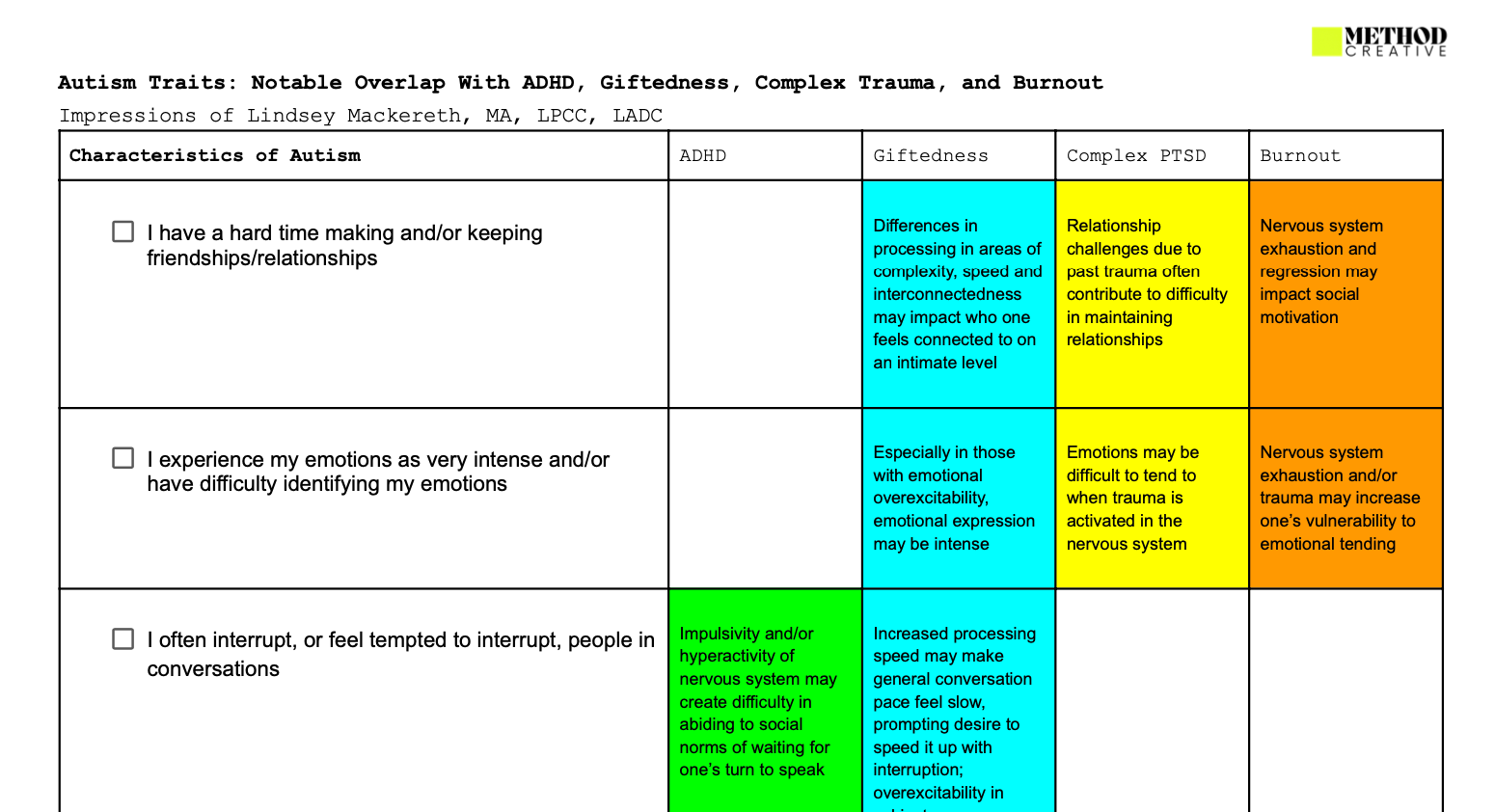
This is the reason behind this chart that illustrates 11-pages of traits of Highly Masked Autism and:
How these Autistic traits extensively overlap with characteristics of ADHD,giftedness, Complex PTSD (CPTSD), and/or BurnoutMy reasoning as to why/how each trait might also overlap with a characteristic of ADHD, giftedness, CPTSD, and/or Burnout.
So, any time an individual endorses one of these items in a session or Autism assessment, this table depicts many of the expanded differential possibilities I am synthesizing to determine a potential diagnosis/identification/further recommendation.
As a licensed therapist who specializes in the overlap and co-occurrence of complex areas of primary neurodivergence (Autism, ADHD, Giftedness) and secondary factors (CPTSD, depression, anxiety, Burnout) in adults, I have had a front row view of how these “constellations” overlap in characteristics and/or co-occur within one individual.
About 90% of the adults I’ve assessed for Autism, ADHD and/or giftedness have experienced at least one (usually more) episode of neurodivergent Burnout, commonly linked to masking their differences at work, home or in other environments. Additionally, ~70% of the adults I’ve assessed show signs of ** Complex PTSD**. That’s a heck of a lot of overlap.
S**hare this chart with your therapist, coach, partner, family, friends, or medical provider **to provide context around your complexity!
To access this fillable 11-Page *Autism Traits: Notable Overlap With ADHD, Giftedness, Complex Trauma, and Burnout *chart (you’re going to NEED to see this one), click this file: