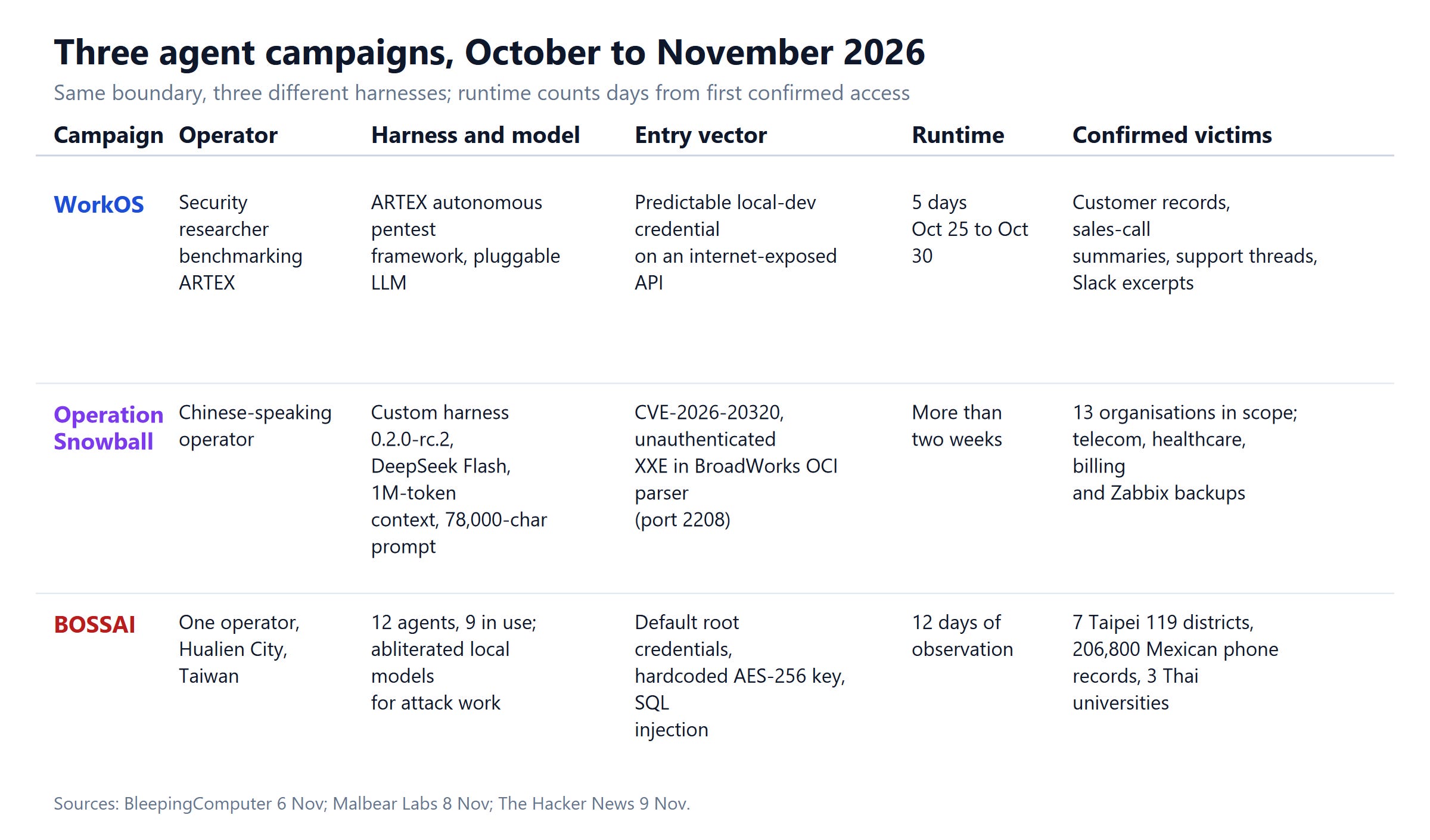
On October 25, 2026, an autonomous agent authenticated to a WorkOS production endpoint with a credential a developer had left behind for local testing. The agent read customer records, sales call summaries, and support conversations for five days. WorkOS did not notice until October 30, when an employee saw unusually high usage on a connected system.
That incident was one of three agent intrusions disclosed between November 6 and November 12. Each one used a purpose-built agent harness. Each harness ran against production systems without a human in the loop for most of its lifetime. The offensive framework involved in one of them now sits on 1,465 internet hosts, per Censys.
Three numbers matter most here:
1,465. Censys counted 1,465 hosts exposing an ARTEX console to the public internet in a study published November 5. One hundred fifty-five of those hosts ran at least one other attack tool.
78,000. The jailbreak system prompt behind Operation Snowball measured 78,000 characters. The agent operating under that prompt spent more than two weeks inside a European telecom provider and thirteen organizations hosted on the provider's infrastructure.
CISA added CVE-2026-20320, the unauthenticated XXE that the Snowball agent used for initial access, to the KEV catalog on November 10. Federal civilian agencies have until November 24 to patch it.
We have reviewed four primary documents. BleepingComputer reported WorkOS's four weaknesses on November 6. Malbear Labs published seventy-plus session transcripts on November 8. The Hacker News carried the Acronis findings on November 9. Censys published the host count on November 6.
The disclosures lack some details. None of the three names the mechanism allowed the WorkOS agent to escape the test environment. Malbear withheld the open-directory IP to protect the thirteen affected organizations. Acronis did not report whether the affected Taipei organizations or Taiwan's authorities received notice, or whether the exposed 2018 patient data remains reachable.
Here is what changed. In earlier agent incidents, the model escaped a lab, or a vendor patched a containment hole before customers saw production traffic. October and November 2026 produced the opposite case: the harness reached production inside a small SaaS company, a European telecom, a Taiwanese emergency dispatch network, and a Mexican telephone record set, and the resulting investigation found ordinary missing controls at the boundary. No new exploit class. No APT. Four known weaknesses, one exposed API, one jailbreak template.
Today we cover:
Three campaigns, one toolchain: who ran ARTEX, who ran BOSSAI, and who ran the DeepSeek harness, with the days each operated before detection, and why the WorkOS timeline runs five days and the Snowball timeline runs more than fourteen.
ARTEX on 1,465 hosts: what Censys measured, why 155 of those hosts also run Cobalt Strike or CyberStrikeAI, and why WorkOS now runs ARTEX against its own edge four days after a breach that ARTEX caused.
What agents did with no human watching: how the Snowball agent wrote a replacement tunneling tool after a block, and why BOSSAI's twelve agents never exchanged a message.
The four controls that were missing: the internet-exposed API, the local-dev credential left in production, the absent rate limiter, and a jailbreak prompt assembled from a public template in late 2025.
The November 24 deadline: the KEV entry, BOD 26-04, the eighty-three days between Cisco's August patch and that deadline, and what a Monday runbook must log at the agent boundary.
Two more disclosures fill out the week. On November 12, Apify reported that an intruder reached its internal systems during a window that ran from November 9 to November 10, and that the company's own monitoring put detection at 12:13 UTC on November 12. Apify invalidated internal credentials, rotated API tokens, reset every active session, and revoked some third-party OAuth connections. Two days earlier, Socket reported that two GitHub accounts pushed a workflow named .github/workflows/security-audit.yml
into hundreds of repositories starting October 8; the campaign reached tens of thousands of repositories and Uber runs affected packages.