Disclosure: This article is sponsored by Ridge Security. I am an advisor to Ridge Security and thank its executive team for the opportunity to collaborate. I also wrote the analysis of a model benchmark that Ridge Security published in September 2026, which is cited below. Descriptions of every vendor, including Ridge Security, are based on public information (company websites, press releases, marketplace listings and trade press) as of the date above. Capabilities in this market change monthly, so confirm details with each vendor.
Penetration testing has a cadence problem. Most organizations still test on an annual or semiannual cycle, while their applications, APIs, and infrastructure change every day. A new class of platforms is closing that gap by using AI agents to do the work of a pentester: map the target, form attack hypotheses, execute exploits within an approved scope, prove what is actually exploitable, and hand back evidence and fixes.
2026 is the year this category moved from experiments into procurement. XBOW raised a $120 million Series C at a valuation above $1 billion in March, Novee emerged from stealth in January with $51.5 million, and in July IDC named Ridge Security an IDC Innovator in IDC Innovators: Autonomous Penetration Testing for DevSecOps, 2026.
The platforms below share a goal but differ sharply in how they get there: what they can test, where their context comes from, which AI models they rely on, and where they run. This guide profiles seven of them, starting with Ridge Security, and closes with a buyer checklist and FAQ.
**Ridge Security (RidgeGen, RidgeBot, RidgeOne):**for enterprises and MSSPs that need governed autonomous testing across the whole estate, from web apps and APIs to networks, hosts, Active Directory and IoT/OT, with on-premises deployment and a choice of AI model.**XBOW:**for teams that want a cloud service focused on continuous testing of web applications and APIs, with Microsoft Security Copilot and Sentinel integration.**Novee:**for application-heavy enterprises that want a purpose-trained offensive model across web, API, mobile, desktop and LLM applications.**Equixly:**for API-first organizations and teams shipping MCP servers and LLM applications.**Xint.io:**for teams that want black-box web application testing and code analysis from the offensive research team at Theori.**Prime Security:**for product security teams that want white-box pentesting tied to design reviews and code reviews.**Corgea:**for startups and developer-led teams that want AI pentesting bundled into an AI-native AppSec platform.
Autonomous penetration testing uses AI agents to carry out scoped offensive testing with minimal human direction. A capable platform discovers or ingests the attack surface, decides which attack paths to pursue, executes them under policy, verifies that an exploit actually works, and reports the result with evidence, remediation guidance and a way to retest the fix. It is easiest to understand by contrast with tools buyers already own:
**Dynamic application security testing (DAST)**sends predefined payloads to a running application. Agentic platforms add reasoning: they follow application logic, chain weaknesses across steps and roles, and test business rules that signature-based scanners cannot see.**Breach and attack simulation (BAS)**replays known attack scenarios to check whether security controls detect or block them. Autonomous pentesting looks for exploitable paths in your specific environment.Pentesting as a service (PTaaS) and bug bountyare delivery models built around human testers. Several of these providers now add agents of their own, which blurs the line.Human-led pentesting and red teamingremain the benchmark for novel research, high-risk systems and formal attestations. Autonomous platforms are best understood as continuous coverage between, and in support of, those engagements.
Gartner groups related tools under adversarial exposure validation (AEV), and IDC frames the application-focused segment as autonomous penetration testing for DevSecOps. Whatever the label, the buyer’s question is the same: can the platform find real, exploitable risk safely and repeatedly, and prove it?
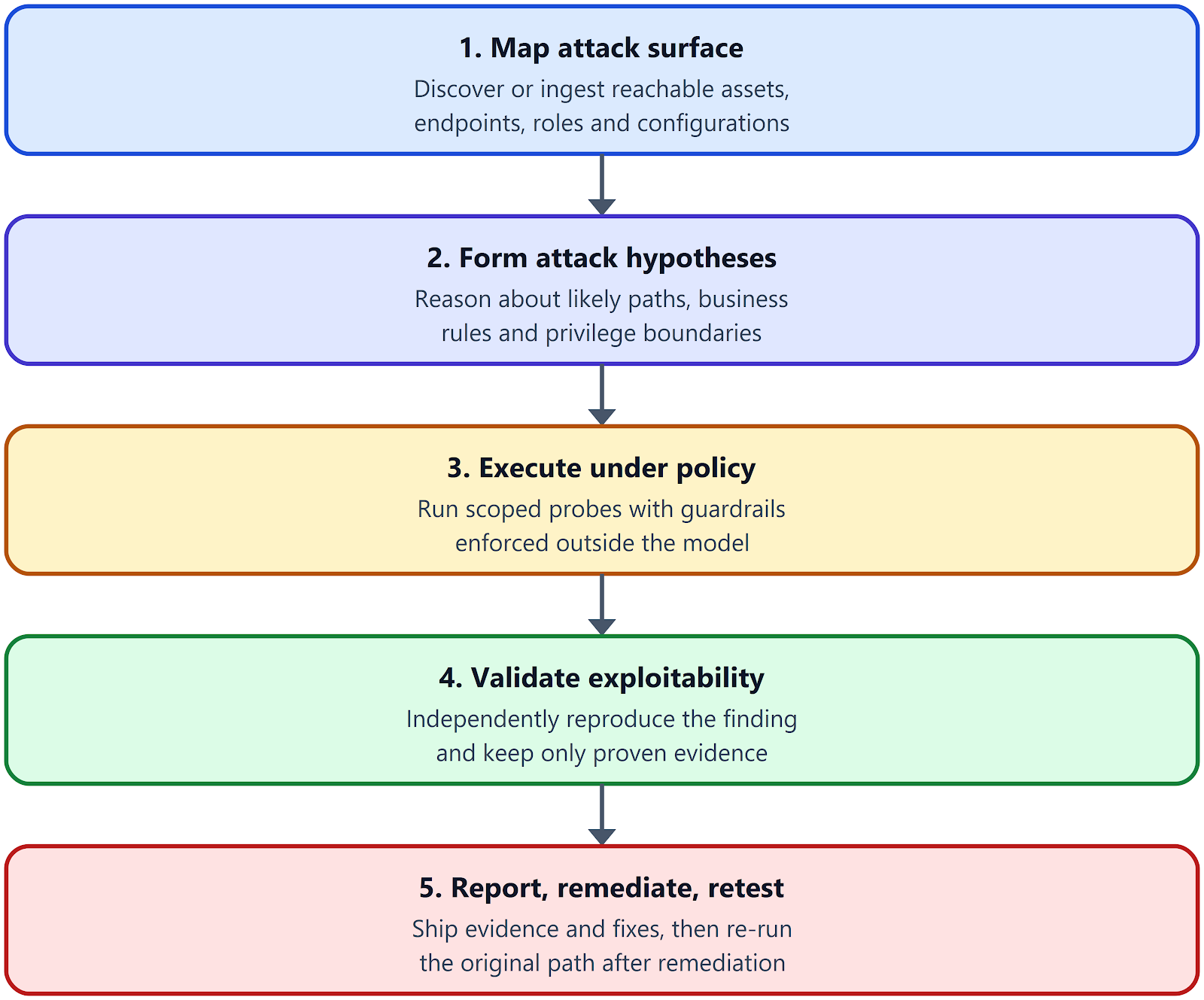
Figure 1 shows the agentic loop that separates autonomous pentesting from signature scanners: map the surface, form hypotheses, execute under policy, validate exploitability, then report, remediate and retest.
Figure 1: Autonomous pentesting execution loop
That loop is the shared methodology across the category. The differences that matter to a buyer sit one level down: what the platform can reach, how it proves a finding, how it stays safe in production, and where your data and models live.
The questions below are the shortlist I use when a vendor demo turns into a procurement conversation. Ask them in this order, and treat vague answers on proof, guardrails or data residency as a reason to pause.
**What can it actually test?**Some platforms cover only web applications and APIs. Others extend to mobile, LLM applications and MCP servers. A few also test networks, hosts, Active Directory, cloud and IoT/OT. Real intrusions rarely stay at the web tier, so match the scope to where your risk lives.**How does it prove a finding?**Look for a validation step that is separate from discovery, reproducible evidence (requests, responses, payloads, scripts), and a clear policy for unconfirmed results.**How is it kept safe?**Ask whether guardrails are enforced outside the model or depend on the model following instructions; whether there are graded testing modes for production and non-production; how scope is confined; whether credentials ever appear in model prompts or logs; and what is recorded for audit.**Where does its context come from?**Black-box platforms start from a URL. Others use credentials, API specifications, source code, design documents or cloud configuration. Ask whether what the platform learns in one run carries into the next.**Which AI model does it use, and who controls that choice?**Approaches range from proprietary offensive models, to orchestration of several frontier models, to bring-your-own-model designs that include self-hosted open-weight models. This affects cost, data exposure, and what happens when a model refuses an offensive step mid-test.**Where does it run, and where does your data go?**Most platforms are SaaS. If you are in a regulated sector, test segmented or air-gapped networks, or cannot send findings and credentials to a third party, on-premises deployment is decisive.**How does it fit your workflow and budget?**Check CI/CD triggers, ticketing such as Jira, SIEM and SOAR feeds, APIs, and automatic retesting. Then check the pricing basis (per pentest, credits, per asset or subscription) and any AI token costs you will carry yourself.
Figure 2 consolidates the seven buyer questions into a single checklist covering test scope, proof, safety, context, model control, deployment residency and workflow cost.
Figure 2: Seven vendor evaluation questions
With those questions in hand, the next step is a side-by-side view of the seven platforms this guide covers. The matrix below is compressed on purpose: it records what each vendor says publicly about surfaces, context, models and deployment, not a lab ranking.
Table 1 lists each platform against the same five buyer fields: primary testing surfaces, approach and context, AI model strategy, deployment options, and public proof points. Read across a row for one vendor, then down a column when you are comparing a single decision such as on-premises deployment or model control.
Cells marked “Not detailed publicly” mean I could not find a vendor statement as of the date on this article. That is not evidence that a capability is missing; it is a prompt to ask the vendor directly during a proof of value.
Table 1: Seven autonomous pentesting platforms at a glance
The table reflects public information as of November 2026. “Not detailed publicly” means I could not find a vendor statement, not that a capability is missing.
What it is. Ridge Security is a Silicon Valley company co-founded by Lydia Zhang (President) and Nick Mo (CEO). It built its business on RidgeBot, an automated penetration testing and continuous security validation platform, and has since moved into agentic AI with RidgeGen. Ridge serves enterprises in financial services, government, telecommunications and other critical industries. In July 2026 IDC named it an IDC Innovator in IDC Innovators: Autonomous Penetration Testing for DevSecOps, 2026 (doc #US54175326).
The product family.
RidgeGenis Ridge’s agentic AI platform for continuous offensive security testing, generally available to enterprises and managed security service providers since August 2026.RidgeBotis the continuous security validation platform for IP-based environments, including network infrastructure, operating systems, databases, applications, websites, OT and IoT. RidgeBot 7.0 (June 2026) added fully automated Active Directory penetration testing, from enumeration and credential extraction to lateral movement and Domain Admin path validation, mapped to MITRE ATT&CK.RidgeOne(October 2026) is a self-contained appliance that pairs RidgeGen with an open-weight model running on NVIDIA DGX Spark, so testing runs inside the customer’s environment with no external AI calls and no ongoing token costs.
How RidgeGen works.
**Finding is separated from proving.**Test Agents probe the attack surface, Validation Agents independently reproduce what they find, and an Evidence Gate promotes only proven findings to the report.**Stateful by design.**RidgeGen preserves what it learns during an assessment, and a shared Ridge Knowledge store builds enterprise memory across runs. Operators can also teach it about their environment through an open prompt interface. This matters for multi-step attack chains, where one proven weakness, such as an authentication bypass, should change what gets tested next.Reasoning is separated from authority.Safety-critical policy is enforced outside the model’s discretion. Testing runs in one of three zones:Safe(the production default, with write, modify and delete actions blocked), Guarded (temporary, cleaned-up writes allowed only to prove a finding) andAuthorized-Aggressive(non-production only, with signed authorization). Higher-impact actions need explicit approval and are logged for audit.**Credentials stay out of the model.**SafeBox applies credentials at the tool boundary, so they never appear in a prompt, in agent memory or in stored evidence.**Bring your own model, and your own agents.**RidgeGen supports Anthropic Claude, Google Gemini and Vertex AI, OpenAI, Grok and self-hosted open-source models, and customers can switch between them. Custom agents can be added, but they inherit the platform’s authority model, tool boundaries and verification gates.**Fix and verify.**Each validated finding comes with a remediation plan, and one click re-runs the original attack path to confirm the fix. A REST API and integrations with enterprise ticketing and ITSM platforms including Jira and ServiceNow, DevSecOps pipelines, SIEM, SOAR and vulnerability management tools, including CrowdStrike Falcon Next-Gen SIEM, move results into existing workflows.
Where Ridge stands out.
**Scope beyond the web tier.**Most platforms in this guide test applications. Ridge’s portfolio covers applications and APIs and also the infrastructure an attacker moves into next: hosts, networks, Active Directory and IoT/OT. For buyers who want one governed program instead of separate tools for application and internal testing, this is the main differentiator.**Your data stays in your environment.**RidgeGen deploys on-premises as a self-contained package, and RidgeOne goes further by running the model locally too. That is a practical requirement in many regulated, government and critical-infrastructure environments, and it is uncommon in a category dominated by SaaS.**Model choice, backed by evidence that the harness matters.**In a September 2026 benchmark that Ridge published (I wrote the analysis), eight AI models ran inside RidgeGen across 96 model-target runs against VAmPI, Metasploitable3, OWASP Juice Shop and OWASP WebGoat. Grok 4.5 led cumulative coverage at 77%; Claude Opus 4.6 reached 63% at roughly $217 per run; Gemini 3 Flash reached 52% at about $5.42 per run; and the open-weight GPT-OSS-120B had the best efficiency, at 16.9 findings per million tokens for about $2.32 per run. Frontier models also sometimes refused legitimate steps mid-workflow, which Ridge handles with architecture and tool-layer controls rather than relying on the model. The takeaway: the best general-purpose model is not automatically the best pentester, and a platform that lets you choose can tune for coverage, cost or data locality.**Depth on a common target.**In a March 2026 head-to-head on OWASP Juice Shop with every tool using the same model (Gemini 3 Flash), RidgeGen reported 55 findings, all evidence-backed and nine of them critical, compared with 27 findings for Shannon (10 of them validated) and six for Strix. RidgeGen was the only one of the three to report business-logic findings.**Third-party recognition.**Beyond the IDC Innovator designation, Ridge was named a sample vendor for adversarial exposure validation in Gartner’s 2026 Hype Cycle for Security Operations and is recognized in Gartner’s Market Guide for AEV. It received Frost & Sullivan’s 2026 Global New Product Innovation Recognition for RidgeBot, a 2026 Intellyx Digital Innovator Award and a 2026 GOVIES award. RidgeBot holds a 4.5 out of 5 rating on G2 from 101 reviews.
What to consider.
Ridge offers several products for different buyers, so map your use case to the right one: RidgeGen for in-depth testing with an agentic approach, RidgeBot for broad and fast validation, and RidgeOne for a turnkey private appliance.
When you bring your own frontier model, its token spend is an operating cost you manage, and model choice changes coverage, as the benchmark shows. RidgeOne’s local model is the fixed-cost alternative.
The benchmarks above are vendor-run against intentionally vulnerable applications. As with every vendor here, run a proof of value on your own environment.
Best for: enterprises, government agencies and MSSPs that want one governed platform for application and infrastructure testing, need to keep testing data on-premises, and want control over which AI model does the work.
Figure 3 traces RidgeGen’s separation of finding from proving: Test Agents probe, Validation Agents reproduce, an Evidence Gate promotes only proven results, and remediation includes one-click retest, with safety zones and SafeBox kept outside the model.
Figure 3: RidgeGen validate-then-report pipeline
What it is. XBOW was founded in 2024 by Oege de Moor, who created GitHub Copilot and GitHub Advanced Security, and is based in Seattle. It is the best-funded company in this group: a $75 million Series B in June 2025, a $120 million Series C led by DFJ Growth and Northzone in March 2026 at a valuation above $1 billion, and a $35 million extension in May 2026.
How it works. XBOW tests web applications and APIs, authenticated or unauthenticated, in production or staging, and reports only exploits it has validated. Its agents combine models from several providers, an approach XBOW has described publicly as “model alloys.” It runs as SaaS on AWS and is not installed in customer environments. Pricing is usage-based through Attack Credits; a 12-month credit package is listed on AWS Marketplace at $50,000. At RSAC 2026 XBOW announced integrations with Microsoft Security Copilot and Microsoft Sentinel data lake, and it also offers a Jira integration, a public API and EU data residency.
Proof points. In 2025 XBOW became the first autonomous system t…