Evil is older than empires.
Roughly since the dawn of humanity, we’ve been carrying out horrific injustices. Slavery has been nearly universal throughout history. Conquering other nations, slaughtering their men, and raping their women was seen as not merely acceptable but noble and praiseworthy. The Romans left infants to freeze to die of exposure. In Rwanda, babies were hacked to death with machetes; genocidal ethnic slaughter continues around the world to this very day.
This is one of the more disturbing facts about human history. Evil actions are not limited to evil people. Acts that you’d expect only a sociopath to perform have been widely accepted. The people who cooperated with the Nazis were ordinary. So were the Rwandans who hacked innocent people to death with machetes. There is almost no limit to the evil that ordinary people will perform in the right settings. Most people are willing to torture an innocent person because someone in a white lab coat tells them to.
Very likely our society is carrying out horrific injustices too. It would be a suspicious pattern if this ubiquitous cross-cultural trend of omnipresent evil suddenly stopped 40 years ago. If every society in history, until our own a few decades ago, has carried out evils on the level of slavery, then you should suspect ours continues to carry out evils on the level of slavery to this very day. You should think this even if no specific grave evils come to mind. Past societies didn’t think they were evil either.
So if you don’t want to go along with atrocities, being an ordinary person, even a nice one, isn’t enough. The most putrid moral abominations ever carried out were facilitated by nice, ordinary people. Raise the people of today in Nazi Germany, and many would have been Nazis.
Similarly, if you want to avoid atrocity, sneeringly dismissing any counterintuitive moral conclusion that goes against the entrenched practices of your society won’t do. If you’d done that in the past, you’d have dismissed the abolitionists who claimed slavery was evil, the feminists who claimed women were entitled to the same basic rights as men, and those bleeding hearts who suggested it was a violation of human dignity to slaughter and rape innocent enemy non-combatants.
If you don’t want to do evil things, then you have to seriously entertain the possibility that your society might be doing evil things. And note: seriously entertaining the possibility does not merely consist in thinking, every once in a while, “it may be that our society does evil things.” It also does not consist in declaring that the political issue of the day that you care about most is so important that those who disagree with you are like the Nazis. The worst atrocities have generally been mostly ignored; whether slavery should be abolished was not the main political agenda item for almost any time in history. Probably the #1 item on the political agenda isn’t going to be the most consequential moral issue.
Being serious about not participating in atrocities involves thinking very hard about particular sources of potential atrocity, where the interests of large classes of beings are written off. For example, think to yourself: is it very bad that most people (likely including you) don’t give money to effective charities, even when doing so could spare innocent children from death? Or alternatively: is the fact that we annually torture a population of animals more than the number of people who have ever lived so we can eat them, causing more suffering in a few years than all the suffering in human history so far, a serious moral issue? Or alternatively: is the fact that we kill lots of fetuses before they’ve exited the womb a big deal?
I am telling you to consider these questions, not where to come down on them. For my view, I think early stage abortions are permissible. But if they’re not, then society may be doing something utterly grotesque to the most vulnerable. You should try to think hard about each particular source of potential atrocity, rather than sneering at it or dismissing it. This is why even though I’m not pro-life, at least not for early-stage abortions, I have the utmost respect for many of those who are—and the utmost disappointment in those who treat it as an issue to be dismissively shrugged off.
This is one of the things that saddened me so much about the recent AI consciousness discourse. People seemed extremely eager to near-instantaneously dismiss the possibility that AI was conscious. Rather than thinking through the question, considering arguments on both sides, and consulting our leading theories about AI consciousness, they rushed immediately for some excuse to write the whole thing off.
Failing to attribute consciousness to conscious beings has been a common error. Throughout the 70s and into the 80s, it was thought that infants weren’t conscious. Anesthesia wasn’t given when surgeries were carried out on infants. If you, upon hearing some suggestion that a group currently treated as insentient might be sentient, had reacted with dismissive sneering, then you would have been on the wrong side of many disputes of the past. You’d have been on the side that unnecessarily tortured infants.
Of course, this is not to say that we should attribute consciousness to every being imaginable. I don’t think rocks are conscious—nor even that plants, mussels, and oysters are. But it is a reason to think seriously about the question. You should try to approach it with a kind of open-mindedness that isn’t just about rationalizing your pre-existing beliefs; a kind which, if applied to past disputes, would have gotten the right answer. You should err on the side of caution, on including more beings in your moral circle, rather than fewer.
More generally, we should be very wary about arguments for writing off the interests of certain groups. Past societies reserved their worst atrocities for members of the outgroup. The outgroup could include slaves, foreigners, or members of other ethnic groups. A constricted moral circle is the cause of most historical injustice.
Upon noticing that past societies have wrongly failed to attribute moral importance to morally important beings, we should suspect that our society is doing the same. Then, upon noticing, say, the giant torture farms that operate at the heart of America and cause more suffering in a few years than all the suffering in human history—that cause billions of beings more pain than you’ll ever know for the sake of tastier food—we should suspect that we are similarly blind to the cries of mattering beings.
Of course, we have our excuses as they had theirs. Read those defending slavery and you’ll find arguments for the practice. That you can think of a defense of a practice isn’t much assurance against the possibility of it being an atrocity, when every atrocity ever carried out has had its share of defenders. In general, noting the poor historical track record of those who wholly wrote off the interests of large classes of beings, you should be wary about ignoring lots of sentient beings’ interests.
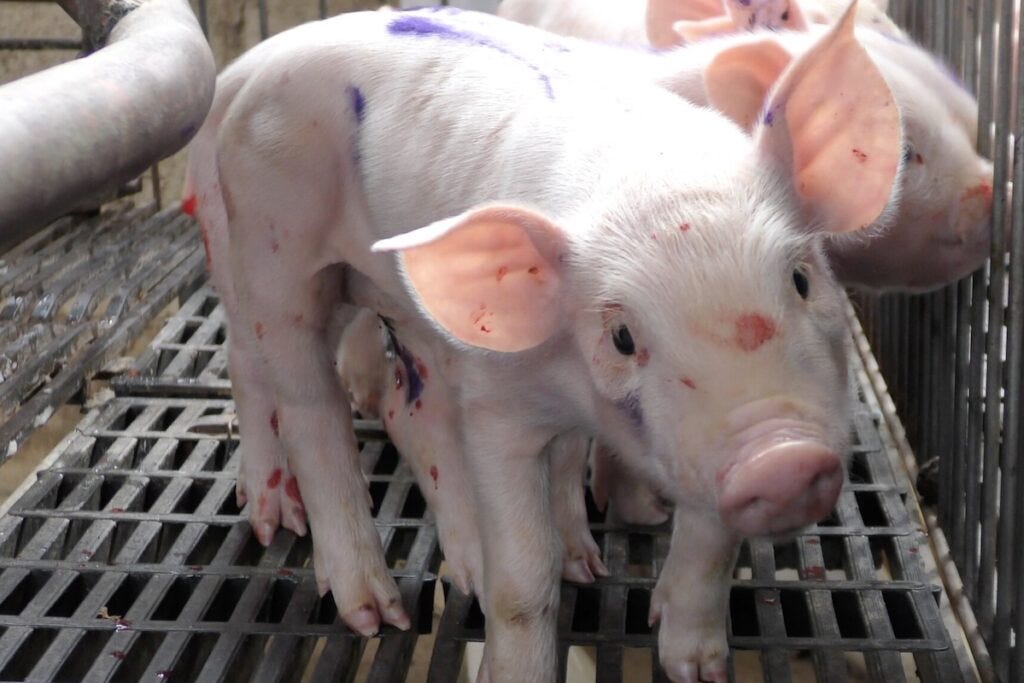
You should strive to have compassion for all the parties involved, when considering a practice of potential great moral import. You should try to think about what it’s like to be those creatures that society neglects. When thinking about factory farming, say, imagine being a mother pig trapped for most of your life in a tiny crate too small to turn around in, with open, festering wounds, feces piled up around you, your baby stolen from you, your tail sliced off with no painkiller, and an upcoming trip across vast distances to a hellish gas chamber.
Hear them as they scream and imagine what it’s like to be the one screaming. When you hear them screaming, does it seem humane? Does it seem like anything other than a crime? If you see them as they are, rather than as ignorable meat factories, does the gassing of these defenseless, innocent creatures seem like anything other than a grotesque crime—one very much like the crimes of the past? My friend put it well:
I was trying to stare into my dog’s soul the other night (as one does) and was just hit with this wave of revelation about the degree of willful ignorance that it requires to deny the sentience, intelligence, personality, emotional depth, and so on of non human animals. The mass torture and abuse that we inflict on these creatures for the sake of trivial entertainment, gustatory pleasure and the like is truly unfathomable. No organized human society can claim to possess a modicum of moral decency while we continue to behave in this way.
Or consider what it’s like to be a child in Malawi dying of malaria. This child, though distant and outside our society, matters like the children in our society do. She laughs and cuddles and plays like the toddlers you know. She is dying, you can do something to stop it, but almost no one does, because we’d rather spend our money on luxuries.
We buy luxuries as children die who we could save.
If you really think vividly about the perspective of the dying child, rather than writing her off because of the inconvenience of taking her seriously, doesn’t failing to save her seem grotesque? Doesn’t it seem evil? Doesn’t it seem relevantly like walking past a drowning child, with the only difference being the proximity of the child—when spatial distance is almost the paradigm instance of a morally unimportant feature?
If you want to avoid atrocity, you’ll have to approach the potential atrocities of today with the kind of open-mindedness that allows you to figure out when society is in the wrong. Punting to popular judgment, coming up with some shallow excuse to continue doing whatever you wanted to do, and summarily writing off the interests of those outside of our society’s moral circle nearly guarantees tolerating the atrocities of one’s society.
Those who recognized the evils of slavery often did so because they saw that an enslaved person is someone, just like a non-enslaved person. They saw the victims of these practices as they are. If we see clearly, in the same way, we will have to cease those culpable omissions that cause children to die, and we will have to shut down the gas chambers. Peer into a gas chamber, see its victim as someone, and it isn’t hard to see what justice demands.