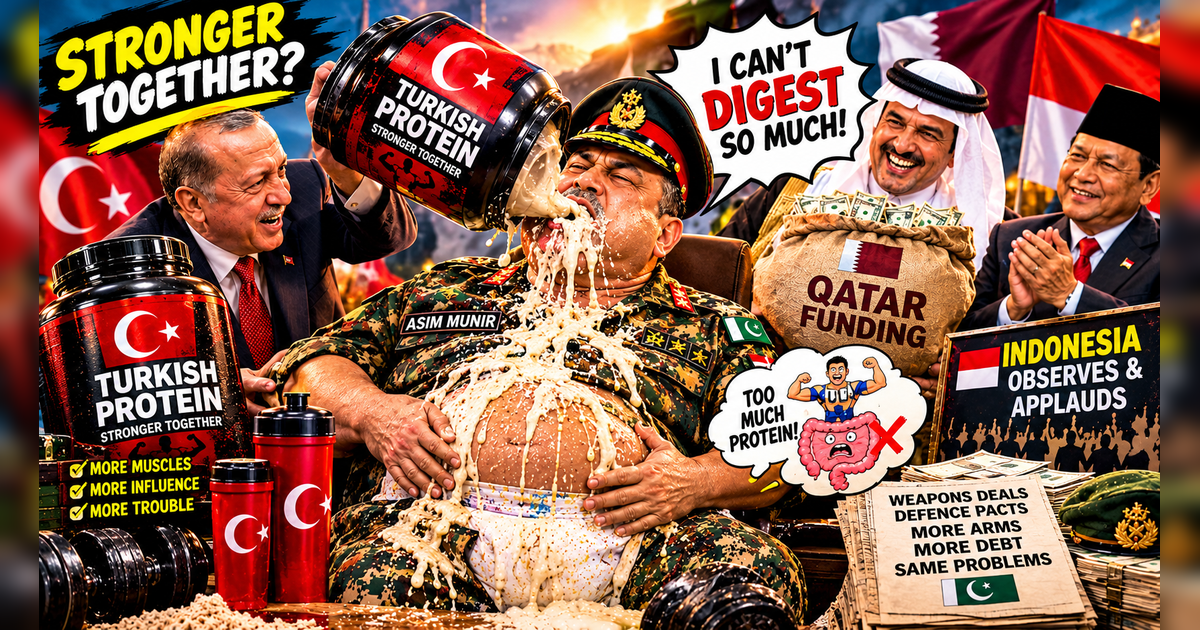
Four countries just signed a new defence agreement in Doha and the cameras looked away. Behind it sits a machine with a bank, a customer, a builder with a grudge, a superpower keeping its hands clean, and a target. Learn to see it here, and you’ll see it everywhere.
🏦 Qatar has oceans of oil money, and the influence machine it built under American protection is wearing out.
🛍️ Indonesia is a fast-growing buyer of weapons.
🏗️ Turkey wants its imperial glory back and holds a NATO keycard to advanced technology.
🎭 America wants Pakistan strengthened but cannot be seen arming it, so it works through Turkey.
🧪 Pakistan has lost its cheap way of hurting India and now needs a real military.
🎯 India is the target. The hidden aim is to keep it pressured, and the side effect is to drain its resources.
**How to read this briefing: **facts are stated as facts. Inferences are marked “our reading.” Forecasts are marked “we predict.” The tone is ours, but the sorting is honest, so you always know which is which.
The rest shows how these pieces lock together, and why the whole structure is weaker than it looks. 👇
Qatar. Turkey. Pakistan. Indonesia.
On October 21, 2026, in** Doha**, the defence ministers of Turkey, Qatar, Pakistan and Indonesia signed the Badr accord. Badr means** “full moon.”** 🌕 geohurriyetdailynews
Let’s be precise from the first line, because precision is what makes everything after it hit harder. Badr is a memorandum of understanding, not a mutual-defence treaty. It does not create a collective military alliance or oblige the members to support Pakistan in a conflict with India. What it does is foster cooperation in military production, boost military capabilities, and support technical military training, research and development. Turkey’s own ministry stressed that “the agreement holds substantial economic importance.” Pakistan joins new four-nation defence pact. What is the ‘Badr’ agreement? Should India be concerned?
Notice what that means. This is not a pact to fight. It is a pact to build, sell and test. If you came looking for an **“attack on one is an attack on all” clause, you’ll miss the real machine. **The real machine is industrial, financial and strategic, and it needs no such clause to run. In our reading, it is also an instrument of a wider campaign gathering momentum: an effort to isolate India on the world stage.
This story reaches far beyond South Asia. Wherever defence contracts, energy fortunes and media narratives shape your world, this machinery is relevant to you. But India’s citizens need to understand it most urgently. So let’s ask the question that most coverage skipped:
What is the purpose behind these four countries joining forces?
Every answer unlocks the next. By the end, you’ll see a design built from money, wounded pride, borrowed weapons, a plan to pressure a rival, and a business model so cold it may change how you read every future headline about conflict. 🧩
We start with the money.
Qatar is swimming in petrodollars, fortunes earned by selling petroleum and natural gas. Not millions. Tens, even hundreds, of billions. 🛢️
That created a peculiar problem. What do you do with that much money?
Wealth alone didn’t set Qatar apart. It earned its fortune the way every other oil state in the Middle East earned theirs. Its neighbours were rich too, and money by itself doesn’t buy a seat at the head of the table.
So Qatar made a strategic choice. Not recently. Decades ago. 🕰️
The logic went something like this:** “Why not play a different game? Why not spread propaganda inside the other countries of the Middle East to keep them in check and shape the narratives?”**
To play it, Qatar needed a machine. The machine was Al Jazeera.
Al Jazeera is a propaganda channel, an instrument of Qatari state power. We’re not the only ones who say so. In September 2020, the US Justice Department ordered AJ+, Al Jazeera’s US digital arm, to register as a foreign agent, finding that it acts “at the direction and control” of Qatar’s leaders, and that Al Jazeera and its affiliates are “controlled and funded by the Government of Qatar.” pressfreedomtrackerpressfreedomtracker
Al Jazeera disputes this and says the order followed UAE lobbying. Fair enough. But notice what that dispute concedes. Even Qatar’s rivals, who lobbied hardest against the channel, saw it as a weapon of the Qatari state. Shutting down Al Jazeera was among the conditions the UAE set for lifting its blockade of Qatar. Nobody demands the closure of a newsroom. They demand the closure of a weapon. Mother Jones
And look at its pattern. It finds some kind of problem in nearly every country in the region, except Qatar itself.📺
Propaganda takes skill, so Qatar didn’t use amateurs. It recruited master propagandists from the great Western media institutions.
The origin story is almost too neat. In 1996, the first BBC Arabic television station closed after censorship attempts by the Saudi government, and many of its former workers were hired by Al Jazeera by the time it launched. Qatar took the BBC’s trained, credible, Western-schooled talent and pointed it at the region. Later, as Al Jazeera built its English operation, it kept recruiting from the big Western newsrooms. Its first English-language hires included a journalist from the BBC’s Today Programme, and its staff included people from ABC’s Nightline. Wikipediawikipedia
If you want to broadcast every other country’s troubles, you hire the best problem-finders money can buy. 😉 And a channel staffed by alumni of the West’s own institutions carried instant credibility with exactly the audiences it wanted to move.
Here is the layer most people miss, and it is the key to the whole Qatar chapter.
Qatar didn’t build this machine alone. It built it under American protection. Qatar hosts Al Udeid, the largest American base in the Middle East. That base is Qatar’s insurance policy and Washington’s leverage. A tiny state can afford to broadcast the troubles of every neighbour when the most powerful military on earth sits a short drive from its capital. israel-alma
Our reading is that the relationship wasn’t one of orders. It was one of licence. Diplomatic cables released by WikiLeaks showed that the Qatari government had offered favourable Al Jazeera coverage as a bargaining chip in diplomatic negotiations. **And the channel’s tone bent with the geopolitics: it used apologetic language about NATO operations in Libya, a far cry from the “aggression” and “invasion” language used for Afghanistan and Iraq. **geopoliticalmonitorgeopoliticalmonitor
Think about what that tells you. A channel whose coverage can be traded in negotiations, and whose tone softens when NATO acts, is not an independent newsroom. It is a licensed instrument. Washington didn’t have to operate it. It only had to let Doha keep it, and benefit whenever Doha aimed it somewhere Washington could live with, and shaping the political mood of the Middle East was exactly that kind of target.
(Did Al Jazeera ever criticise America? Of course, loudly. Qatar also kept deep ties with Iran, partly because the two share the world’s largest gas field. That is exactly what makes the model so useful. A licensed instrument that sometimes growls at its protector looks independent, and independence is what makes it credible.)
We cannot responsibly share the decades-old covert relationship between the CIA and Qatar in public. Therefore, please bear with us.
This is just the tip of the iceberg. The real, insider-grade content regarding the US-CIA and Qatar nexus is reserved exclusively for our Buy Me a Coffee members.Join - The Spy Analyst Deep State at 50% off for a limited timeThe closest you can get to classified secrets without a clearance!
Propaganda saturates.
Think of a car alarm. The first time it blares, the whole street looks up. By the twentieth time, nobody turns their head. Audiences are not endless sponges. Keep telling people what to feel, and at some point they tire, tune out, and stop reacting. Even propaganda has a ceiling.
Qatar has reached that ceiling. And look how far its meddling went. After building Al Jazeera, after interfering in the affairs of country after country, in 2017 it picked a fight with its own master, Saudi Arabia. (Saudi Arabia, the UAE, Bahrain and Egypt cut ties and imposed a blockade.) Qatar was quarrelling with the very hand that protected it. And at the heart of the rupture sat Al Jazeera again. The prized instrument of Qatar’s influence nearly wrecked its relationship with its most important neighbour.
We won’t wander further into that feud. What matters is the lesson Qatar took from it.
Then the protective umbrella itself began to crack. A think-tank study observed that Qatar’s attempt to “dance at two weddings,” keeping Washington and Tehran both close, failed to stop Iran from harming Qatar itself, and that this followed an Israeli strike in Doha. A state that can be struck by Israel and by Iran learns something brutal: influence broadcast through a screen is no substitute for hard power. jppijppi
So the realisation settled in, slowly:
“I have all this money. My propaganda machine is wearing thin. My protector can’t guarantee my safety. What on earth am I going to do with it?”
The answer it reached: put that money into a military alliance. 💡
The skeptic says Badr is a Gulf state reducing its dependence on Washington, the opposite of our analysis. Look at where the hedge goes. Not to Beijing or Moscow, but to Turkey, a NATO member, the very country Washington is now lifting sanctions on, and to Pakistan, a country Washington is courting. Hedging inside the Western ecosystem isn’t a break with America. It is a diversification of risk within the camp. Qatar can doubt its protector and still invest where the protector’s friends are.
Qatar is the bank.🏦
You may be thinking:** “Indonesia is nowhere near Qatar. What could those two possibly have in common?” **🗺️
On the surface, nothing. Different regions, different histories, no natural link. And yet Indonesia is the second most important player in this arrangement.
Indonesia, the world’s largest Muslim-majority nation, is an emerging defence market. In plain terms, it is a rising country that wants to buy a huge amount of military equipment, and it isn’t short of suitors. Many countries in the region are eager to sell to it. 🛍️
Indonesia is the customer.
🏦 Qatar supplies the money.🛍️ Indonesia supplies the demand.
A fortune and a buyer. What’s missing is a builder, a seller, and a strategist with a motive. And among the four countries, the most important one is about to enter the story.
Of Qatar, Turkey, Pakistan and Indonesia, Turkey matters most right now. To see why, you have to understand a very old wound.
Turkey is sitting there, ready to proclaim itself the leader of the Sunni Muslim world. (Sunni Islam is the larger of Islam’s two main branches, and leading it carries enormous prestige.) It sees its biggest rival for that crown as Saudi Arabia.
Saudi Arabia calls itself the leader of Sunni Muslims. In Turkey’s eyes, that is a fake claim, and Turkey loves to point to one number: modern Saudi Arabia was founded only in 1932. 📅
Now set that against the memory Turkey carries.
For roughly 600 years, while the Ottoman Empire stood, Turkey was the leader of the Islamic world. Then the empire fell. In the world that followed, Saudi Arabia suddenly declared itself the leader of Sunni Muslims. In Turkey’s view, the entire influence modern Turkey once held across the Islamic world simply vanished overnight.
That wound still drives policy. Erdoğan is running a campaign to revive that Ottoman glory. 👁️
When you map the psychological profile of the Turkish leadership alongside their ideological and geopolitical motivations, this sense of Ottoman supremacy is the most crucial detail hiding in plain sight.
Seen through that lens, Turkey’s sudden interest in Pakistan begins to make sense.
Turkey’s first reasoning is: “I’m a NATO member.” NATO is the Western military alliance, and membership gives Turkey access to advanced, privileged technology. Turkey has NATO’s second-largest army and a robust defence industry, and it has a military base in Qatar.
Think about what that gives it. A NATO-grade industrial base. Components and standards that Western militaries trust. A foothold in the Gulf. 🗝️ That is Turkey’s keycard, and it is a card almost no other Muslim-majority country can swipe.
We have said this before, and people with only shallow knowledge never get it. If you follow the headlines alone, the story looks simple. But those who study geopolitics in depth understand it today:
Turkey is America’s lackey, and a remarkably effective one.
(A proxy, or lackey, acts on another’s behalf so the other doesn’t have to be seen doing it.)
We don’t say this merely because Turkey is in NATO. We say it because Turkey is a spectacularly skilled proxy.
On the surface, Turkey puts on a show. Its relationship with Washington looks strained. Cold. Distant. A real feud. And on paper, it was:
In 2019, Turkey was expelled from the F-35 programme after buying Russia’s S-400 air-defence system.
migflugIn December 2020, Washington imposed CAATSA sanctions over the purchase.
al-monitorTurkey had already paid roughly $1.4 billion for six F-35s it never received.
al-monitor
If that were a permanent rupture, it would stay frozen. Watch the sequel instead. On July 7, 2026, at the NATO summit in Ankara, President Trump said the US would lift the sanctions, adding **“we don’t want to sanction friends,” **and signalled he would consider selling Ankara the F-35. Turkey’s foreign minister replied that there was political will on both sides, and that there should be no defence industry restrictions between allies. al-monitoral-monitor
To be fair, the F-35 itself is still blocked. US law bars the transfer while Turkey keeps the S-400, and as of mid-August the deal hadn’t moved. But that sharpens our point. When Washington wants something from Ankara, it finds a way. When Congress blocks the biggest prize, Washington still opens every other door. The strain on the surface is real enough to serve as cover, and thin enough to vanish when business calls. migflug
In reality, the strain isn’t what it looks like. Our reading is that **Amer…