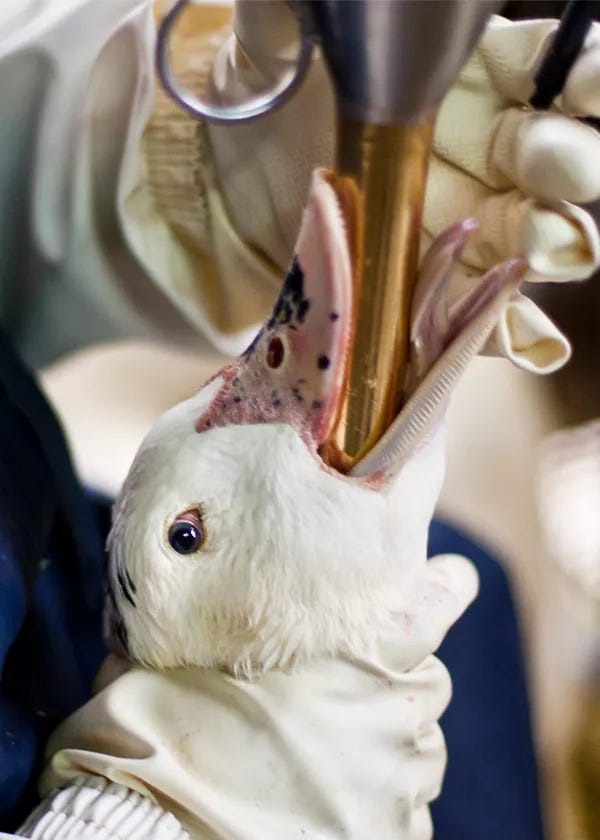
Suppose you learned that your neighbor Fred kept geese in small cages in his basement. He shoved a tube down their throats to force feed them sickening quantities of food, causing their livers to grow to many times their normal size. After a short period, he killed them. This was done because fattening their liver made it tastier.
Fred would be doing something evil. For the same reasons, the foie gras industry is evil.
It is a remarkable fact that even in a country with as deplorable a disregard for animal welfare as America, foie gras is so cruel as to be almost synonymous with animal cruelty. This synonymity is well earned; foie gras is evil and grotesque. DC is currently voting on Initiative 86 which would ban foie gras. They should vote yes.
Foie gras has been consistently condemned as inhumane by outside bodies reviewing it. It involves shoving a metal pipe down the throat of the ducks and force feeding them so that their livers grow to many times their normal size. While it’s often claimed that ducks don’t have a gag reflex, this is unclear.
There are many ways that foie gras production causes grievous distress to ducks:
The ducks are fed sickeningly large amounts extremely quickly.
If the corn gets stuck in the duck’s esophagus, it’s sometimes pushed down with a stick.
Corn mash used to fatten up ducks is nutritionally inadequate.
Foie gras has its distinct taste because of the fat in the duck’s liver. Ordinary duck livers are about 5% fat. Foie gras ducks’ livers are 50% fat. This causes serious liver diseases in the fattened ducks.
Behavioral evidence indicates ducks find the process very distressing.
“Force-feeding can cause a number of injuries: pain and injury from handling caused by the tubing of the forcefeeding funnel; trauma caused by injecting a high-temperature corn mash; bruising or perforation of the esophagus when the pipe is inserted; hemorrhaging and inflammation of the neck resulting from too forcible an introduction of the pipe to the throat; or asphyxia caused by food improperly forced into the trachea. Wounds of the esophagus may subsequently become infected with opportunistic pathogens.”
About half of foie gras ducks break bones.
Liver expansion makes it hard for the ducks to walk properly. Imagine your liver swelling to such a size that you can barely walk.
While in an ordinary 2 week period, mortality rate for a duck is .2%, during the foie gras feeding period, the mortality rate is 2-4%.
Like many other farmed animals, foie gras ducks are crammed together with little space.
If you did this to a dog, everybody would agree you were torturing it (I tried to get ChatGPT to make me an image of what this would look like—unsurprisingly, it refused). If you shoved a metal pipe down a dog’s throat and force fed it to such sickening extremes that its liver increased in size ten-fold, causing it great distress, obviously that would be monstrous. Foie gras is similarly cruel.
So what do the defenders of foie gras say in response?
One thing they say is that ducks naturally gorge, leading to expanded livers. But this involves liver size increasing a little bit, at most around 50%, not 700%.
Often the defenders of foie gras reply with obvious whataboutism.
I agree that we should ban very cruel practices in beef, pork, and chicken farming. But even if you disagree, foie gras is much crueler than those. We should not ban vegetables, because they are very unlikely to be conscious. Similarly, the argument that we shouldn’t do some good thing until we’ve ended world hunger is obviously fallacious and nobody would buy it in any other context. Nobody would say “let’s wait to ban dog torture until we’ve ended world hunger.” If these are the arguments that the foie gras defenders are making, then the position is in dreadful shape indeed.
Other replies included:
This is a fully general argument against animal cruelty laws in food production. By this standard, we should permit people to eat live dogs. As for the claim that the bill is poorly written, this is right, but it’s very unlikely that it would ban other things, given the clear intent of the bill’s drafters. Courts avoid interpreting laws in absurd and unintended ways. And very likely the DC council would clarify to prevent overly broad interpretations.
A popular reply has been that those wanting to ban foie gras are inconsistent. Other elements of the food system are similarly cruel. This is wrong on two counts. First, foie gras is unique in degree of cruelty. Second, we shouldn’t permit some specific cruelty just because there are other similar instances of cruelty. The path towards a more humane world takes place one issue at a time. If we didn’t make any steps towards a less cruel world unless we were willing to make every step, then we would make no moral progress.
If you’re in DC, vote to end this torture.