Living in Costa Rica has made me a beginner again in ways I didn’t expect.
I can write books, teach a room full of people, and spend an afternoon discussing religion, philosophy, psychology, mortality, meaning, and the peculiar predicament of being human. I have spent enough years doing certain things that I rarely have to think about how to do them anymore.
Then someone asks me a perfectly ordinary question in Spanish and I stare back at them, searching my brain for words I know are in there somewhere.
My Spanish is getting slightly better, but progress has not spared me from embarrassment. I can sometimes follow a conversation with enough confidence to think, Look at me, I speak Spanish now, and then one unfamiliar word enters the sentence and the entire operation collapses.
Sometimes I understand every word except the one word upon which the meaning of everything depends. Other times I understand the words individually but cannot assemble them quickly enough before three more sentences arrive and I am now several conversational exits past where I was supposed to get off.
I have become familiar with the expression people get when they realize they have lost me. They slow down. I concentrate harder. They repeat themselves. I nod thoughtfully, hoping to project the impression that I am processing something profound rather than having absolutely no idea what they just said.
They usually see through me. At that point we begin the international ritual of pointing, gesturing, repeating words, trying different words, laughing, and eventually opening the Google Translate app on my phone. Somehow, we get there, although I am not always entirely certain where “there” is.
Living in another country is different from visiting one. When you visit, not knowing things is part of the adventure. You expect to be confused. You point at menus, mispronounce place names, take wrong turns, and accept your incompetence because you will soon return to the world where you know how everything works.
Living somewhere is different because eventually you need the water heater fixed. You need to understand why the internet isn’t working, where something is sold, when something will arrive, and what the person at the counter needs from you. You need to figure out why the road is closed, what the neighbor is trying to tell you, and whether the thing someone just said means today, tomorrow, next week, or some beautifully elastic category of time you have not yet learned to inhabit. These are not philosophical problems. They are the ordinary business of Tuesday.
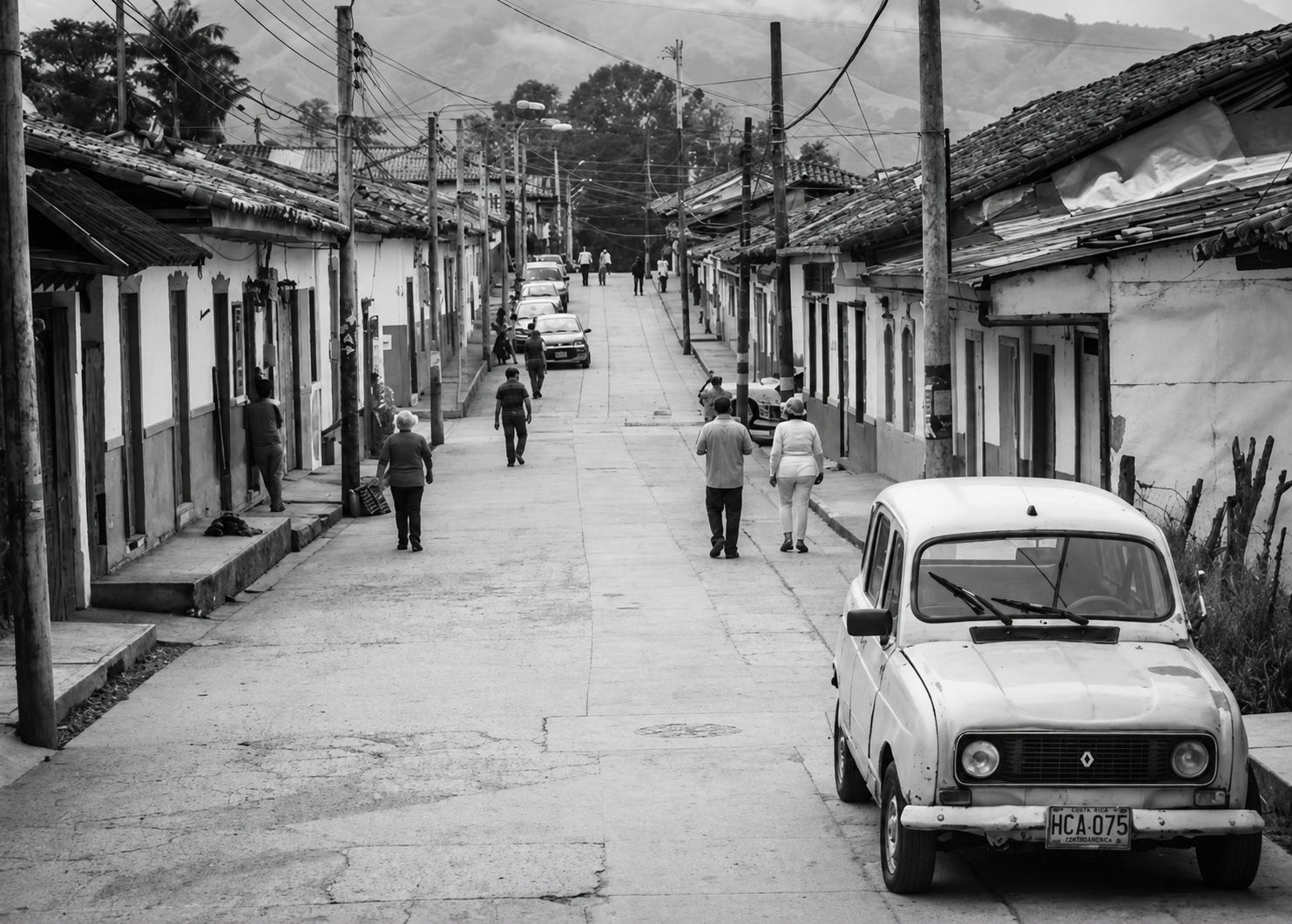
I live in a mountainous region of Costa Rica where the landscape still regularly stops me. Some mornings the mountains appear almost close enough to touch. Other mornings they disappear completely behind clouds and rain. Roads climb and fall at angles that make my former ultramarathoner legs remember things my present legs would prefer not to discuss. Houses sit along hillsides in ways that make me wonder who first looked at that particular piece of earth and decided this was exactly where a house should go.
I still occasionally wake up surprised that I am not visiting. This is where I live now.
People sometimes ask why we moved to Costa Rica. The answer deserves its own story, and maybe I will tell it sometime. For now, the short version is that Amy and I reached a point when we were ready to live differently. We wanted a life closer to the natural world, less organized around the assumptions and rhythms we had inherited, and open enough to discover what might happen when we stepped outside the life we already knew how to live. Costa Rica became the place where that possibility turned into an actual life.
The realization catches me at unexpected moments: driving a road that has become familiar, recognizing someone in town, knowing where to find something without looking it up, or giving directions to a place I once needed directions to find myself.
Rain has its own personality here. It does not always arrive politely. Sometimes you can hear it coming before it reaches you, moving across the landscape until suddenly the roof is carrying on a conversation too loud to ignore. Other times the rain settles in and stays, and the world seems to shrink. Mountains vanish, distances collapse, and life becomes whatever is immediately around you.
From a distance, Costa Rica is easy to imagine as a beach. Resorts, palm trees, warm water, tropical abundance - the version of the country most visible to people who come here for a week and then fly home. That Costa Rica exists. But it is not the Costa Rica I encounter most days. We live in the mountains, far from the resort version of the country, and life here has introduced me to realities I knew almost nothing about before I arrived.
My heart is routinely broken by how hard ordinary life can be for people around us. I see people working long days for very little, families stretching what they have, homes assembled and repaired with whatever is available, and people carrying burdens that would remain almost entirely invisible to someone passing through.
I don’t want to turn my neighbors into illustrations of hardship or pretend that struggle is the whole story of life here. It isn’t. I also encounter generosity, humor, resourcefulness, family, beauty, and forms of neighborliness that have taught me a great deal. But living here makes it impossible for me to sustain the postcard.
That has become another part of being a beginner. I arrived knowing Costa Rica largely from the outside. Living here keeps showing me how much I didn’t know. A place becomes more complicated when the people in it stop being scenery. You begin to learn who lives behind the doors you pass, who is working the fields on the mountainsides, who is repairing the road, who cannot afford what seems inexpensive to you, and how different the same country can look depending upon the life you are living inside it.
I have come to love the mornings especially. I am usually awake long before daylight, making coffee in the darkness while the sounds of animals and people slowly announce another day. Eventually the landscape begins to appear. Shapes become trees, darkness becomes distance, and mountains emerge where moments earlier there seemed to be nothing. Some mornings I simply sit there and watch the world return.
Parts of my life have trained me to be the person who knows. I have spent decades reading, writing, teaching, speaking, counseling, organizing, and trying to put language around things that are difficult to name. After enough years, competence becomes almost invisible. You walk into certain rooms already knowing how to move through them, what you can contribute, and where to reach when you need the right words.
Costa Rica regularly takes that advantage away from me. I don’t know the word. I misunderstand the custom. I stand in front of some appliance wondering what the buttons mean. I watch other people navigate ordinary situations effortlessly while I try to determine what everyone else apparently knows.
Sometimes another person has to rescue me from an interaction that a six-year-old Costa Rican could navigate without difficulty. I have smiled when I should have answered, answered when I should have listened, and walked away from conversations wondering whether I had just agreed to something without realizing it. On certain days I would happily trade whatever character-building benefits might come from all this for the ability to explain precisely what is wrong with the hot water.
I spent much of my adult life getting better at things. That is what we are supposed to do. Learning becomes practice, practice becomes experience, and eventually much of what once required effort becomes almost automatic. Competence accumulates. Familiar problems become easier to solve, our abilities become clearer, and without necessarily realizing it, we begin arranging more of our lives around the places where we already know what we are doing.
Then you move somewhere and can’t explain a plumbing problem.
Language exposes this most quickly for me because words have been my tools for most of my adult life. I trust words. Writing gives me the luxury of slowing experience down until I locate the language I want, changing a sentence, deleting it, starting over, and waiting for the exact word to show up. Spanish conversation offers no such mercy. The sentence is happening now, the other person is waiting, and I cannot disappear for twenty minutes and return with a better verb.
I reach for whatever words I have. Nuance is usually the first casualty. All the qualifications and distinctions I can make in English suddenly become inaccessible, leaving me with a much smaller collection of possibilities: yes, no, please, thank you, I don’t understand, can you say that again? A person can hide quite effectively inside eloquence. That becomes considerably harder when your available vocabulary could fit comfortably on an index card.
Not understanding people can be frustrating, and needing help with things I could handle easily in English is not an experience I appreciate every time it happens. I also know that learning Spanish by choice while living comfortably in Costa Rica is very different from having to master another language because your safety or livelihood depends upon it. Mostly, I am noticing what happens to me when my usual tools stop working.
I watch faces more carefully. I listen for tone and pay attention to hands. I notice whether someone is being patient, amused, hurried, confused, or trying just as hard as I am to find another route through the conversation. Communication becomes less tidy. Sometimes we succeed, sometimes we laugh, and sometimes neither of us knows what the hell the other person is saying. Somehow, we can still part smiling.
I am getting to know a version of myself I encounter less often in the places where I know what I am doing. He is less polished and asks for help more often. He gets things wrong. He walks steep roads more slowly than he once would have and occasionally discovers that the body he remembers and the body carrying him up the hill are operating from different historical records. He is also learning the names of things again.
A word that has been ordinary to millions of people their entire lives becomes new to me. I hear it, repeat it badly, forget it, encounter it again, and eventually discover that it has quietly become mine. Then one day someone says something and I understand without translating it into English first. Nobody announces the achievement. I may not even notice it until several seconds later. Something that once sounded like noise has become meaning.
I have started thinking about this as beginnerhood. The word is not mine, but I find myself drawn to it. I mean something more than simply being inexperienced or new at something. Beginnerhood, as I am coming to understand it, describes a willingness to remain teachable in the places where our competence runs out.
I am beginning to wonder whether being a beginner is something worth practicing rather than something we should be in such a hurry to escape. Much of adulthood is organized around becoming proficient. We learn how things work, develop expertise, form opinions, establish routines, and gradually surround ourselves with a life we know how to navigate. That isn’t wrong. I have spent much of my life doing exactly that. But competence has a way of becoming enclosure if we never again place ourselves where we do not already know what to do.
Being a beginner changes the way I move through the world. I listen more carefully because I cannot assume I understand. I ask questions I might otherwise have been embarrassed to ask. I depend upon other people. I notice things that familiarity would allow me to overlook. I make mistakes in public and discover that the world continues turning.
Beginnerhood has been less about becoming inexperienced again than becoming available again - to surprise, instruction, embarrassment, curiosity, and the possibility that reality still has something to teach me.
I don’t want to become incompetent at the things I have spent years learning to do. I want to remain capable of entering places where my competence cannot protect me from uncertainty. Learning Spanish happens to be doing that for me now. Living in Costa Rica is doing it too. Next year it may be something entirely different. The point is not to remain perpetually unskilled. It is to resist becoming so accomplished at being ourselves that nothing unfamiliar can get in.
I don’t know how long it takes before a foreign place stops feeling foreign. Maybe that is the wrong expectation. I arrived here from somewhere else, and the people around me carry histories, references, jokes, memories, and ways of understanding this place that I do not share. This landscape was full of stories before I ever saw it, and it will never become mine simply because I learned how to find my way around.
I am becoming more comfortable with that. Living here does not require me to understand everything, and belonging does not seem to require pretending that I do. You can’t understand everything about life before you participate.
I can learn the roads, butcher another verb, ask someone to repeat themselves, laugh when I get it wrong, and try again tomorrow. I am not sure I would have appreciated how much of life works this way if I had remained exclusively in places where I already knew the language.
This morning I made coffee while it was still dark. The mountains were invisible, though I knew where they were. Somewhere nearby a rooster was already announcing himself with unreasonable confidence, and cool air came through the window while the first suggestion of daylight gathered outside.
Soon people would begin moving along the road and another ordinary day would require me to understand things I do not yet understand. At some point someone will probably say something to me in Spanish, and I will catch some of it and miss most of it. I will lean forward, listen more carefully, search for whatever words I have, and find myself once again becoming a beginner.