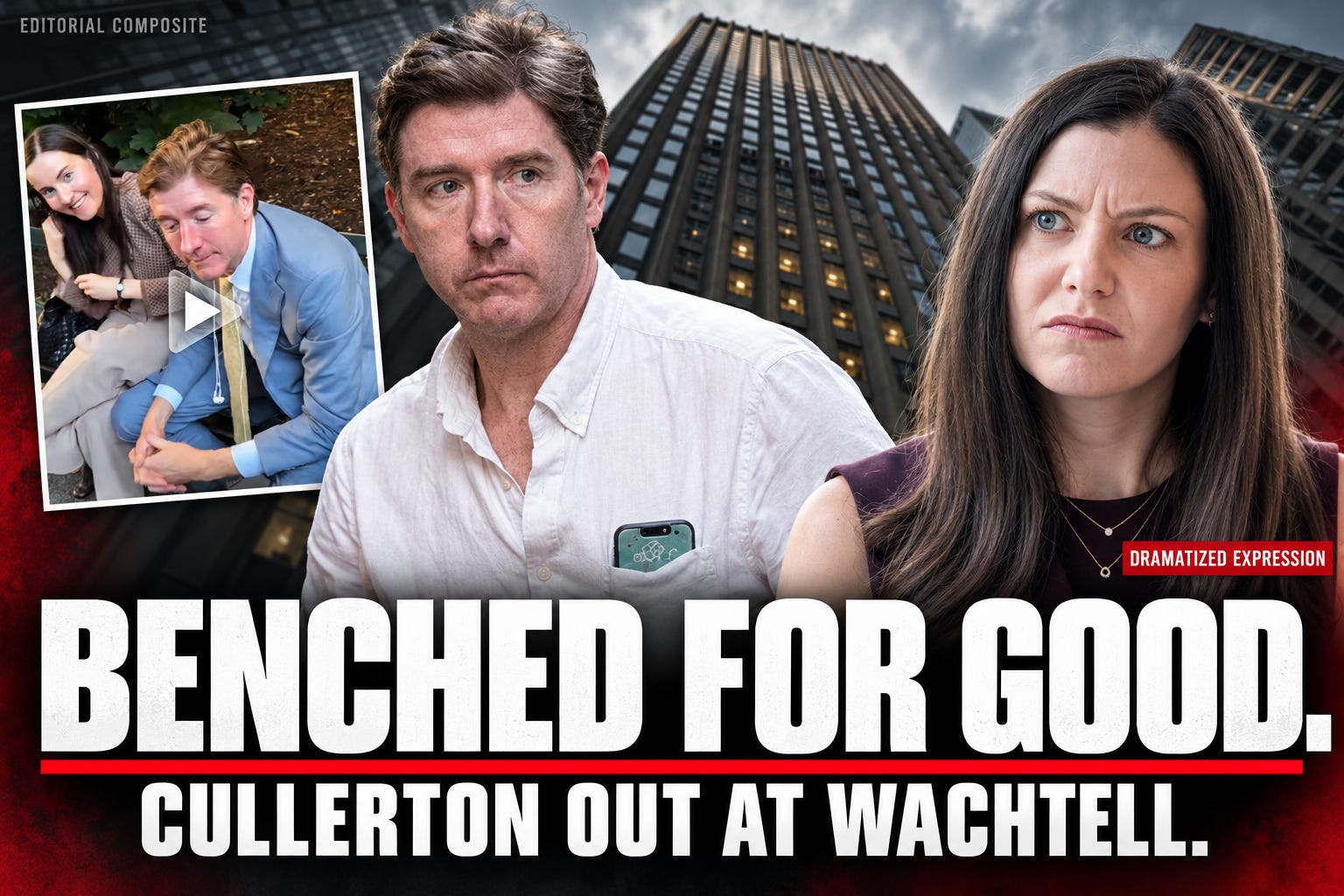
LUTHMANN NOTE: Cullerton’s wife, Moira Kim Penza, prosecuted me. I disclosed that in our earlier coverage, and readers deserve the disclosure here. My position is straightforward: a prosecutor’s reputation should invite scrutiny as demanding as the scrutiny she directed at others. Former classmates have made specific accusations, a contemporary newspaper documented the threat, and records requests seek the investigative history. Those sources must be tested, including where their accounts conflict. Penza deserves accurate attribution and an opportunity to answer. She also deserves persistent questions. I intend to keep asking them, and to report what the records show. This piece is about her husband (for now) and is entitled “Benched For Good,” first available on NY News Press.
(NEW YORK, NY) – Nathaniel Cullerton has lost his Wachtell partnership after a public kiss turned a planned career payday into a professional evacuation. The New York Post reported September 17 that the firm and Cullerton had mutually agreed to part ways following weeks on leave and an investigation into his relationship with junior associate Kelsey Borenzweig. Wachtell got an exit agreement. Cullerton got the distinction of leaving one of America’s most powerful law firms with a Central Park bench attached to his name.
The firm’s diplomatic language cannot soften the chronology. Cullerton, 45, had been preparing to join Gibson, Dunn & Crutcher when footage of him kissing the 29-year-old associate spread across social media. Gibson Dunn abandoned the planned hire, and Wachtell placed him on leave. This publication’s August 26 coverage examined the approaching departure, and the additional exposure sources said the firm feared. September’s announcement supplies the consequence that August’s reporting anticipated: Cullerton’s future at Wachtell is finished.
His departure lands amid a broader raid on Wachtell’s partnership, with Bill Savitt moving to Gibson Dunn and Mark Gordon joining Linklaters. Those departures advertised the prices rivals would pay for Wachtell talent. Cullerton’s departure advertised the cost of becoming a public liability. He had been positioned to participate in the same lucrative migration; instead, the scandal left him outside Wachtell with the Gibson Dunn destination already erased. Whatever accommodations the separation agreement contains, the career reversal is brutal.
Cullerton’s rank made the video a management problem from the moment the participants were identified. Partners occupy the commanding heights of a law firm: assignments, evaluations, client access, and advancement pass through the system they control. Borenzweig worked in the same litigation practice, and both lawyers appeared on Wachtell’s OpenAI team. A relationship across that professional divide demanded questions about disclosure and supervision before strangers on TikTok started asking them.
The Post reported that Wachtell did not prohibit consensual relationships between colleagues, making the disparity in rank especially significant to understanding the firm’s response. No accusation by Borenzweig of coercion or retaliation appears in the reporting reviewed here. The institutional issue remains plain: a firm hired to guide powerful clients through sensitive crises found its own judgment under examination. Who knew about the relationship, what disclosures were made, and whether it affected firm decisions are questions Wachtell’s separation statement leaves unanswered.
The financial consequences give those questions weight. The Post’s July reporting estimated Cullerton’s annual Wachtell earnings at at least $4 million and described the collapse of his expected Gibson Dunn opportunity. His actual separation terms remain undisclosed. Even without that accounting, the damage is visible: the anticipated lateral move failed, and the existing partnership ended. Wachtell has removed Cullerton from its roster while keeping its investigative findings out of public view. That arrangement serves the firm’s interest in closing the matter. Reporters have every reason to keep asking how it happened.
Sources familiar with Wachtell’s thinking told this publication in August that the firm expected Cullerton’s wife, former federal prosecutor Moira Kim Penza, to commence a divorce action in New York Supreme Court. They described the prospect of continuing matrimonial coverage as part of the firm’s calculation. Wachtell has not confirmed that account, and no filing has been verified for this update. The sources’ explanation nevertheless identifies an obvious institutional incentive: retaining Cullerton would keep the partnership tied to every development in a scandal it wanted to contain.
A matrimonial proceeding could extend the story from a humiliating video into disputes over income, assets, and the financial aftermath of Cullerton’s departure. New York’s Domestic Relations Law § 235 restricts public access to divorce papers and related records. The statute protects sensitive information; it cannot erase the public attention surrounding two prominent lawyers whose household has already become tabloid material. Any confirmed filing or public statement would renew that attention.
Penza became nationally known through the prosecution of NXIVM leader Keith Raniere, followed by prominent private litigation and “The Vow.” Her public career has revolved around examining hidden conduct, credibility, and abuses of power. That history gives the scandal its extraordinary media pull. According to the sources’ account, Wachtell understood the danger of remaining a recurring character in the coverage. Cullerton’s departure gives it distance before Penza’s next move becomes public.
Penza also faces accusations reaching back to Loyola School in Manhattan in 2001. The underlying incident appeared in a March 15 New York Post report: threatening emails targeted students and administrators, police guarded the school, and investigators sought to trace the sender.
The article did not identify Penza. Former students cited in this publication’s subsequent reporting supplied her name, accused her of shifting blame to another student, and said she was removed from the school. Sources further claimed family connections helped prevent criminal consequences. Those accusations await documentary corroboration.
The requests now identify specific records capable of testing those accounts. NYPD request FOIL-2026-056-26279 seeks investigative reports, witness interviews, suspect-identification material, and communications involving Loyola. Manhattan District Attorney request FOIL-2026-901-00570 seeks referrals, intake records, screening decisions, and documents explaining the prosecutorial disposition. Earlier acknowledgments projected responses by January 6, 2027, and October 21, 2026, respectively. Those dates describe the agencies’ projected responses; the records themselves remain the objective.
The institutional questions are concrete. Who did investigators identify? What happened to the inquiry? Did prosecutors receive a referral, and what decision followed? Cullerton’s employment disaster supplies no answer to those separate questions about Penza. The files may. Wachtell has delivered its preferred closing language, but the agencies holding the Loyola records still face requests for an account of their own conduct. A mutual separation can end a partnership. It cannot answer what police and prosecutors did with a school-threat investigation.