A lot of the Democratic candidates who did well last week say things about the political economy of the United States that sound like things Bernie Sanders might say.
Many on the left have pointed this out in their post-election commentary, and I agree that it’s factually accurate.
But the reason for this is that Bernie Sanders’s rhetoric about the need to unrig a rigged economic system, check the power of billionaire donors, and fight for the little guy rather than for special interests is not distinctive. It’s the kind of language Democrats have used throughout the existence of America’s oldest political party.
That’s why I find it strange that Sanders’s communications director, Jeremy Slevin, insists that pre-2016 presidential candidates did not engage in the kind of non-specific populist rhetoric that we heard from James Talarico. 𝕏Slevin goes so far as to say that “anyone pretending otherwise is obviously full of shit.”
This is one of these things where I think a lot of people who are younger than me are genuinely confused about the history of American party politics. It is absolutely true that in the specific context of the 2016 presidential campaign, Hillary Clinton campaigned on some slightly bizarre anti-populist ideas about how breaking up banks won’t end racism, followed by putting forward an unusually character-focused general-election campaign against Donald Trump.
But that is what was unusual. Both the effort to win a primary largely by out-woking Sanders and the effort to win a general election with character attacks rather than issue appeals were idiosyncratic.
Ryan O’Donnell, who graduated from college 19 years ago, says that if I’d been working campaigns 20 years ago like him, I’d know that Bernie innovated specifically by “centering the idea that billionaires and corporations have rigged the system.”
Now, here I think the tragic reality is just that I am 45, and as a result, my political memory goes back further than 20 years.
But even within the O’Donnell window, I recall Barack Obama’s 2008 speech to the A.F.L.-C.I.O. in which he said that “for far too long, through both Democratic and Republican administrations, the system has been rigged against everyday Americans by the lobbyists that Wall Street uses to get its way.” Obama’s 2012 campaign against Mitt Romney was famously populist in its linking of Romney’s regressive tax agenda to his personal wealth and his work in private equity. I’ve often cited Obama’s second term as a break point in Democratic Party thinking, but the difference is that after Obama’s re-election (and especially after the 2014 midterms), Democrats moved left on social issues and energy.
Notably, Sanders, who used to be an immigration moderate and an opponent of gun control, also moved left on social issues.
On economics, though, while Bernie has clearly had a lot of influence within the party since his 2016 run, it’s just not true that his populist rhetorical flourishes are distinctive.
You can’t really talk about Bernie Sanders without talking about Medicare for All.
The concept of single-payer health care is, of course, not original to him. But it was Bernie, distinctively, who in the wake of the Affordable Care Act’s passage said “not good enough” and revived the whole idea of a push for big bang health-care reform.
What’s more, Bernie has literally redefined the meaning of Medicare for All as a slogan. When I started my career, Medicare for All was John Conyers’s H.R. 676, which was more literally modeled on how Canadian health care works — it featured a hard-capped global budget, for example — than Sanders’s version of Medicare for All. I would like to see a Medicare for All initiative that’s modeled on Australian Medicare rather than Canadian Medicare. But unlike Sanders, I do not wield a lot of influence over intra-caucus health-care politics.
Bernie also played an important secondary role to Elizabeth Warren in persuading the Biden administration to ditch a generation of consumer-focused antitrust policy in favor of a neo-Brandeisian approach that emphasizes corporate power and market concentration. While that hasn’t gotten nearly as much mass public attention as Medicare for All, it is, if anything, a clearer example of Sanders’s influence, because his people genuinely did run all the agencies.
Last but not least, Bernie has exerted a lot of influence over the specific idea of a wealth tax.
As one of the few people who actually read his book, I am aware that Thomas Piketty proposed a wealth tax in “Capital in the Twenty-First Century” as a revenue-neutral idea. When I interviewed him, he criticized property taxes as falling heavily on the middle class and for not properly distinguishing between a situation where you have $600,000 in housing wealth and a situation where you have a $600,000 home and $480,000 in mortgage debt. He wanted to replace property taxes with a progressive net-wealth tax to encourage a more equitable distribution of financial assets.
And this is what comes to mind when I think about distinctively Sandersite economic-policy ideas.
These are ideas that Democratic Party nominees have mostly not embraced, and they’re influential enough that it’s plausible the 2028 nominee will embrace one or all of them but also controversial enough that the 2028 nominee might embrace none of them.
This rhetorical stuff, on the other hand, is just how Democrats talk.
The whole idea of the Democratic Party not only is but always has been that an electoral republic needs a mass political organization the purpose of which is to combat the concentrated power of financial capital. I am aware that the musical “Hamilton” is not a literal work of history, but part of its power is that Lin-Manuel Miranda does a good job of capturing these basic themes of American political conflict.
In the first cabinet rap battle, Thomas Jefferson calls out Alexander Hamilton’s financial schemes as dirty dealing by well-connected political insiders (“His plan would have the government assume states’ debts / Now, place your bets as to who that benefits / The very seat of government where Hamilton sits”) and celebrates productive labor over financial machinations (“In Virginia, we plant seeds in the ground / We create, you just wanna move our money around / This financial plan is an outrageous demand”).
Contemporary Democrats, of course, reject Jefferson as a slaver (Hamilton retorts, “your debts are paid ‘cause you don’t pay for labor”) and no longer hold Jefferson-Jackson Day fundraisers.
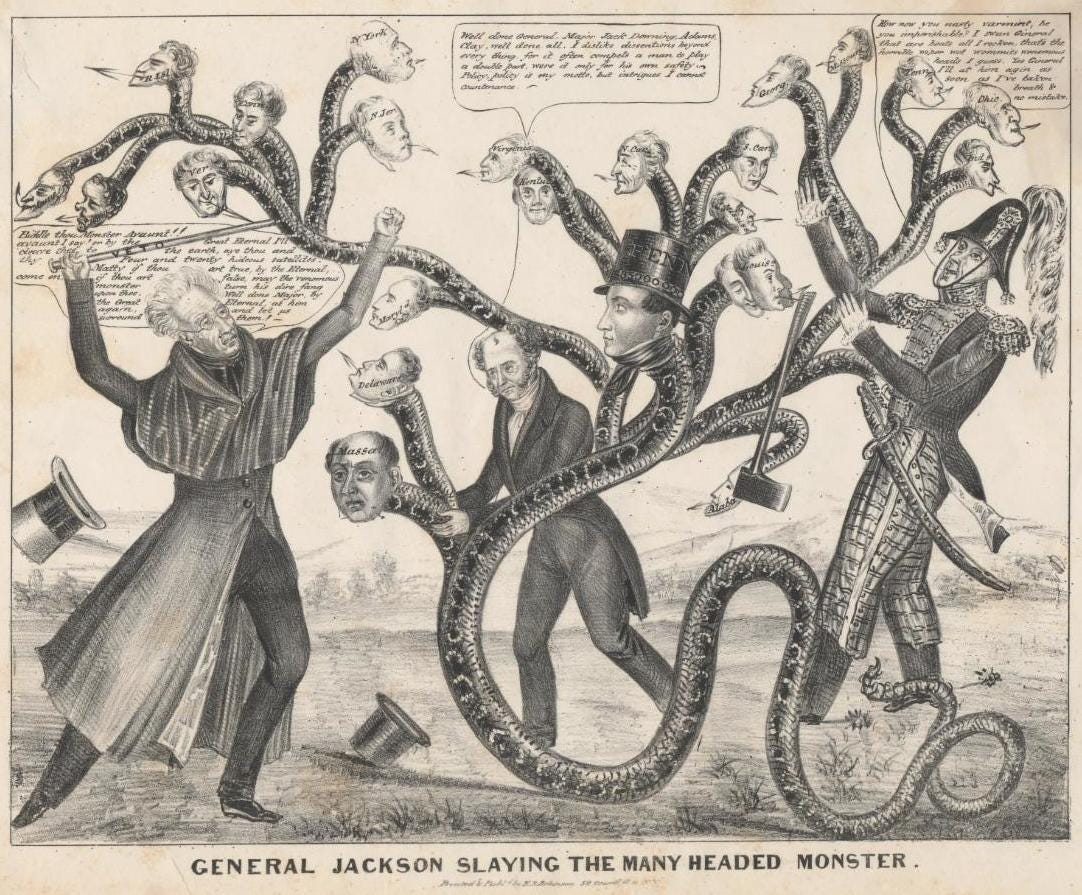
But the reason the dinners originally had that name is that Jefferson and Andrew Jackson were the founders of the party. Jackson, like Jefferson, was a slaver and extremely un-woke. But the economic-policy issue at the center of Jackson’s presidency was his effort to kill the Bank of the United States, which he and his allies characterized as a system-rigging hydra of economic and political influence that threatened the true spirit of democracy.
I don’t have time to do the entire political history of the United States, but let’s just yadda yadda yadda to the first presidential acceptance speech that I remember watching. Bill Clinton said:
I was raised to believe the American Dream was built on rewarding hard work. But we have seen the folks of Washington turn the American ethic on its head.
For too long those who play by the rules and keep the faith have gotten the shaft, and those who cut corners and cut deals have been rewarded.
People are working harder than ever, spending less time with their children, working nights and weekends at their jobs instead of going to P.T.A. and Little League or Scouts. And their incomes are still going down. Their taxes are still going up. And the costs of health care, housing, and education are going through the roof.
Meanwhile, more and more of our best people are falling into poverty even though they work 40 hours a week. Our people are pleading for change, but government is in the way. It has been hijacked by privileged private interests.
Clinton, of course, was not a distinctively populist Democrat on economics. What made him distinctive as a candidate was that he embraced the death penalty, criticized Jesse Jackson for hosting Sister Souljah, and otherwise had a moderate approach to culture. There’s a progressive critique of the substance of Clintonomics, but the way this critique worked — former Labor Secretary Robert Reich is its canonical voice — was that Clinton betrayed the promise of his populist campaign with his governance choices.
But then right after Clinton, the nominee was Al Gore, whose campaign slogan was “the people, not the powerful” and whose speeches were full of themes about a rigged system, such as “whether you’re starting out to raise your own family or getting ready to retire after a lifetime of hard work, so often powerful forces and powerful interests stand in your way and the odds seem stacked against you, even as you do what’s right for you and your family.” Next up was John Kerry, whose campaign, of course, talked a lot about national security but whose economic message was focused on the evils of Benedict Arnold C.E.O.s who were shipping your job overseas.
It’s true that Hillary Clinton largely eschewed these themes, but she’s the exception; the populist rhetorical mood is the connective tissue that holds the Democratic Party together across space and time.
It’s a good idea for politicians to use good slogans and put good zingers in their speeches. But governing actually matters a lot.
I think it’s kind of weird that economic populist types who are way more left-wing than I am are excited about Governor-elect Gina Hinojosa, largely on the basis of the way she blasted the data center industry even though she was explicitly disavowing any kind of income tax for Texas.
I am (famously) not that left-wing, and this is too right-wing for me. Texas is a fast-growing, high-inequality state with a high poverty rate and no Medicaid expansion. If they adopted the same 3 percent flat income tax as Louisiana (not exactly a hotbed of leftist politics), they could raise a ton of money while still having a tax competition advantage vis-a-vis Oklahoma and New Mexico, to say nothing of New York and California.
I very, very rarely write articles slamming Democrats for a lack of progressive ambition, but I think this is a real whiff on policy substance — though admittedly she’d have to run harder toward the center on culture to be able to pull it off.
Regardless, the point is that sane people don’t just care what politicians say — they care what they do.
Sanders doesn’t just criticize Obama for failing to invoke populist rhetorical tropes; he embraces a leftist conspiracy theory about Obama’s handling of the financial crisis. Progressives think it was wrong of Bill Clinton to embrace deficit reduction and at the time they were furious about free trade (today Abdul El-Sayed has emerged as a big tariff critic) and the now-forgotten 1996 Telecommunications Act. I am on the side of Obama and Clinton about that stuff, which is part of why I’m not enthusiastic about the idea of a bunch of left-factionalists running economic policy in 2029.
But this is not an argument about whether politicians should vow to fight for the little guy against the rigged system where special interests screw you over. Everyone thinks Democrats should run like that!
And beyond rhetoric, it is genuinely outrageous how Trump has prioritized the interests of his A.I. executive benefactors over the public interest in regulating this industry. That’s something every Democrat should say because the voters agree with it and because it’s true.
As a candidate for office, though, what’s distinctive about Talarico is that he took more moderate positions than establishment Democrats do on oil and gas and on transgender issues while criticizing the Biden record on immigration. He sounds like Bernie on economics in the sense that all Democrats sound broadly populist in their rhetoric and have for literally hundreds of years.