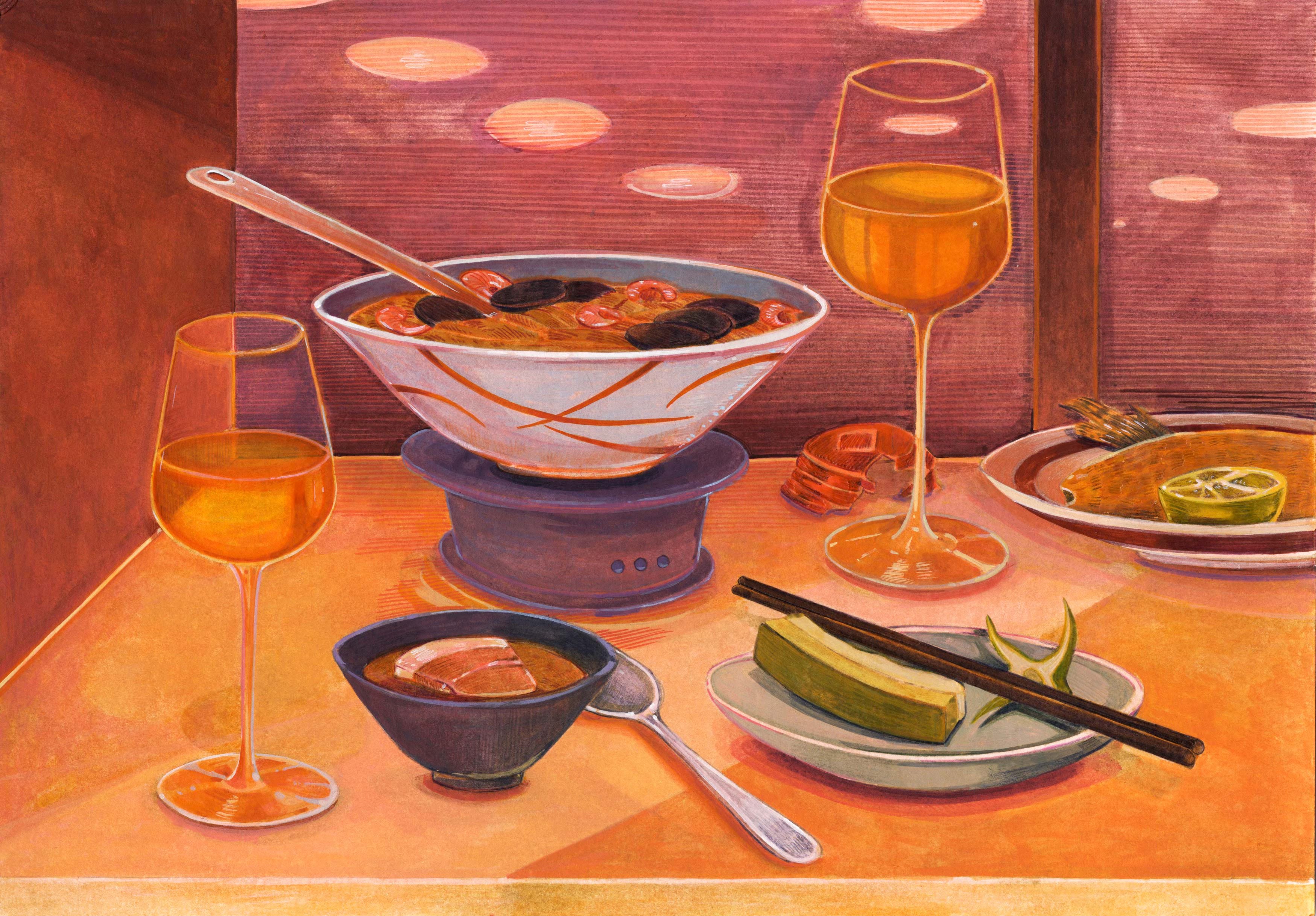
Good morning and welcome to Vittles. Today we’re publishing a long read by Lavender Au on how bistros have transformed the dining scene in China’s major cities. While bistros initially seemed like a local expression of recent Western restaurant trends – think: small plates, natural wines, carefully curated spaces with exposed brick and handwritten chalkboard menus – as thousands of bistros flooded Shanghai and Beijing, the phenomenon transformed into something else entirely. As Lavender reports, what exactly ‘bistro’ means in China has become increasingly hard to pin down.
Today’s article is free to read, but if you would like to support our work, please consider a subscription to Vittles for £7/month or £59/year. Vittles** is entirely subscriber funded,** and your subscriptions help to pay all our writers, photographers and illustrators at a fair rate. You can also support us by ** buying a copy of Issue 3** of our print magazine.
Shortly after I moved back to Beijing in 2023, I went to a newly opened restaurant called 一粲Bistro, which was near some traffic lights that had become social-media famous for lighting up with coloured hearts. Inside were rattan chairs, low-slung pendant lights and rows of wine bottles. With only one private room, it wasn’t designed for those staples of Chinese dining (the family gathering, the business dinner, the banquet); there was no white-tablecloth-double-chopstick-set arrangement here. Instead there were wine glasses next to simple ceramic plates. One customer had brought their dog – something I don’t remember ever seeing before at a restaurant in Beijing.
Initially, if it weren’t for the wooden chopsticks on the table, I could easily have believed that I was in a natural wine bar or small-plates restaurant in London. But then Yunnan dishes began to arrive: beef with mint, a fried tilapia, winged beans. And, to add to the confusion, according to everyone around me we were in a bistro – the new buzzword among people who ate out in China.
At the time, it seemed as though every new restaurant was labelled a bistro. Even people who knew almost no English or French had picked up this one word. I heard there was a bistro every five blocks in Shanghai. When I thought of bistros in the European context I thought of polished copper bars and unfussy French classics, but what exactly bistro meant in the Chinese context proved difficult to pin down. Most served little or no French food – instead, there were Yunnan bistros, Guizhou bistros, Sichuan bistros, Xibei bistros and Dongbei bistros. If bistros had Chinese names as well, they often used the term xiaojiuguan – 小酒馆 – which translates to tavern or wine bar. But beyond broad agreement that ‘bistros’ served wine, the meaning of the term became blurry.
One person told me that no bistro in China was actually a bistro. Another said there were real bistros and imposters, the latter copying the aesthetic without thinking deeply about which food went well with wine. A third, a chef, felt that bistros were about vibes – well, food and vibes, but mostly vibes. One friend was particularly blunt when I asked what she thought of when I said ‘bistro’: ‘Showing off, but with no money to show off.’
Some restaurant owners had been to France and drawn inspiration from its bistros. Many others had not. Irrespective, everyone I spoke to had a clear idea of what French bistros were like, and although they had different ideas of what bistro meant in China, they all agreed that it wasn’t that. So, I wanted to know – what was a bistro and where did this phenomenon come from?
‘One person told me that no bistro in China was actually a bistro. Another said there were real bistros and imposters’
My non-exhaustive memory of the dining scene in pre-pandemic Beijing is this: you had hole-in-the-walls with harsh fluorescent lighting (who cares because you’re going for good noodles, not the decor), mall restaurants (very shiny), a near-infinite number of hotpot and barbecue spots (both of which are scalable and often lucrative models) and sit-down restaurants serving regional food. None of these places served wine – drinking, if it happened, was generally all about beer and baijiu. Wine was mainly associated with fine dining: think middle-aged businessmen and officials (this was pre-anti-corruption campaigns), high ceilings, young waitresses in qipao and lots of sea cucumbers.
The biggest non-Chinese cuisines, by far, were Japanese and Korean, although there were some brunch spots and international chains, and at least one Italian place with an imported pizza oven. I only realised there were French restaurants in Beijing when a French friend’s parents visited and went to one because they were homesick.
That all began to change in 2020. The bistro trend took off when the Chinese border was still closed but pandemic restrictions had lifted sufficiently to allow dining out. People had been shut in their homes for months, unable to travel and starved of human connection. They wanted to close the distance between themselves and other people, not to be separated by gigantic tables that made conversation difficult. They wanted to experience something new.
According to Ian Dai, founder of natural wine brand XiaoPu小圃, the first bistro to take off was Shanghai’s SOiF, which had opened the year before, in 2019. ‘It was world-class,’ he said. In appearance, SOiF was a textbook example of a natural wine bar – a tiled counter, a wine wardrobe, menu items handwritten on the behind-bar mirror – and served a selection of small plates including sardines on toast and oeufs en meurette.
Dai believes it was the international nature of SOiF (one of the restaurant’s three co-founders was from Quebec, and its staff were a mixture of Chinese and Westerners) that made it such a hit. It attracted a similarly international clientele. SOiF’s success showed the industry that a bistro built around strong wine sales could be highly profitable (although Dai notes that no one has quite managed to match it since).
It’s no surprise that the first bistros in China opened in Shanghai: as the location of the Chinese headquarters of LVMH and L’Oréal, and home to many satellite French-founded advertising and PR firms, Shanghai hosts China’s largest population of French people, and Westerners generally. ‘Naturally they brought their lifestyle habits with them,’ Dai says.
These habits included a more casual approach to dining. When Mike Liu and his business partners opened the pasta bar Yaya’s (which came to be known as a bistro) – first as a late-night pop-up in 2021, then as a fully-fledged restaurant the following year – their goal was to create a place that people could slide in and out of (in contrast to existing Italian restaurants in Shanghai, which were generally more traditional). The menu includes a pappardelle lamb ragu with Xinjiang spices and sour cream, as well as snacks like Guizhou sour anchovy toast. ‘We don’t have the most amazing décor but … there’s a spirit of fun,’ Liu says.
This atmosphere of fun was integral to the success of bistros. The bistro’s target customer was the young professional who worked long hours and wanted someplace where they could unwind, but without committing to the stiffness of formal banquets and private rooms favoured by the older generation (and without the associated minimum spends). 小川川菜 Ogawa Bistro, 壮壮酒馆 Bistro Strong, PuR’aisin 皮酉海让葡萄酒酒吧, Umamiya 酒鱻酒场, Meraki 189 麻吉: the list of places in the bistro bracket just got longer and longer. And crucially, bistros – at least initially – were a way to signal taste and identity. Suggesting a bistro meant you were curious about food and knew interesting spots: they were social currency. People couldn’t get enough.
Soon there were enough bistros in Shanghai for people to start writing ‘top six’ lists on RedNote, then top thirties (the rise of the bistro was partly facilitated by the app’s citywalk trend, which suggested walking routes around a city; bistros became places to da ka 打卡 – the equivalent of checking in). By 2024, there were 33,000 registered bistros across China, including bistro chains like Yeego and Ameigo. Although they were largely confined to China’s tier one cities – Shanghai, Beijing, Guangzhou and Shenzhen – they trickled down to other urban centres too. I saw several in Chengdu when I visited in 2025, and when I searched online recently, I found them not only in expected places like Dali in Yunnan (famously where professionals go when they’re burned out), but also Ordos, a sparsely populated city (by Chinese standards) in Inner Mongolia. The bistro had become an established urban restaurant format.
While the earliest bistros leaned towards Western cooking, the format soon began to incorporate Chinese regional cooking. Food writer Gia Wang (based in Shanghai) recalls that the first bistros she visited offered more explicitly Mediterranean cuisine, but she soon noticed ones that stuck to local flavours, as well as those that served European dishes with a Chinese inflection (like the signature dish at Yaya’s, a lasagne made with mapo tofu sauce). There were also those that did the inverse, such as Bastard in Shanghai, which serves Cantonese cheung fun stuffed with tuna, and Somm’s Table in Beijing, where I had a northeastern Chinese version of a charcuterie board arranged with braised pig ears, pork skin jelly and pickled cucumber.
‘By 2024, there were 33,000 registered bistros across China, including bistro chains like Yeego and Ameigo’
Most bistros tend to serve small plates, explicitly intended for sharing. As a result, cuisines that lend themselves to mixing and matching were particularly apt for the format. Wang said that Yunguichuan (a combination of Yunnan, Guizhou and Sichuan) cuisine took off because it contains a range of flavours – sour, spicy, numbing – that are easier to chop and change. Taiwanese cuisine worked well, too, because it is inherently a fusion cuisine.
At Cila 恣辣 in Shanghai, which opened in 2024, Wu Linye serves food from Xibei, China’s northwest. The food she ate growing up in Xi’an was ‘mostly carbs on carbs’, she says, various combinations of the same staple grains. ‘You’re limited to potatoes, sweet corn and wheat. You might rotate them, you might create something amazing, shape it into a lion or a tiger, but essentially it’s still a steamed bun.’ Unlike the south, there wasn’t a huge variety of vegetables, mushrooms or fish in Xibei in the nineties.
Wu uses a wider variety of spices and ingredients at Cila than what she grew up with, so the food isn’t strictly traditional. She focuses on finding points of connection with other cuisines – including those from West Asia and North Africa – that share similarities with her own traditions, but she avoids describing her food as innovative (创新菜; there was a trend in the nineties for taking everyday dishes like mapo tofu, presenting them in fancy vessels with dry ice and rose petals, and charging 180 yuan – around £20, quite a lot at the time – which has left a lasting negative impression of culinary ‘innovation’).
Another bistro staple is Yunnan cuisine. Before the bistro boom, Yunnan restaurants generally presented themselves as rustic and home-style, and Yunnan food wasn’t particularly popular – it wasn’t one of the eight major culinary traditions of China. But it has since become one of the most widely embraced cuisines. Starry Xiao, a chef from Kunming, Yunnan’s capital, believes that is because ‘Yunnan food is arguably the best suited for wine pairings’. The cuisine tends to be more acidic than that of other Chinese culinary traditions, and also has a fresh sourness from fruit and fermented items like salted or pickled vegetables.
The first bistro menu that Xiao created was for White Tiger Village 白老虎屯 in Beijing. He’d been making relatively traditional dishes and wanted to do something new. One of the dishes he designed featured a classic French ingredient, the oyster; Xiao paired its fresh, oceanic aroma and mineral notes with a fermented starfruit granita and dry-cured beef (gan ba). The result wasn’t Yunnan cuisine in the traditional sense (neither oysters nor starfruit are native to Yunnan, although Xiao ate a lot of the latter growing up), but still they contained the flavours of the province: its mixing of fruit with chilli, salt and other seasonings. And the dish could be paired with a range of Chardonnays.
Xiao also designed the menu for the recently opened Feng Full, a northeastern bistro concept in Beijing. Some people (including Wang) believe that northeastern food isn’t suited to the bistro format because it doesn’t go well with wine, so Xiao’s goal was to make it lighter, bring out fermented flavours, and some acidity. ‘Without acidity, it’s easy to get palate fatigue,’ he said. He also tweaked traditional dishes. In his version of guo bao rou, in which crispy sliced pork is coated in sweet-and-sour sauce, he used Italian white vinegar for a fruitier flavour.
Just like the food, the wines at China’s bistros don’t necessarily adhere to tradition. Liu notes that the rise of the bistro occurred as natural wine was starting to take off in Shanghai. According to Dai, you can divide wine-drinkers in China into three groups: firstly, wine lovers who know everything, then people rich enough to drink bogendi (Burgundy) every day and, finally, newbies willing to try anything. The bistro was integral in introducing this third group to wine, opening up a new market for wines like his.
‘Xiaocai liked the chicken feet but thought his dad’s chicken rolls were better. His overall judgement was ‘65% authentic’
While at business banquets, prestige and price often mattered more than what was in the bottle, bistro-goers were more open to local and natural wines. Cila, for example, has one of China’s most extensive selections of domestically produced wine. Although wine drinking in general has been falling in China (as part of a broader decrease in consumption linked with the economic downturn), in 2023, there were more than three times as many searches for natural wine as for craft beer on the restaurant app Dianping. Customers were drawn to the irreverent branding of natural wine. Rather than buying it for their bosses or clients, or gifting it to their friends, they drank it themselves. Choosing good Chinese wines became a point of pride when entertaining, and according to Wu, they possess an obvious advantage: ‘People can pronounce the name on the bottle.’
On a Saturday night in April, I went to a packed Fujianese bistro in Sanlitun, an upscale shopping area that overlaps with the embassy district in Beijing. I asked my friend Xiaocai to join me, since the food was from his hometown and he likes wine. He took a look around, smoked a cigarette in the courtyard, then told me if he’d known we were coming here, he’d have suggested somewhere else.
The restaurant was packed. Xiaocai handled the ordering. Soon our small table was filled with Fujianese snack-shop favourites: beef soup, an oyster pancake presented like okonomiyaki, braised chicken feet, butterfish, chicken rolls (which, despite the name, are made from pork belly, water chestnut and shallots), fish-ball slices, trotters and two types of sweet taro peanut soup. Xiaocai liked the chicken feet but thought his dad’s chicken rolls were better. His overall judgement was ‘65% authentic’.
There were two key stumbling blocks. First, although Xiaocai knew every dish on the menu, he’d never seen them all in one place. In Fujian, each dish would have its own specialist snack shop; at the beef soup shop, for example, the only other dishes on the menu would be beef iterations. The other difference was the price. Xiaocai typically spent around ten…