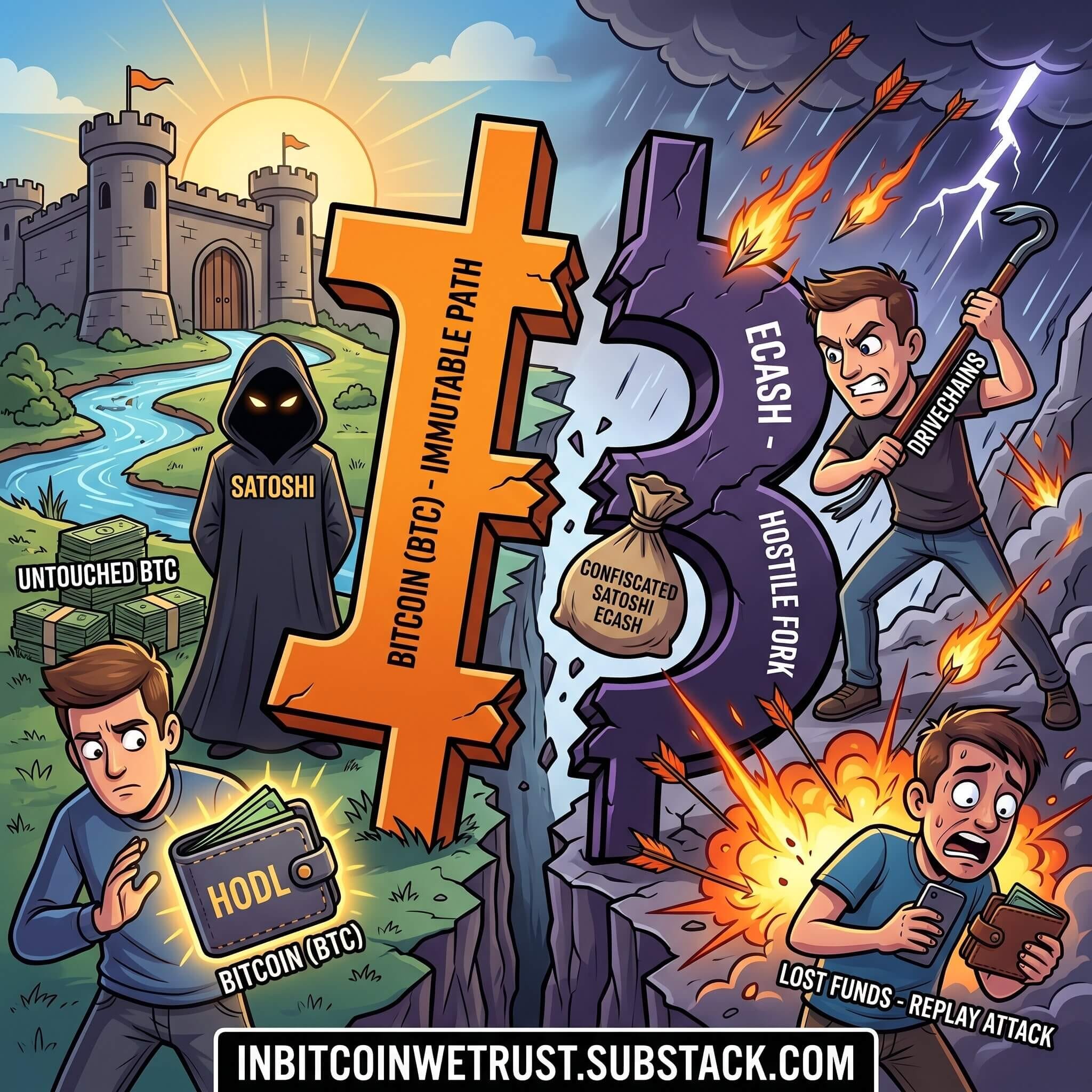
Some dates leave a permanent, sometimes jagged mark on the history of decentralized protocols. August 2026 is already shaping up to be one of those pivotal, controversial moments. Paul Sztorc, an emblematic, highly vocal, and controversial figure in the Bitcoin ecosystem, has announced the launch of a hostile Bitcoin hard fork, dubbed “eCash.”
This is not merely a software update. It is an ideological schism, a technical provocation, and an economic gamble that threatens to shake the peace of mind of everyday BTC holders. Between technological innovations rejected by the grassroots community, the arbitrary redistribution of “dormant” billionaire wealth, and the deliberate introduction of major security risks for the average user, the arrival of eCash is a powder keg.
To navigate the impending chaos, you need more than just a surface-level understanding. You need to know the mechanics of the code, the economic theory of money, and the exact steps to protect your digital sovereignty. Here is the definitive, deep-dive analysis of what is about to happen, the hidden mechanisms at play, and above all, how to build a fortress around your capital.
To understand the gravity of Sztorc’s play, we must return to the absolute fundamentals of blockchain governance. In the decentralized world of Bitcoin, there is no CEO, no board of directors, and no IT department to force an update. The rules are enforced entirely by consensus among tens of thousands of independent nodes (computers) running the software.
When developers want to upgrade Bitcoin, they generally rely on Soft Forks. A soft fork is a backward-compatible upgrade. It tightens the rules. Nodes that don’t upgrade can still interact with the network, even if they don’t understand the new features (like SegWit in 2017 or Taproot in 2021).
A Hard Fork, however, is a radical, non-backward-compatible break in reality. It is a loosening or complete rewriting of the consensus rules. Imagine changing the rules of a chess match mid-game, declaring that pawns can now move backward. If half the players refuse to acknowledge this new rule, the game physically cannot continue on the same board.
From that moment, the universe splits. Two separate games are now played on two different boards, even though the pieces were identical at the moment of the fracture.
Paul Sztorc’s hard fork is scheduled for block 964,000, estimated to occur around August 2026. At this exact cryptographic milestone, the Bitcoin network will experience a mitosis:
**Bitcoin (BTC):**Will ignore Sztorc’s software, continuing on its path, faithful to its current, conservative consensus rules. For the true Bitcoin network, this event is a non-issue.**eCash (the newcomer):**Will mine its first block under new rules, violently splitting away from the main network.
The crucial detail—and the source of all the incoming confusion—is that these two chains share their entire history up to block 963,999. Because Bitcoin uses an Unspent Transaction Output (UTXO) model, every fraction of a bitcoin you own is tied to a specific cryptographic lock. Since eCash copies the ledger exactly, your cryptographic locks (and the keys you hold) exist on both networks.
Mechanically, if you hold 1 BTC in self-custody the second before the fork, you will magically hold 1 BTC and 1 eCash the second after. But as we will explore, this is not “free money.” It is an illusion fraught with danger.