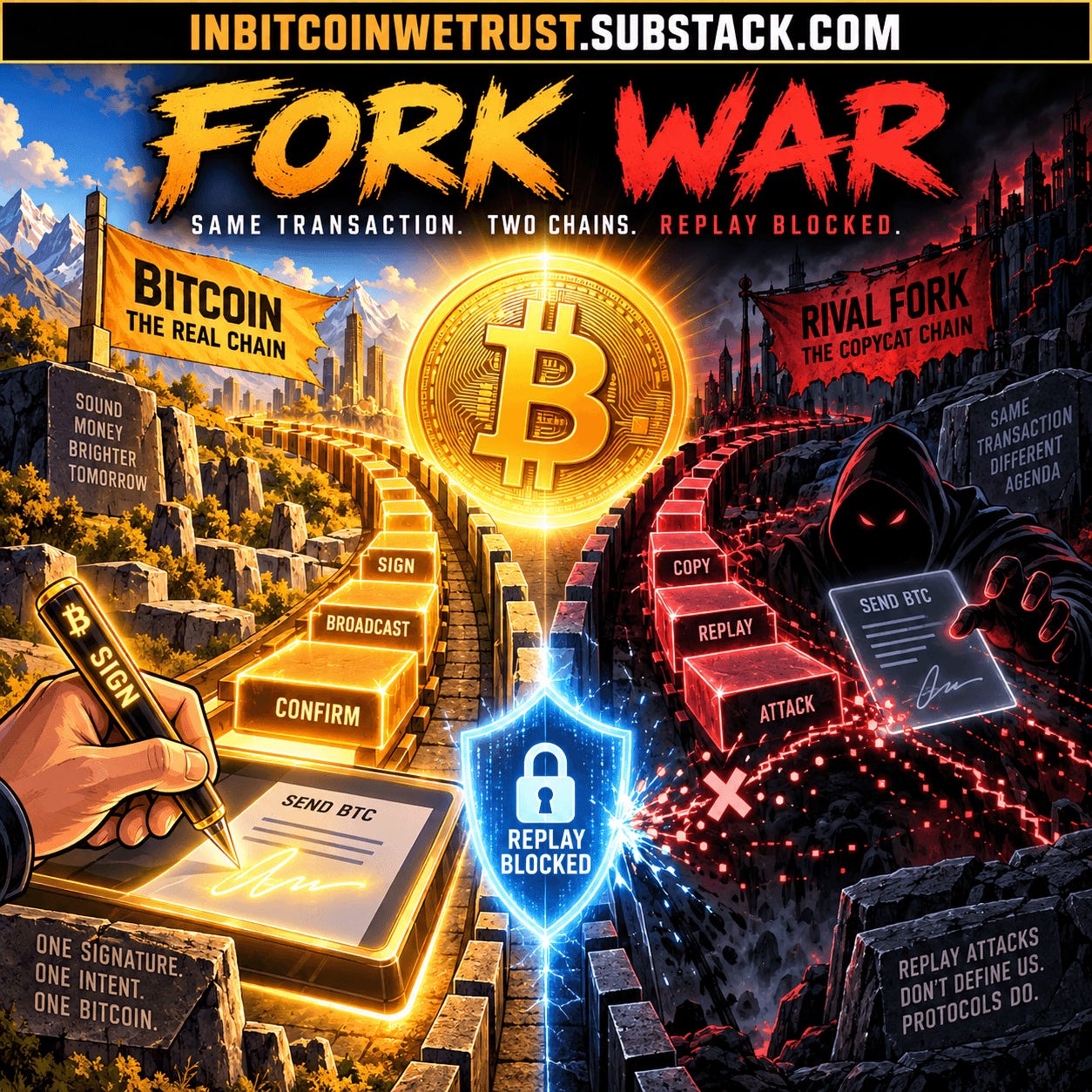
The worst moment to discover that you cannot safely separate your Bitcoin from a rival fork is when you are already trying to sell that fork.
By then, you need more than a convincing argument about which chain deserves your support. You need a transaction that does exactly what you intend. That is why preparing for a contentious split means examining the mechanics of spending long before holders have to navigate a crisis.
Imagine trying to sell a coin you never wanted — and discovering that you also sent away the Bitcoin you intended to keep.
Your hardware wallet was never hacked. Your seed phrase never leaked. The signature was yours, and it worked exactly as designed.
The problem was that it worked in two places.
During certain blockchain splits, a transaction signed for one chain can also be valid on the other. Someone can copy it, broadcast it again, and cause the corresponding coins to move there too. That is a transaction replay. You intended one payment; the shared rules allowed two.
For a long-term Bitcoin holder, that creates an uncomfortable possibility: being right about which chain to keep does not automatically make it safe to sell the other one.
That is the problem behind a developer discussion about universal opt-in replay protection, summarized in ** Bitcoin Optech’s August 28 newsletter**. The preparation is still at the proposal and review stage.
The question it raises deserves attention anyway.
We spend plenty of time talking about the right to reject changes to Bitcoin. Much less time goes into explaining what exercising that right could involve when money is actually on the line.
Open models are closing the gap. But the last few percentage points could determine which jobs AI can finish — and who gets paid.
The familiar fork narrative is appealing: you held Bitcoin before a split, so now you control coins on both networks. Keep the Bitcoin. Sell the alternative. Increase your stack.
But two balances on a screen do not necessarily mean two independently spendable assets.
Consider a simplified example. Alice controls a transaction output worth 1 BTC before a contentious split. Both chains preserve that output and its spending conditions. On Chain A, it represents 1 BTC. On Chain B, it represents one unit of the forked asset. Their market values may be entirely different.
Alice wants to keep Chain A’s coins and send Chain B’s coins to a buyer. She signs a transaction spending the shared output to an address the buyer controls, with the appropriate fee deducted.
If that transaction also satisfies Chain A’s rules and its input remains unspent there, someone can rebroadcast it on Chain A. If confirmed, Alice has transferred the corresponding BTC to the same spending conditions on that chain as well.
No second signature is necessary.
This does not let the person replaying the transaction freely replace the recipient with their own address. An ordinary signature commits to the payment’s outputs. The danger is that the intended recipient on one network may also gain control of coins on the other.
A replayed transfer to an address Alice controls would have different consequences from a replayed payment to a buyer. Context matters. “Replay attack” is not a synonym for an attacker gaining unrestricted access to your wallet.
It means your authorization can travel farther than you intended.
Self-custody remains essential to direct control over your coins. But a private key cannot communicate intentions that the transaction format and validation rules do not express.
Your wallet might label a network “Fork B.” You might connect to a server serving Fork B. You might be absolutely certain that you are selling only Fork B’s asset. None of those facts, by itself, makes the signed transaction invalid on Chain A.
The protection has to exist in what the networks validate.
This is an important distinction for anyone who equates secure signing with a safe transaction. A signing device can protect a key perfectly while approving a transaction whose consequences the user has misunderstood.
The practical question is therefore more demanding than “Did I sign this?”
Under which rules—and on which chains—can this signature spend my coins?
Moonsettler’s ** Delving Bitcoin proposal** would let an opt-in transaction commit to a block in a particular chain’s history. Validation would require that block to be present. Anthony Towns suggested identifying it through a height and a short hash suffix, potentially using five or six bytes instead of a full 32-byte hash.
The intuition is straightforward. After two chains diverge, they can have different blocks at the same height. A commitment can distinguish those histories.
Think of it as adding a condition to a payment: this authorization depends on this particular history being present. That is more precise than choosing a network name in an interface.