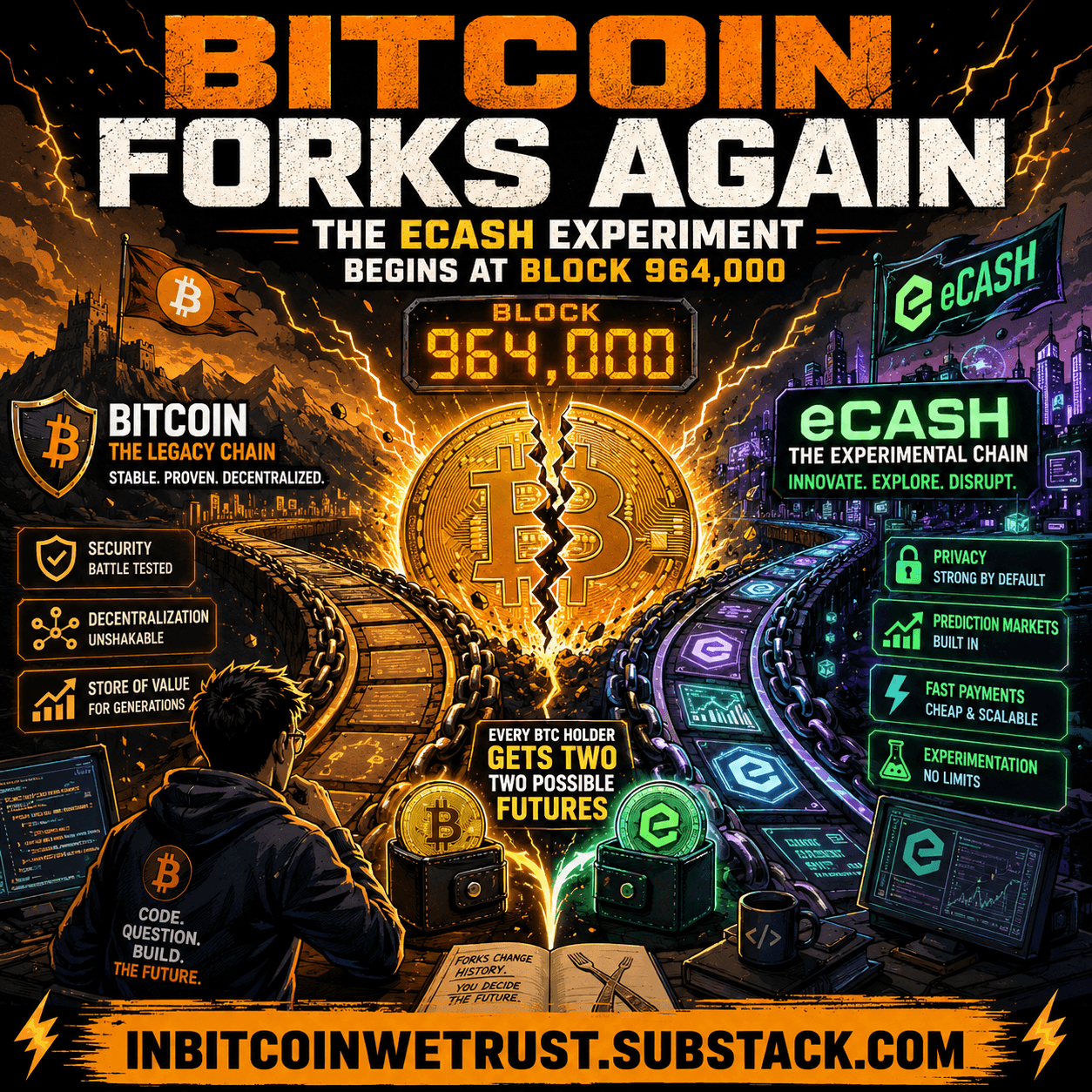
Every BTC holder is about to face an old Bitcoin question in a new form: if someone copies Bitcoin’s entire history, changes the rules, and gives you coins on both chains, which one is actually Bitcoin?
Bitcoin is approaching block 964,000.
Normally, that would mean nothing.
Another block height. Another ten minutes. Another small step toward the next halving.
This time is different.
Around block 964,000—currently targeted for roughly August 21, 2026—a group led by longtime Bitcoin developer Paul Sztorc plans to launch a hard fork called eCash.
Your Bitcoin will not disappear. Bitcoin will continue. But Bitcoin’s history will be copied into another network.
If you control 1 BTC before the split, the basic idea is that you will still control your 1 BTC on Bitcoin — and the corresponding eCash on the new chain.
One history. Two futures.
And unlike the chaotic BIP-110 experiment that recently tried to enforce new rules while remaining inside Bitcoin’s SHA-256 ecosystem, eCash is not pretending there won’t be a split.
eCash is deliberately creating one.
That makes this experiment much cleaner technically.
It also makes the philosophical question much harder.
When you intentionally copy Bitcoin and walk away, what exactly are you creating?
Big Tech is spending hundreds of billions on AI. The only question that matters now is: who earns it back?
This distinction is essential.
Bitcoin itself is not scheduled to activate eCash.
Bitcoin Core is not suddenly adding Drivechains at block 964,000.
Your existing Bitcoin node will not wake up and start following a new monetary system.
The Bitcoin network can simply continue operating under the rules it already uses.
eCash is launching a separate blockchain.
Technically, this is what a hard fork can do.
Take Bitcoin’s existing ledger. Preserve the transaction history up to a particular block. Then introduce incompatible rules.
From that point forward, two networks can exist.
Bitcoin goes one way. eCash goes another.
The eCash tooling currently describes activation around block 964,000, with an estimated timestamp around August 21, while retaining SHA-256d proof-of-work and enabling ** BIP-300** and
That is very different from trying to convince Bitcoin users that everyone should adopt the new rules.
Sztorc does not need Bitcoin consensus to create another chain. He only needs software, miners, users, and enough economic interest to make that chain live.
Whether it becomes valuable is another matter entirely.
Sztorc summarized the idea simply when he announced the project.
Your coins split.
Someone holding 4.19 BTC before the fork would have 4.19 BTC on Bitcoin and a corresponding 4.19 eCash on the new network. The original Bitcoin remains untouched.
This is not magic.
The fork copies Bitcoin’s ownership history.
The private key proving ownership of an output before the split can therefore correspond to ownership on both branches afterward, subject to the new chain’s rules.
We have seen this before.
Bitcoin Cash did it. Bitcoin SV did it. Bitcoin Gold did it.
A fork can copy Bitcoin’s ledger.
What it cannot automatically copy is Bitcoin’s network effect.
That is where the real experiment begins.
One clarification before going further.
There is already a cryptocurrency called eCash, using the ticker XEC, descended from Bitcoin Cash ABC.
That project is unrelated to Sztorc’s 2026 Bitcoin hard fork.
Yes, that makes the naming situation unnecessarily confusing.
The existing XEC network has its own history, technology, and community.
Sztorc’s eCash project is a new Bitcoin-derived hard fork built around his long-running Drivechain work.
So if block 964,000 arrives and people start talking about “eCash,” pay attention to which eCash they mean.
Crypto apparently had too few naming collisions already.
The free coins will attract headlines.
They are not the real reason this fork exists.
The real reason is Drivechain.
Paul Sztorc has spent more than a decade arguing that Bitcoin should support sidechains through proposals generally associated with BIP-300 and BIP-301.