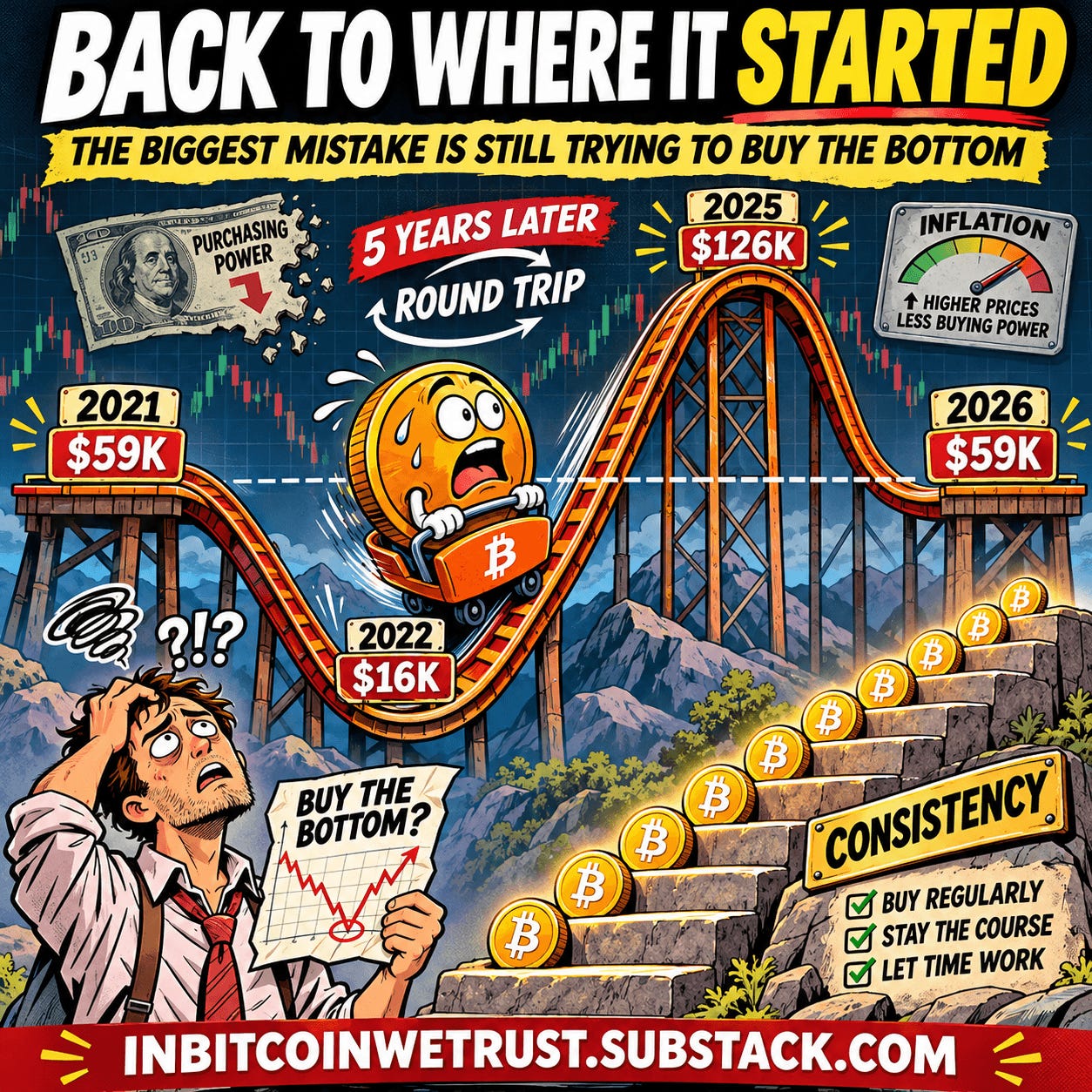
Bitcoin climbed above $126,000, then collapsed, returning to its 2021 price. Five years of volatility have produced almost no nominal gain from one unlucky entry point. But the real lesson isn’t about predicting the next rally. It’s about how ordinary investors build wealth when nobody knows what comes next.
Imagine buying Bitcoin on November 25, 2021. You had spent months reading about inflation, central banks, the future of money, and the extraordinary potential of a decentralized financial system. Your friends thought you were taking an unnecessary risk. Your bank probably didn’t understand why you wanted to own something that produced no interest and had no government backing.
But you had done your homework. You understood Bitcoin’s 21 million supply limit, its halving mechanism, and the difference between holding actual BTC and trusting a third-party custodian. You weren’t trying to become a millionaire overnight. You wanted to build savings that governments couldn’t dilute through discretionary monetary expansion.
So you invested $10,000. Bitcoin was trading around $59,000. You transferred your coins to a hardware wallet and promised yourself that you would hold them for at least five years.
Then came the roller coaster. In 2022, Bitcoin collapsed below $16,000. Your investment appeared to have lost nearly three-quarters of its value. Your friends reminded you that they had warned you. In 2023, Bitcoin began recovering. In 2024, Wall Street finally embraced spot Bitcoin ETFs. The institutions that once dismissed Bitcoin started offering products built around it. The price surged past $100,000.
Then, in October 2025, Bitcoin reached an extraordinary record above $126,000. Your original $10,000 investment was briefly worth more than $21,000. You felt vindicated. You had survived the darkest moments, ignored the noise, and watched the world begin to recognize what Bitcoiners had understood for years.
But you didn’t sell. Why would you? You were investing for the long term. And then the market turned again. By November 25, 2026, Bitcoin was back near $59,000. Almost exactly where you had entered five years earlier. Your $10,000 investment was worth approximately $10,000 again, before fees and taxes.
Five years. Two brutal bear markets. A historic institutional adoption wave. A new all-time high. And almost nothing to show for it in nominal dollars.
That’s a difficult result to accept. But here’s what makes this story genuinely interesting. Your experience is not necessarily the experience of someone who invested $100 every week over those five years. It isn’t the experience of someone who bought during the 2022 collapse. And it isn’t the experience of someone who entered Bitcoin in November 2024 or near the October 2025 peak.
All those investors owned the same asset. They lived through the same market. Yet their financial outcomes could be dramatically different. This is why I believe the most important lesson from Bitcoin’s disappointing five-year return isn’t about predicting where the next bottom will occur. It’s about something much more fundamental.
Most people spend their investing lives trying to predict prices when they should be building a process that doesn’t require them to predict anything perfectly.
And Bitcoin’s latest five-year performance provides a particularly painful opportunity to understand why.
Let’s begin with the uncomfortable numbers. According to historical Bitstamp market data, Bitcoin closed at approximately $58,990 on November 25, 2021. Five years later, on November 25, 2026, it was trading around $59,000. The price data can be checked through the historical Bitcoin archive and CoinGlass’s current and historical BTC market records.
Different exchanges and data providers may produce slightly different five-year returns because they use different prices, observation times, and reference dates. Bitcoin trades continuously, and November 25, 2026, is still in progress as this article is written. But the broad conclusion is unmistakable. A Bitcoin investment made near the late-November 2021 price has generated very little nominal appreciation over five years.
This is not the narrative Bitcoin investors expected in 2021. At that time, many believed Bitcoin was entering a new era. The pandemic had produced extraordinary fiscal and monetary intervention. Inflation was accelerating. Institutional interest was increasing. And Bitcoin seemed uniquely positioned to benefit from a world losing confidence in traditional monetary systems.
The expectation was understandable. But markets rarely reward compelling narratives on the schedule investors prefer. Bitcoin initially collapsed. It recovered. It reached a much higher peak. Then it surrendered nearly all the appreciation relative to that particular 2021 purchase date.
The result is especially remarkable considering how much happened in between. The U.S. Securities and Exchange Commission approved spot Bitcoin exchange-traded products in January 2024. Traditional financial institutions created new ways to access Bitcoin. Custody infrastructure expanded. The asset gained recognition among investors who would never consider operating a Bitcoin wallet.
You can read the SEC’s original January 10, 2024, approval statement. And yet, for somebody whose investment began at the wrong moment in November 2021, those developments did not guarantee a positive five-year result.
That’s an important distinction. A technology can make progress while its market price delivers disappointing returns over a particular investment period.
Bitcoin doesn’t become a superior investment automatically because adoption increases. The price already reflects investors’ expectations about the future, and those expectations can become excessive. The same is true of companies, commodities, real estate, and entire stock markets.
A good asset purchased at an unreasonable price can become a bad investment for a very long time. And an asset purchased at a depressed price can produce strong returns even while the surrounding sentiment remains terrible.
That brings us to the first major lesson.
Why a booming stock market and record home values are compounding wealth for existing asset owners while pricing a generation of wage earners out of the middle class.
A five-year return sounds objective. And mathematically, it is. Take the ending price. Divide it by the starting price. Subtract one. But the result depends enormously on which starting date you choose.
Consider Bitcoin’s approximate price at several points in its history.
Every investor in this table owns the same Bitcoin. Yet the outcomes range from substantial gains to losses of more than 50%. A November 2022 buyer has a very different story to tell from somebody who bought near the October 2025 high. And the investor who purchased in November 2020 has a very different experience from the investor who arrived one year later.
This doesn’t make the five-year comparison invalid. It makes its interpretation more important. A rolling five-year return measures the result of buying at one historical moment and selling or valuing the investment exactly five years later. It does not measure the experience of everyone who accumulated Bitcoin throughout that period. It does not measure the total profitability of the network. It does not establish the return available to a future investor. And it certainly does not predict the date of the next market bottom.
That final point is critical. Some commentators see a disappointing five-year return and immediately announce that Bitcoin’s long-term investment case has failed. Others argue that similar periods of weak returns preceded strong recoveries and therefore a new bull market must be imminent. Both conclusions are too confident.
A disappointing historical return is information about the past. It is not a trading signal with a guaranteed future payoff.
You cannot prove Bitcoin is finished from one five-year window. But you cannot prove that buying today will be profitable simply because a previous weak window was followed by a rally. The future doesn’t owe investors a repetition of the past.
And this is where long-term investing requires something more sophisticated than choosing a favorite historical chart.
There’s another uncomfortable detail. Even if Bitcoin’s dollar price is almost unchanged over five years, the purchasing power of those dollars is not.
According to the U.S. Bureau of Labor Statistics, the Consumer Price Index for All Urban Consumers stood at 277.948 in November 2021. By October 2026, the latest monthly reading available when this article was prepared, the index had increased to 337.511. That’s approximately 21.4% cumulative inflation.
The underlying figures come directly from the November 2021 BLS release and the October 2026 BLS release.
Now consider the consequences. Suppose your Bitcoin investment was worth exactly $10,000 in November 2021 and remains worth exactly $10,000 today. In nominal terms, your return is zero. But maintaining the same purchasing power would require approximately $12,143. Your unchanged $10,000 represents only about 82.4% of its original purchasing power.
That’s a real loss of roughly 17.6%, measured against the U.S. CPI, before fees and taxes. In other words, the headline “Bitcoin returned nothing over five years” actually understates the disappointment for somebody evaluating the investment in terms of goods and services. The dollars are still there. Their purchasing power has declined.
Of course, keeping the original $10,000 in non-interest-bearing cash would also have exposed it to inflation. Bitcoin is not uniquely responsible for that monetary erosion. And alternatives such as interest-bearing savings, bonds, or equities have their own risks and returns.
But the comparison exposes an important weakness in simplistic Bitcoin narratives. The statement that Bitcoin has a fixed supply does not mean its market purchasing power will be stable over every five years.
Bitcoin’s supply is predictable. Its exchange value is not.
That is the distinction many investors learned the hard way. And it’s one we need to confront before discussing how people should approach the next five years.
Bitcoin has returned almost nothing for investors who bought near its November 2021 price—and inflation has made the result considerably worse. But one purchase date doesn’t describe what happened to everyone who invested during those five years.
In the premium investigation, I examine why regular accumulation can produce a different result from a single purchase, what dollar-cost averaging can and cannot accomplish, how Bitcoin’s four-year cycle can mislead investors, and the practical framework I believe matters far more than predicting the next bottom.