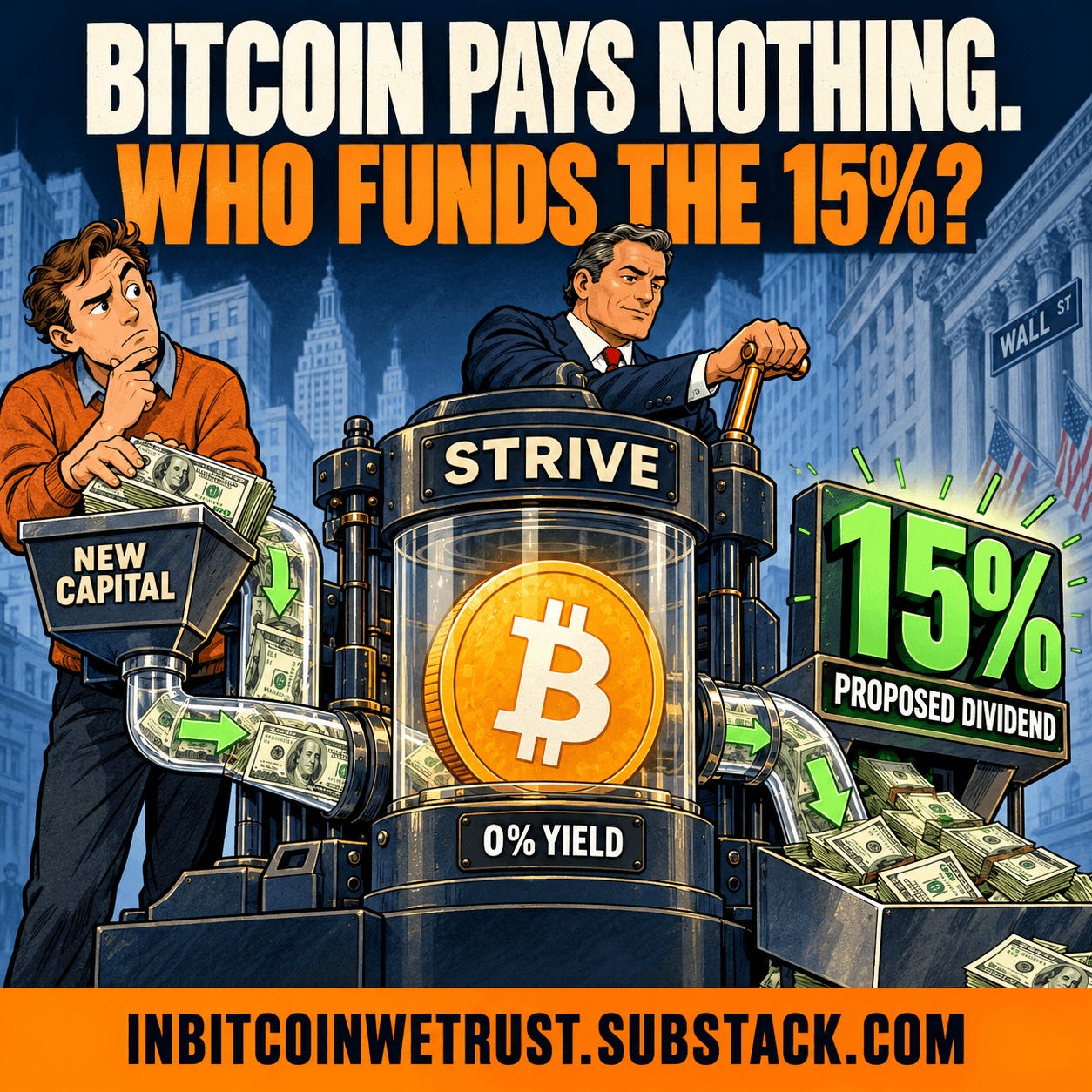
Bitcoin will never send you a dividend.
You can hold it for a month, a decade, or your whole life. Simply owning it does not produce another bitcoin, a dollar of interest, or a quarterly payment.
For many Bitcoiners, that is part of the attraction. No issuer promises to make your money grow. You own the asset. What happens to its purchasing power is a different question.
Then you open a corporate filing and see 15%.
On October 13, 2026, Strive announced a proposed offering of five million shares of SATS, a perpetual preferred stock carrying a 15% annual dividend rate on a $100 stated amount.
Its proposed regular payment dates fall on every business day, beginning November 9, subject to board declaration and legally available funds.
That is an attention-grabbing proposition: a company built around Bitcoin offering investors frequent cash payments at a double-digit annual rate.
I understand the appeal. People have mortgages, children, parents to support, and bills that arrive whether Bitcoin is having a good month or a terrible one. Wanting income from an investment is entirely reasonable.
But the income has to come from somewhere.
And in this case, the most revealing part of the story appears several pages away from the headline number.
Strive’s preliminary prospectus says:
“We expect to fund any dividends paid in cash on the SATS Stock primarily through additional capital raising activities.”
The risk disclosure specifies that expectation for the period following the initial 18-month reserve window.
That sentence deserves to travel as far as the 15% headline.
It tells us what investors are being asked to believe: that a company can turn a Bitcoin strategy, cash reserves, and continued access to capital markets into a durable stream of dollar payments.
The investment includes a second bet: the financing must keep working.
Bringing production home means finding power, skilled workers, and industrial know-how that Washington cannot summon with a tariff.
Start with what SATS actually represents.
Buying a preferred share means buying a corporate security with specified economic rights. It does not give you control of the company’s Bitcoin or a wallet containing your personal allocation of its treasury.
That distinction matters because Bitcoin and a security issued by a Bitcoin-owning company can deliver very different outcomes.
Bitcoin can rise while a particular corporate security disappoints. A preferred share can keep paying for a while even as Bitcoin falls. Both can lose value simultaneously for different reasons.
The details of the security determine which risks you have agreed to carry.
Here, “cumulative” means unpaid regular dividends continue accumulating. It does not guarantee payment on schedule; the board can decline to declare them. The filing also says unpaid regular dividends do not themselves earn additional dividends or interest.
For someone depending on cash income, the difference between an accumulated entitlement and money received can be enormous.
There is another easy misunderstanding: a 15% dividend rate is not a guaranteed 15% investment return.
Consider a simple illustration. You buy a security for $100, receive $15 over a year, and finish the year with a share worth $80. Before taxes and fees, your total return is negative 5%.
The payments arrived. Your wealth still declined.
Likewise, paying $120 for a share distributing $15 annually produces a 12.5% current yield. Paying $80 produces an 18.75% current yield, assuming the full dividend is paid. The underlying dividend rate can remain unchanged while the market price and your outcome move dramatically.
Strive’s October 13 preliminary filing leaves the public offering price blank. Its $100 stated amount is therefore not confirmation of the final purchase price.
These distinctions can sound tedious beside a giant 15% number. They become much more interesting when it is your savings at stake.
Strive has a substantial asset base behind this proposal. The filing reports approximately 32,773 BTC, $310.3 million in cash and cash equivalents, and $50.3 million in Strategy’s STRC preferred stock as of October 9.
The company also plans to allocate existing cash and securities equivalent to $22.50 per SATS share to a reserve covering the first 18 months of dividends.
The arithmetic helps make the scale tangible. Five million shares multiplied by $22.50 would mean $112.5 million allocated to that reserve. Five million shares multiplied by a $15 annual dividend would mean $75 million a year in regular dividend accrual, assuming that share count remains outstanding and the proposed terms apply.
Those are calculations from the proposed terms, not confirmation that the offering has closed.
A reserve is useful. It can give management breathing room and reduce the immediate need to approach investors every time a distribution is due.
But a reserve is a stock of resources. A recurring dividend is a flow of payments.
Moving assets into a designated account does not, by itself, create an income stream capable of replenishing every dollar paid out. Investment earnings may help. Operating cash flow may help. Asset sales may help. New financing may help.
Something must eventually replenish the pool if the payments continue.
The reserve buys time. The business still has to make that time count.
Before anyone reaches for the word “Ponzi,” slow down.