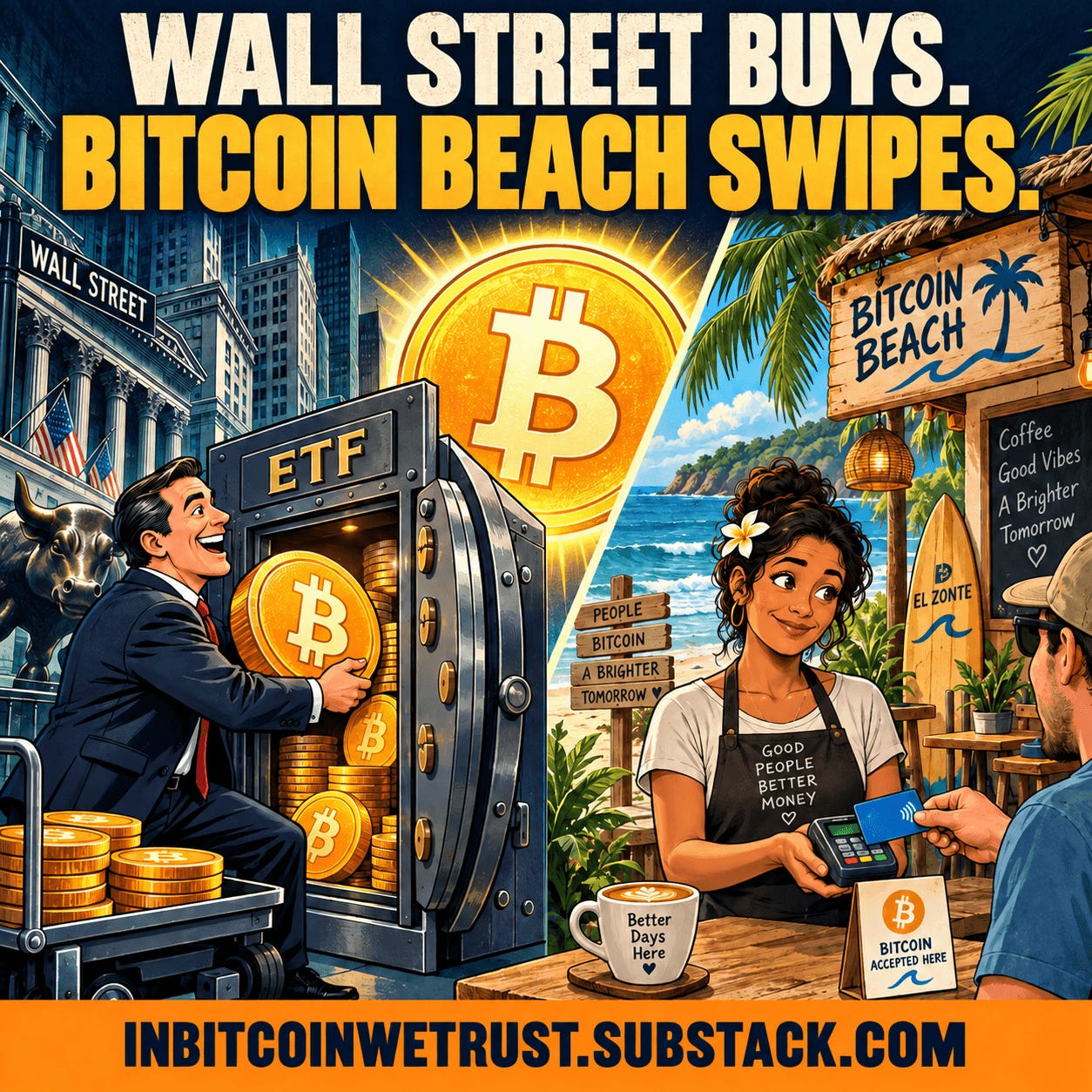
Nearly $1 billion entered U.S. spot Bitcoin ETFs in the week ending September 4, while a troubling report from El Zonte exposes the gap between owning Bitcoin and using it as money. The explanation goes deeper than HODL—and the outcome will shape who benefits from Bitcoin’s success.
Bitcoin can attract billions of dollars through brokerage accounts and still struggle to become the easiest way to pay for lunch.
That is the uncomfortable collision at the center of this story.
During August 31–September 4, 2026, U.S. spot Bitcoin ETFs attracted approximately $986.7 million in net inflows, calculated from Farside Investors’ published daily totals. BlackRock’s IBIT accounted for $691.5 million, approximately 70% of the week’s aggregate net inflow. The final three sessions alone, September 2–4, brought in approximately $1.01 billion, following outflows on September 1. September 4 added $174.6 million, including $117.4 million into IBIT.
That is a burst of renewed demand, with reversals along the way. It reinforces the broader point: traditional finance has built a substantial business around access to Bitcoin, even though capital can enter and leave those products quickly.
Set those figures beside a very different dispatch from El Zonte, the Salvadoran community known around the world as Bitcoin Beach.
Bitcoin Core contributor Jon Atack described paying for lunch at a local business. The merchant reportedly told him that his payment was her first Bitcoin payment of the month. Customers who once paid in Bitcoin were now overwhelmingly using cards, she said.
One merchant. One reported conversation. It cannot establish that Bitcoin payments have disappeared across El Zonte, much less across El Salvador. We do not have a representative local transaction series proving that claim.
But the contrast deserves attention precisely because it unsettles an assumption Bitcoiners have repeated for years: that financial adoption and monetary adoption will advance together.
Perhaps they will. They clearly do not have to move at the same speed.
An investor can want more Bitcoin exposure while a merchant wants fewer complications at checkout. Both can make sensible decisions. Both can help explain why Bitcoin is becoming easier to buy through financial institutions than to integrate into ordinary economic life.
The question is no longer simply whether Bitcoin is being adopted. It is what people are adopting it for—and what powers they gain when they do.
Imagine a portfolio manager considering a small Bitcoin allocation.
The manager already has banking relationships, a brokerage platform, reporting systems, and assets denominated in dollars. Bitcoin offers a new exposure inside that existing structure. The investment might be motivated by scarcity, momentum, diversification, client demand, or a belief that more investors will eventually want it.
None of those motives requires changing how the office pays its electricity bill.
Now imagine a restaurant owner deciding whether to accept Bitcoin. This decision touches staff training, payment reliability, supplier invoices, cash flow, refunds, bookkeeping, and the currency available to pay tomorrow’s expenses.
The portfolio manager can add an asset. The merchant has to maintain a working business process.
That difference is enormous. An investment product succeeds when people want to own it on acceptable terms. A payment method succeeds when it repeatedly makes an actual transaction easier, cheaper, safer, or possible in the first place.
This is why ETF inflows and restaurant payments belong on separate scoreboards. One measures demand for a financial exposure. The other measures the willingness of buyers and sellers to use a particular method of exchange.
The same person can participate in both. They can also buy a Bitcoin ETF and never make a Bitcoin payment. Or spend Bitcoin regularly while keeping only a small balance because most of their income immediately goes toward living costs.
We also need to be careful about the phrase “Wall Street is buying.” ETF customers include different kinds of investors. An inflow total does not reveal that every buyer is an institution, that every position is unhedged, or that everyone intends to hold for decades.
What the latest reported weekly figures demonstrate is renewed demand through an institutional distribution channel. That is significant enough without turning every dollar into a declaration of monetary independence.
A brokerage allocation and a circular economy solve different problems. Celebrating the first does not answer whether the second works.
Forget algorithms and silicon. The ultimate battle for Artificial Intelligence will be fought over copper, concrete, and the brutal reality of the global power grid.
Bitcoin Beach matters because its ambition goes beyond offering another way for visitors to settle a bill. The project presents itself as an experiment in a Bitcoin circular economy: a place where people can receive Bitcoin, use it, and keep value moving within a community.
That makes an account of infrequent payments worth investigating. It does not make the account a census.
National figures require similar care. Reporting based on El Salvador’s central bank data put remittances through cryptocurrency channels at roughly $35.4 million out of $5.06 billion during the first half of 2026, or about 0.7%. However, that category is broader than Bitcoin alone. The same report said its dollar volume had risen approximately 39% from a year earlier.
That is a small share of a large market. It is also growth from a small base. Describing it as proof that Bitcoin remittances are disappearing would be wrong.
A remittance category also cannot tell us how often residents buy food with Bitcoin, how much they retain afterward, or how many transfers take place outside the channels captured by the statistic.
The national rollout also needs to be distinguished from Bitcoin Beach itself. When Bitcoin became legal tender in September 2021, the Salvadoran government introduced Chivo, a wallet supporting both Bitcoin and dollars, with a $30 Bitcoin signup incentive. A Chivo download was therefore never equivalent to habitual Bitcoin use. Nor should the performance of that government platform be treated as the performance of every independent wallet or community initiative.
Earlier research nevertheless gives us reason to question the idea that national adoption was ever as deep as the promotional narrative suggested. Fernando Alvarez, David Argente, and Diana Van Patten found that everyday Bitcoin use after El Salvador’s rollout was low and concentrated among people who were already banked, educated, young, and male. That is a more complicated outcome than a simple story of reaching the financially excluded.
The IMF’s assessment also found little evidence of improved financial inclusion during the early experiment. Its timing matters: the paper appeared in March 2025, but its cover says it was completed on March 2, 2023. It is historical evidence, not a fresh survey of conditions in 2026.
Taken together, these sources justify a narrower, stronger conclusion: broad everyday adoption has been difficult to establish. They do not prove that every local experiment has failed or that every use category is declining.
Bitcoin should welcome that distinction. A movement built around verification loses credibility when it accepts flattering statistics casually and demands impossible proof from every disappointing one.
El Salvador’s challenge was never just getting Bitcoin onto phones. It was introducing another monetary asset into an economy already organized around dollars.
Consider what happens when a customer sees a menu price of $8. The number immediately connects to the money in their pocket, their wages, and everything else they could buy. It requires no exchange-rate calculation.
A wallet can convert that price into satoshis instantly. It can hide the arithmetic beautifully. But the economic promise remains denominated in dollars: the restaurant expects to receive the equivalent of $8 when the transaction occurs.
Now extend that relationship through a hypothetical business. The owner owes a supplier $300, an employee $40, and a landlord a fixed monthly rent. If revenue arrives in an asset whose dollar value moves substantially, the owner has another decision to make before those obligations are covered.
A merchant can eliminate much of that exposure by converting receipts immediately. That may make Bitcoin acceptance practical. It also means successful payment processing does not automatically create a business that saves, borrows, pays wages, and signs contracts in Bitcoin.
The distinction is between the asset moving through the transaction and the unit organizing the business.
Bitcoin can perform the first role while the dollar keeps the second. There is nothing incoherent about that arrangement. It simply falls short of a complete change in the monetary system.
The strength of an established currency comes from these overlapping commitments. A customer does not choose money in isolation. Their employer, landlord, suppliers, lenders, and tax authority have already shaped the decision.
Replacing that network takes more than demonstrating a fast transfer. People need a reason to coordinate around the alternative.
The sharpest question for a Bitcoin payment product is therefore very practical: What becomes easier for this person tomorrow morning because they used Bitcoin today?
If the answer requires a long explanation about what money might become in twenty years, the product still has work to do.
A circular economy requires somewhere for the money to go next.
Imagine a customer paying a restaurant in Bitcoin. The restaurant uses some of those receipts to pay a produce supplier. The supplier pays a delivery driver. The driver spends part of the payment at a local shop.
Each additional willing participant reduces the need to convert back into dollars. Each missing participant puts that conversion back into the process.
This is why a cluster of merchants displaying acceptance stickers can look more economically integrated than it is. Those stickers tell us a transaction is possible. They do not tell us whether local income replenishes customer balances or whether merchants can cover meaningful expenses with what they receive.
A town can support many tourist Bitcoin payments without having a durable local Bitcoin income cycle. That can still create business. It simply answers a different question.
The distinction also helps explain why national policy cannot reproduce a community experiment by copying its most visible features.