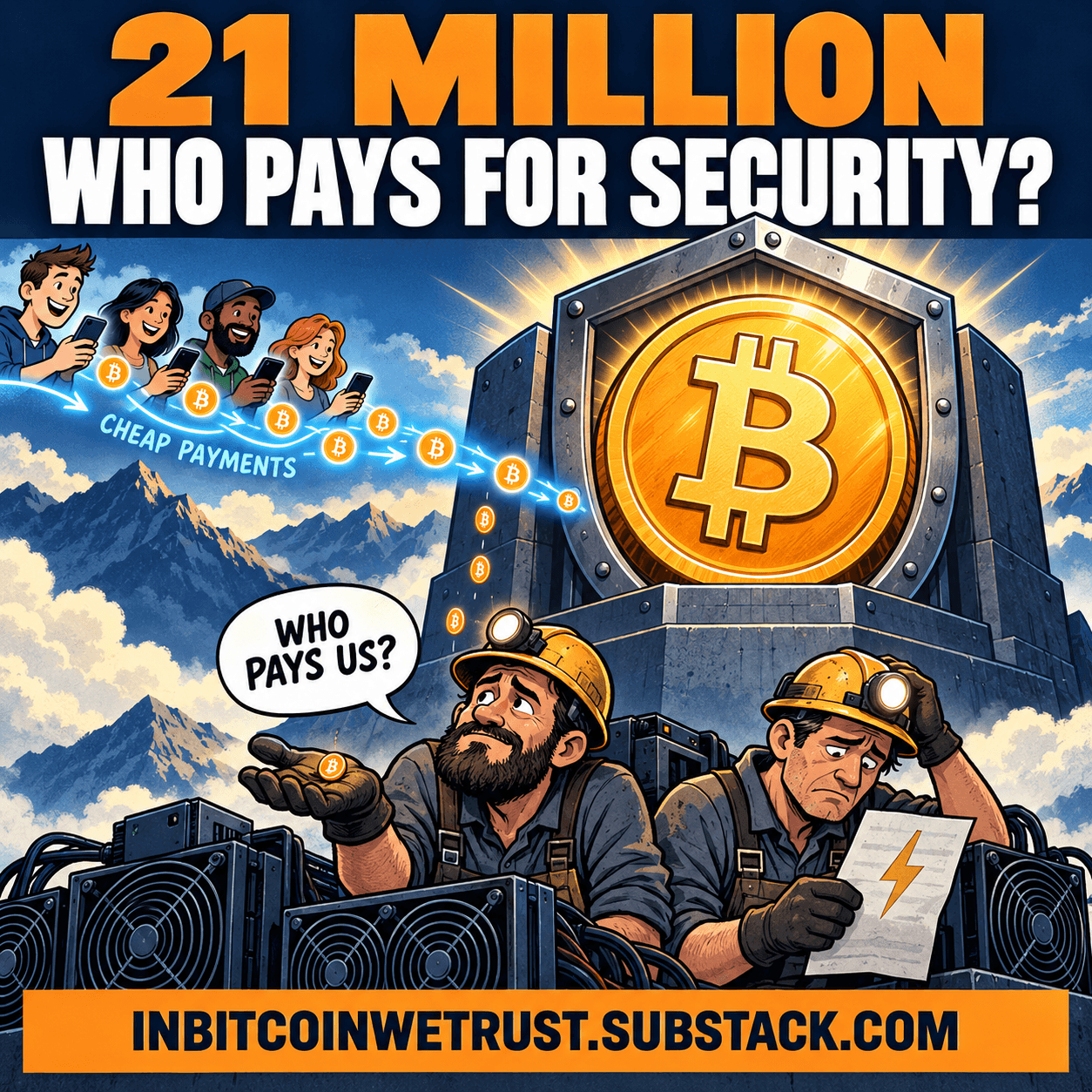
Imagine Bitcoin gets almost everything its supporters want.
Millions more people own it. Businesses build around it. Institutions treat it as a serious reserve asset. Wallets become easier to use. Lightning payments feel effortless. Brilliant developers find ways to fit more economic activity into less blockchain space.
The price rises. Adoption spreads. Transactions get cheaper.
Then someone asks an awkward question:
Who is paying the miners?
That question cuts straight through one of Bitcoin’s most comfortable assumptions. We tend to imagine that a more successful Bitcoin automatically becomes a more secure Bitcoin. More value attracts more investment, more users create more transactions, and transaction fees eventually replace the coins that miners receive through new issuance.
It is a plausible story. Its individual steps, however, are not mechanically connected. An investor can buy exposure to bitcoin without making an on-chain transaction. A payment network can process far more activity while using less blockspace per payment. A company can settle a larger balance without paying a proportionately larger mining fee.
Bitcoin could become more important to the world while its fee market remains surprisingly quiet.
The 21 million limit tells us how scarce bitcoin will be. It does not tell us how much people will pay to settle transactions with it.
Silicon Valley is begging for a ceasefire, but Donald Trump is slamming the gas. Inside the ruthless geopolitical arms race where second place isn’t an option.
That distinction becomes more consequential with every halving. Bitcoin deliberately reduces the issuance that supports mining. At the same time, its users and developers work to reduce the cost of using the system. Both ambitions make sense. Making them work together over decades is an economic challenge that slogans cannot settle.
The uncomfortable possibility is that some of Bitcoin’s greatest achievements could make that challenge harder. The encouraging possibility is that those same achievements could create an economy large enough to solve it. Understanding the difference matters much more than choosing a comforting prediction.
Start with the bill. Bitcoin mining consumes electricity, equipment, facilities, financing, maintenance, and human effort. Those resources have alternative uses. Operators keep committing them to Bitcoin because mining offers a prospective return, under conditions that vary enormously between businesses and locations.
The protocol supplies two principal sources of native mining revenue: newly issued bitcoin, called the block subsidy, and transaction fees. These are distinct components of the total block reward. Confusing them makes the long-term discussion harder to follow.
The current subsidy is 3.125 BTC per block. It halves every 210,000 blocks, with the next reduction expected around 2028. Calendar dates remain estimates because the schedule follows block height. ** Bitcoin.org’s halving reference** documents the current subsidy and the next scheduled reduction.
Following that schedule produces a simple progression:
By the approximate 2040 period, the subsidy will be one-sixteenth of its present size in bitcoin terms. Its dollar value will depend on bitcoin’s price. A smaller number of BTC can still buy more electricity and equipment if each coin appreciates sufficiently. The schedule alone therefore does not establish that mining revenue must decline in purchasing power.
It does establish that the source of funding changes. Under the existing rules, issuance eventually ends around 2140. Long before then, the remaining subsidy becomes small enough that fees could matter much more to mining economics. ** Bitcoin.org’s explanation** describes that intended transition.
Waiting until 2140 to discuss it would miss the point. Mining businesses invest, borrow, replace equipment, and sign contracts throughout the intervening decades. Their decisions respond to expected income, including the possibility that future halvings arrive without a strong fee market to absorb the change.
Satoshi anticipated the transition. Section six of the ** Bitcoin white paper** describes transaction fees taking over the incentive after the predetermined issuance has entered circulation.
There is nothing embarrassing about acknowledging this. Every durable economic system depends on behavior that cannot be fully specified in advance. Bitcoin makes its monetary rules unusually explicit. The willingness of future users to buy settlement remains a market outcome.
To understand that market, forget the price chart for a moment and picture the next block. Users are competing for a limited resource: the ability to have valid transactions included. When many transactions are waiting and inclusion is urgent, bidders have a reason to offer more. When space is readily available, that pressure weakens.