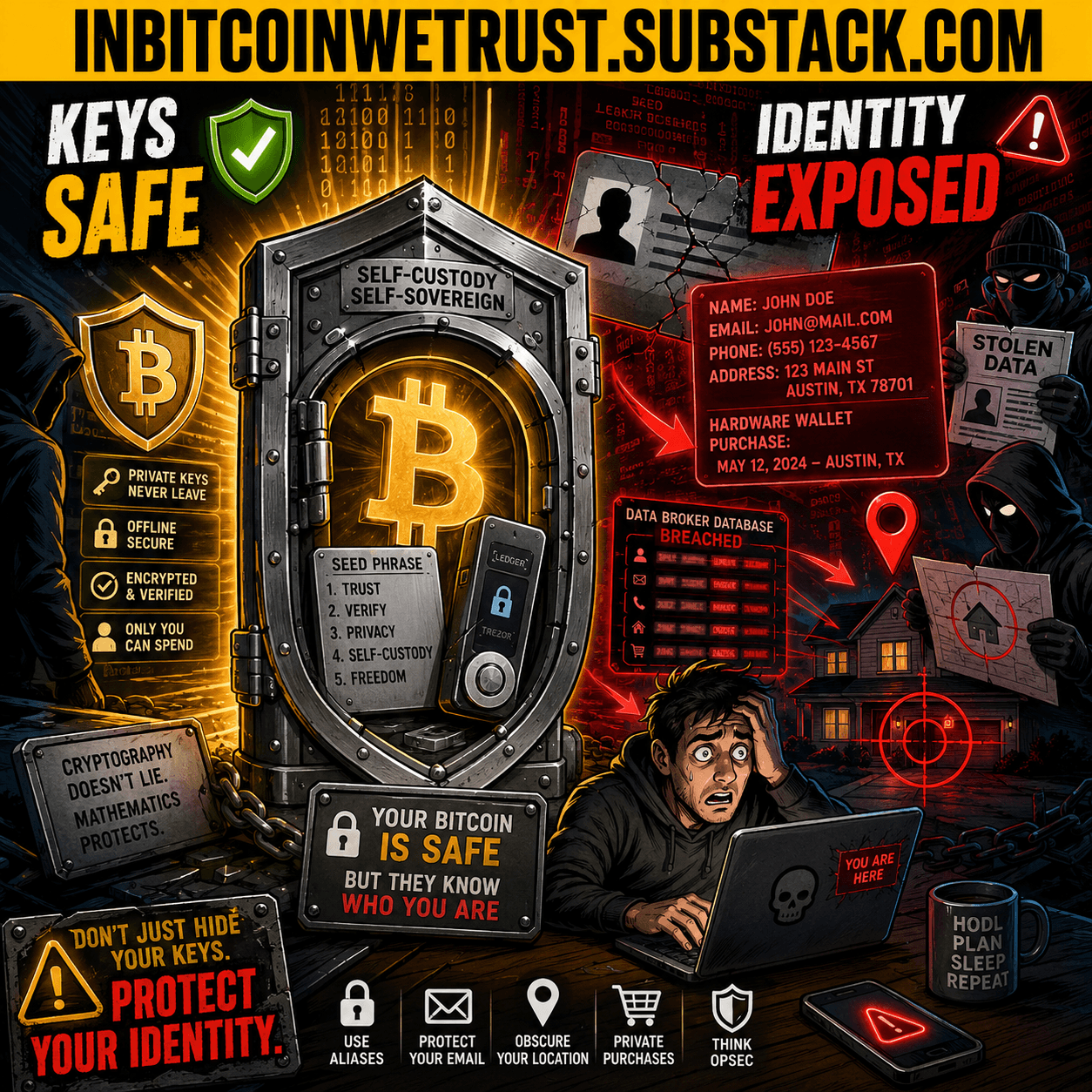
Bitcoiners have spent seventeen years obsessing over one thing:
Protect your private keys.
Generate your seed offline. Buy a hardware wallet. Never photograph your recovery phrase. Never store it in the cloud. Use multisig. Verify addresses on-device. Avoid phishing. Keep your firmware updated.
Self-custody became almost a religion.
And for good reason.
If you control your keys, you control your Bitcoin.
But something uncomfortable is happening.
Attackers are increasingly learning they don’t need to break Bitcoin. They don’t need to crack SHA-256. They don’t need to guess your seed phrase. They don’t even need to hack your hardware wallet.
They may only need to learn one thing: who you are.
Your name. Your email. Your phone number. Your home address. The fact that you purchased a hardware wallet. Maybe the model. Maybe the date. Maybe your IP address. Maybe the exchange where you bought your BTC.
Suddenly, the strongest cryptography in the world is sitting behind something far weaker.
A human being.
At a known location.
And that may be the next great security crisis in Bitcoin.
The silent divorce of accounting from settlement — and how the infrastructure designed to save American financial hegemony is quietly planting the seeds of its own obsolescence.
The traditional Bitcoin security model was digital.
You worried about malware, exchange hacks, seed theft, clipboard attacks, phishing websites, and malicious wallet software.
The solution was straightforward:
Get the Bitcoin off the exchange. Put it into cold storage. Keep your seed private.
Problem solved.
Mostly.
But Bitcoin has changed.
Someone who bought a hardware wallet ten years ago may have been protecting $5,000. Today, the same wallet might secure $500,000.
Or $5 million.
That changes attacker incentives dramatically.
When the prize gets larger, criminals can afford to become more sophisticated.
And sophistication does not necessarily mean better cryptography.
Sometimes it means better intelligence.
Who owns Bitcoin? Where do they live? Who are their relatives? Where do they work? Which phone number do they use? Which hardware wallet did they buy? When are they usually at home?
This is not a cryptographic attack.
It is an identity attack.
And Bitcoin’s success is making it more attractive.
Think about how extraordinary Bitcoin security actually is.
A properly generated private key is effectively impossible to brute-force with current computing capabilities.
That is a remarkable achievement.
But what protects the fact that you own that private keys?
Maybe a database.
A customer-support platform. A marketing company. An ecommerce provider. A shipping company. A cloud service. A hardware-wallet manufacturer. An exchange. An email provider. A tax database.
One weak vendor can expose information that transforms a random Bitcoin holder into a target.
That is the asymmetry.
Bitcoin may require astronomical computational power to attack directly. A poorly protected customer database might require one stolen password.
Recent disclosures around SafePal make the problem brutally clear. The company said an unauthorized party gained access to information associated with tens of thousands of customers.
The exposed information reportedly included details such as names, email addresses, phone numbers, shipping information, and purchase-related data.
SafePal said private keys, seed phrases, and passwords were not compromised.
From one perspective, that is good news.
The Bitcoin or crypto itself was not stolen. The wallets remained cryptographically secure.
But from another perspective, this is exactly the problem.
Imagine receiving a database containing:
Name: John Smith
Address: 17 Example Street
Phone: +XX...
Purchase: hardware wallet
You still don’t have John’s seed.
But you know something potentially much more useful:
John probably owns crypto. And you know where John lives.
That is not a theoretical security issue.
That is actionable intelligence.
The mistake would be to make this article about one company.
It isn’t.
Different wallet providers have experienced different types of incidents over the years, some directly and some through third-party service providers.
The important point is structural.
Hardware wallet companies must operate in the ordinary internet economy. They sell products. They process orders. They answer customer emails. They ship devices. They use analytics. They use support platforms. They sometimes rely on external logistics and marketing services.
Every service creates another place where information can exist.
And every copy of that information creates another potential breach.