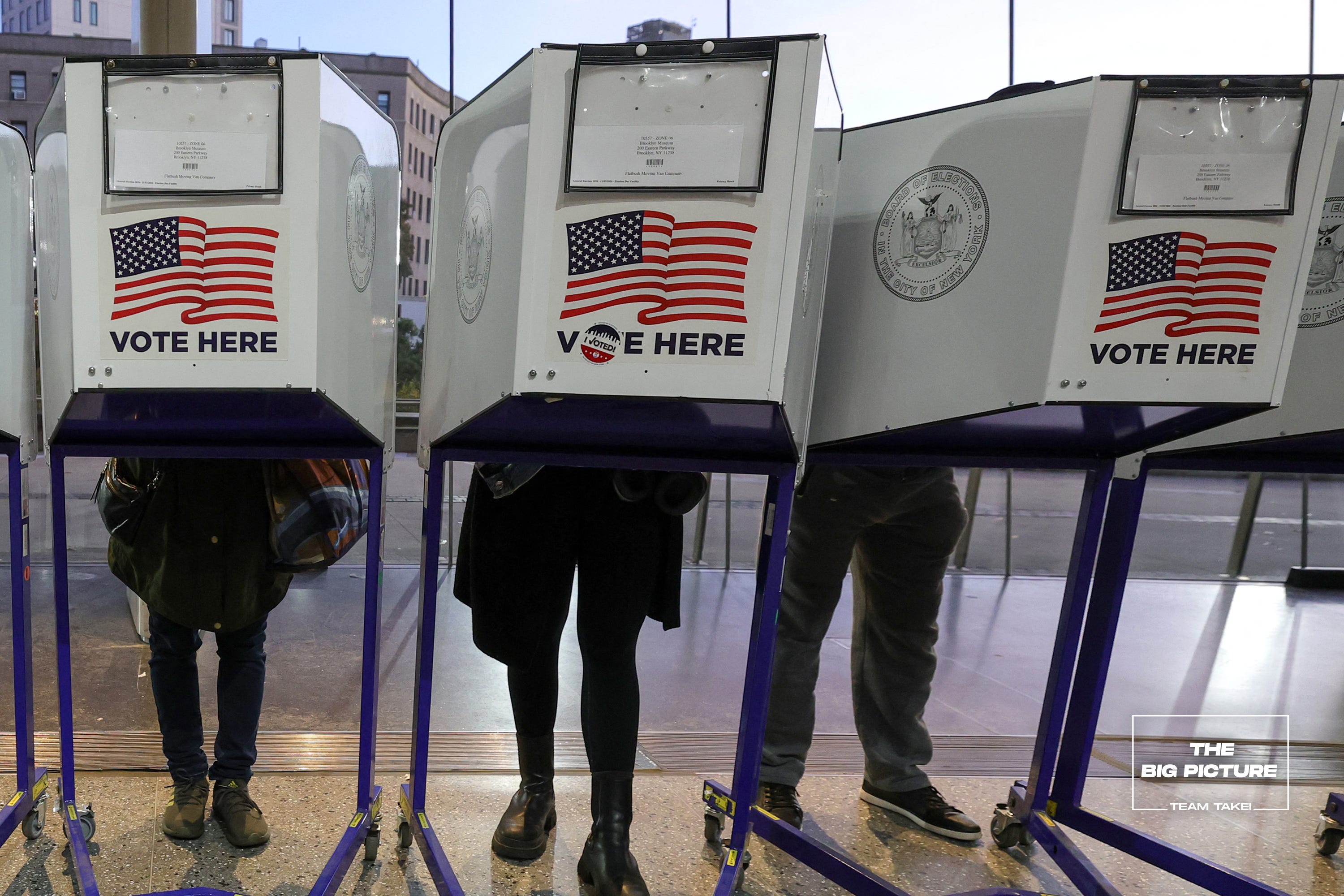
The question on everyone’s mind today is simple: a Blue Wave is coming, but how big will it be? Many of us will be glued to our screens as the returns come in, trying to make sense of it in real time, short of mind-melding with Steve Kornacki.
I have the same basic question as everyone else. Rather than offer predictions, I want to share what I will be looking at tonight, including when, in which state, and even in which district, to get a read on what kind of night it will be for Democrats.
The forecasters have done their part. The Cook Political Report ended the cycle with Democrats favored in 222 seats, 18 toss-ups still on the board, and a projected majority between 227 and 240. Decision Desk HQ puts Democrats’ odds of winning the House at 84 percent and the Senate at 65 percent. Inside Elections sees a gain of 20 to 30 House seats and four to six in the Senate.
A 227-seat majority and a 240-seat majority are very different governments; the bigger one leaves less power to spoilers or factions. The Senate majority comes down to a handful of Republican-held seats the forecasters call coin flips, in Alaska, Kansas, Iowa and Ohio. Democrats must hold Michigan and hope to be rid of Sen. Susan Collins for good in Maine. The spread between a good night and a historic one will unfold early in the evening, following the order of poll closings and the speed of the count.
The fastest-counting states are bunched in the Eastern and Central time zones, and by 10 p.m. ET Florida, Georgia, Virginia, North Carolina, Ohio, Kentucky, Indiana, Kansas and most of Texas will have reported the bulk of their votes. Pennsylvania, Michigan, Arizona, Nevada and California will still be counting, some for days.
My advice: Ignore who is ahead in the early race calls. Instead, watch a few bellwether counties as they report and compare their 2026 margins with those in the 2024 presidential race.
That gap will be the telltale signal. It gets around two election night traps: (1) the early Republican lead in states that report their rural counties first, and (2) the early Democratic lead in states that post mail ballots first. It also works in states where no seats change hands at all.
Florida, which reports very early, is a good example. Trump carried the state by 13 points in 2024, and the legislature redrew the map this spring so that Harris would have carried only four of 28 congressional districts, down from eight under the old lines. In 2026, a Democrat holding a seat in a district that Trump won by 11 points signals a double-digit swing, and a Democrat losing that seat by just one point means nearly the same thing.
The shifts are the real story. The flips are just the scoreboard at any given moment, and that means little until the West Coast weighs in. Indeed, the racially gerrymandered South will post House numbers that could make it seem for much of the night that we are behind in the race to the majority.
Don’t be fooled. Track the spread! I will use three basic benchmarks:
A modest blue wave means Democrats land near 227 seats, a gain of roughly 9-12 seats.
A solid blue wave means a gain of 15-20, sweeping the toss-ups and picking up a few seats the GOP expected to hold, along with a Senate majority of one or two.
A blue tsunami means a gain of 25 or more House seats and Senate pick-ups in several deep-red states for a 53-47 or larger Democratic majority.
Let’s dive in!
Election coverage like today is made possible for all of our readers by the support of our paid subscribers. If you’re able to, consider upgrading to a paid subscription today to help support independent media during this critical time.
Neither Kentucky nor Indiana is in play as a state, so why do we even care what those early returns show? Trump romped in both states in 2024, carrying Kentucky by 31 points and Indiana by 19.
Again, it comes down to the spread. Both states count fast and close early, so these are the first real numbers of the night. I’m looking at two seats in particular.
KY-06: Zach Dembo (D) vs. Ralph Alvarado (R), open seat
Kentucky’s 6th District, centered on Lexington, is open because Rep. Andy Barr is running for the Senate. Trump carried it by 15 points in 2024, and Barr won it by about 26. Solid red, right? Maybe not.
The Republican candidate, Alvarado, is a physician and former state senator who won his primary with Trump’s endorsement and then removed references to the president from his campaign website. Awkward. Democrat Dembo, a former military lawyer and federal prosecutor endorsed by Gov. Andy Beshear, has run on cost of living, Medicaid cuts and corruption, warning in the candidates’ only debate that six rural hospitals in the district are at risk. Despite the past GOP landslides in KY-06, both Cook and Inside Elections now call the race a toss-up.
The county to watch is Fayette, which is essentially Lexington. In 2024 Harris carried it 58 to 40, while Barr lost it by a far narrower two points. The formula for a Republican win across KY-06 is simple: Lose Lexington by just a little and win everything around it by a lot. Alvarado will try to do exactly that, while Dembo will try to run up the numbers in Lexington and win over more rural voters.
My Kentucky takes:
A Democratic loss in KY-06 in the mid to high single digits reads as a modest blue wave nationally.
A KY-06 squeaker, whether loss or win, reads as a solid blue wave.
A Democratic win by more than five points, in a seat Republicans have held since 2012, is a “whoa.” We’d be in blue tsunami land.
IN-05: Victoria Spartz (R) vs. J.D. Ford (D)
Spartz, a Ukrainian-born accountant first elected in 2020, is seeking a fourth term in a district that stretches from the Indianapolis suburbs to the factory towns of the northeast. Democrats smell opportunity; Spartz won her 2024 primary with under 40 percent of the vote, and their candidate J.D. Ford (I call him the openly gay J.D.) is a state senator and the first openly LGBTQ+ member of the Indiana General Assembly. Ford has run on grocery, utility and gas costs. Spartz won in 2024 by 57 to 38, but on Oct. 30 Cook Political downgraded Spartz’s odds from Likely Republican to Lean Republican.
Notably, this district was redrawn after 2020 to shore up Spartz, and until this fall it was widely considered a safe Republican seat. How quickly things change.
The county bellwether is Hamilton, the district’s suburban heart and one of the first suburbs in the country to report tonight. Trump won it 52 to 46 in 2024, essentially unchanged from 2020. Watch whether it flips blue, and by how much.
My Indiana takes:
If Ford overperforms or narrowly wins Hamilton, while Spartz holds IN-05 on rural strength, that’s a sign of a modest blue wave.
Ford carrying Hamilton by five or more points would signal a solid blue wave nationally.
Ford winning Hamilton by a lot and winning IN-05 overall would be like watching the waters recede from the GOP beach as a blue tsunami prepares to crash ashore.
Florida is Trump’s home state and the unofficial capital of MAGA America. He won it by 13 points two years ago, and the legislature redrew the congressional map this spring to make sure the state delegation reflects that.
Nobody expects Florida to turn blue tomorrow. The question is how much it feels the pull of the wave.
One reason I’m following Florida closely is that it is the among of the big states to close its polls and the fastest to count. By law, county supervisors must report the early and mail ballots they’ve counted within 30 minutes of polls closing, and in 2024 about 84 percent of the statewide vote was in by 8 p.m. ET. Democrats are defending seats drawn for them to lose, so I’m watching mostly how much ground they make up despite the gerrymanders. There are many races to follow, but for simplicity I picked two. Both are in districts that voted for Trump by about the same margin as the state as a whole.
FL-14: Kathy Castor (D) vs. Mike Beltran (R)
Castor has represented Tampa since 2007, and the new 14th District would have gone for Trump 55 to 44. Republican Mike Beltran, an attorney and former state legislator, has said Tampa Bay has “precious little to show for Kathy Castor’s two decades of incumbency.” Cook calls the race a toss-up—in a Trump +11 district. Quite telling!
Castor’s district sits entirely inside Hillsborough County, which went for Biden by seven in 2020 and Trump by three in 2024, so the county’s swing is the best real-time read on her race overall. To hold the seat, Castor has to win voters who went for Trump two years ago. We should know within an hour of polls closing whether she’s on track.
FL-22: Pia Dandiya (D) vs. Casey Askar (R), open seat
I like this district as a test case because there’s no incumbent on the ballot. That strips away factors like name recognition and leaves a Democrat and a Republican on level ground. The 22nd District used to be Democrat Lois Frankel’s Palm Beach County seat, but the redrawn map moved so much of it that Frankel is now running next door in FL-23. What’s left stretches across four counties from the Atlantic coast to the Gulf Coast, and Trump carried it by about 11 points after Biden won the same turf by three.
Democrat Pia Dandiya, a former teacher and principal, has run on cost-of-living issues. Askar, a businessman who enlisted in the Marines at 18, has Trump’s endorsement. In September, Cook moved the race from Lean Republican to Toss-up.
Fun side note: Palm Beach County as a whole, the anchor of the new FL-22, went from a comfortable Biden win in 2020 to a near-tie in 2024, when Harris carried the county by about 5,500 votes. The district is redder than the county because the new lines add Republican territory to the west. Palm Beach is also where, if you recall, Democrat Emily Gregory flipped a state House seat that includes Mar-a-Lago in March’s special election. Trump had carried that much smaller district by about 10 points two years earlier. Special elections like that one were telling us something, but how loudly won’t be clear until the general election results tonight. Special elections draw small, motivated electorates, while a midterm draws high-propensity partisan voters in far greater numbers. If Dandiya is running anything like Gregory’s pace in the Palm Beach part of FL-22, the special elections were a preview of what was to come. If she’s running closer to Harris’s 2024 numbers there, they overstated the swing.
My Florida takes:
A modest blue wave has Castor losing FL-14 by five or fewer points, and Askar still narrowly taking FL-22. Two tough losses, but again, it’s the spread against 2024 that matters.
A solid blue wave would be the happy flip of this: Castor winning FL-14 and the FL-22 going to Dandiya, both by low single-digit margins.
A blue tsunami would wash both seats into the blue column by five or more points. I’d be stunned. In a good way, but stunned.
Virginia has drifted Democratic for two decades, and last year’s governor’s race, which Abigail Spanberger won by double digits, suggested the drift had become a roaring blue river. Two of its Republican-held House seats sit in the kind of suburban territory where the 2026 election will be decided nationally.
Virginia counts quickly, but the statewide number has a history of arriving late. In 2020, who can forget how Trump led for five hours until Fairfax County finally reported roughly 400,000 votes after midnight?
That happily won’t be a problem today. The two districts below are nowhere near Fairfax, so their results will come in steadily through the evening. Sen. Mark Warner’s race is safely Democratic, so I’ll be watching only the House here. Trump and Harris split one of these districts, and Trump carried the other by five; together they show how far into Republican territory the wave reaches.
VA-02: Jen Kiggans (R) vs. Elaine Luria (D)
This one is a rematch—and a personal one. Republican Jen Kiggans, a former Navy helicopter pilot, unseated Democrat Elaine Luria by about 3.4 points in 2022. She then held the seat by four in 2024, in a district Trump and Harris split almost evenly. Luria, a Navy veteran who held the sea…