I predicted back in May that the bond market would “break” Washington. Last week we saw signs of that with the Treasury’s increased intervention at the long end of the curve.
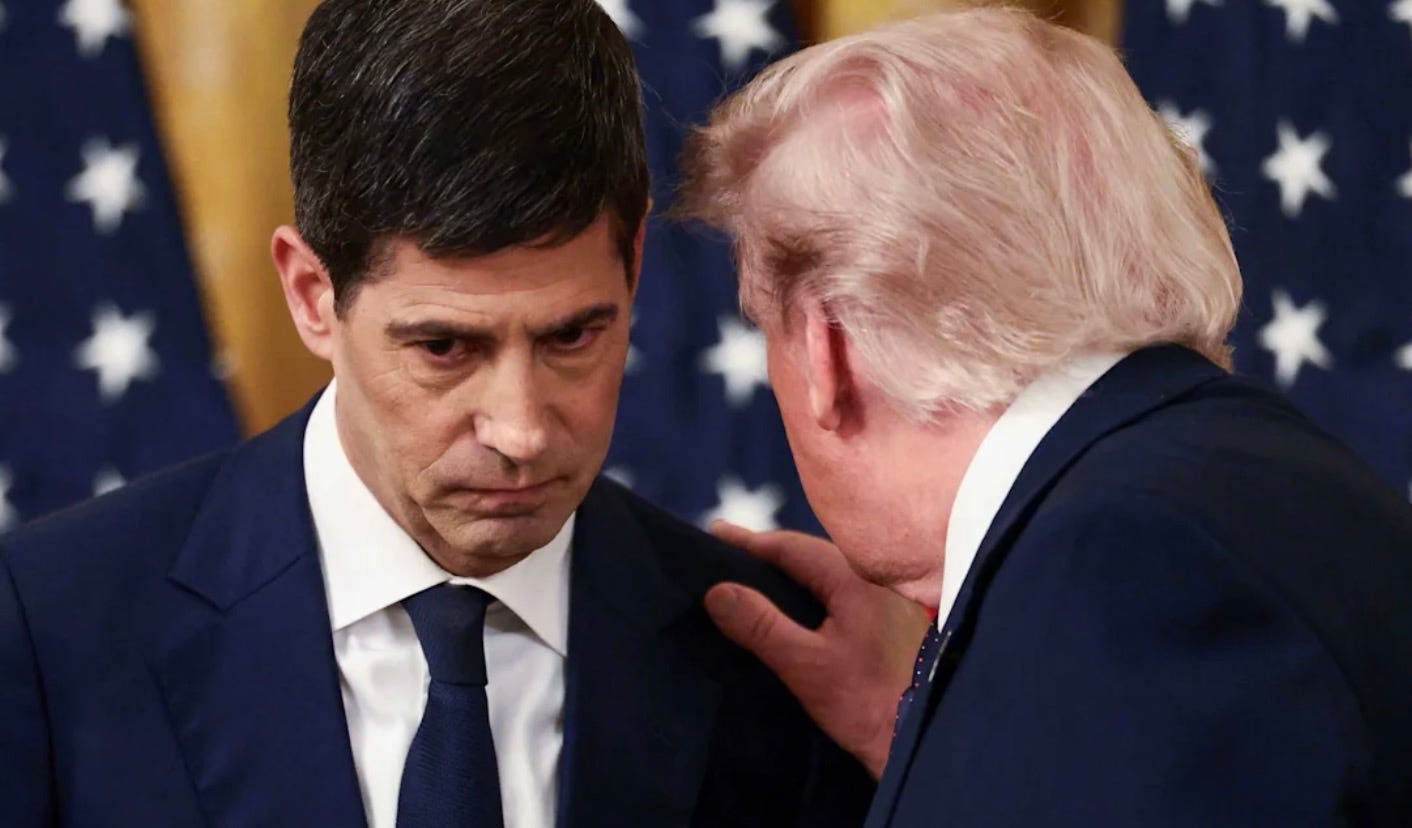
With Treasury already panicking, I expect bonds to “break” the Fed next and the first signs to show up at Jackson Hole this Friday (assuming we can make it until then). Already, the Treasury market spent much of last week making it abundantly clear that Kevin Warsh’s honeymoon as Federal Reserve chairman is over.
The 10 year yield climbed toward 4.74%, while the 30 year briefly pushed above 5.3%, reaching levels not seen since before the financial crisis.
Even after Treasury Secretary Scott Bessent announced plans to at least double certain long dated bond buybacks, yields merely retreated from their most alarming levels rather than signaling that the underlying problem had disappeared. That underlying problem, of course, is now $40 trillion in debt and reckless fiscal spending.
That’s why as of Monday morning, the 10 year was still around 4.71% and the 30 year near 5.25%, leaving the long end of the Treasury market shaky, unconvinced and very much in charge.
I have always said that the Federal Reserve will have a spine right up until the moment it can no longer afford one. There is an old market saying that markets stop panicking when the Fed starts panicking, and there is more truth embedded in that sentence than in most economics textbooks.
Central bankers can talk about discipline, credibility and price stability for as long as financial conditions remain orderly, but when the bond market begins threatening the federal budget, the housing market, equity valuations and the plumbing of the financial system simultaneously, the definition of “responsible monetary policy” tends to become much more flexible.
That is why Warsh’s first Jackson Hole speech as Fed chairman, scheduled for Friday, August 28, could be so important. He is scheduled to speak at 10:00 a.m. Eastern time, 3:00 p.m. in Dublin. Arguably this speech will be the most consequential guidance he’ll give the market since assuming his role.
Every single word will be paid attention to. If Warsh chooses a bagel over his regular flapjacks for breakfast, that will be analyzed. His tie will be analyzed. The number of bathroom breaks he takes will be international news. The market, now begging for reassurance, will be looking for anything optimistic to cling to.
Jackson Hole gives Warsh an opportunity to recalibrate expectations between formal Federal Reserve meetings without explicitly announcing a policy change or committing the central bank to a particular rate path. He does not need to promise a rate cut, restart quantitative easing or unveil yield curve control. He merely needs to acknowledge that higher long term yields are tightening financial conditions, recognize that inflation can continue moving lower without another increase and suggest that the Fed remains prepared to respond if stress in financial markets begins threatening the broader economy.
In other words, he can become more dovish without ever using the word “dovish.”
The Wall Street Journal spent much of its Sunday podcast previewing precisely why the speech carries so much weight. The Journal’s chief economics correspondent, Nick Timiraos, said the consensus after Warsh’s July press conference was that his “tight-lipped, less-is-more strategy” had not paid off. Warsh has not merely stopped promising what the Fed will do next. He has also been reluctant to explain how he views the economy, why the Fed held rates steady in July and how he weighs the trade-offs facing policymakers. That information vacuum has left market participants (in the bond market, at least) unsettled not only by what Warsh has said, but by what he has refused to say.
On the podcast, Fed governor Frederic Mishkin argued that persistent inflation and an economy operating near full employment could justify a more hawkish posture. But the discussion nevertheless also laid out several reasons why I think Warsh may use Jackson Hole to soften the message and calm the long end of the bond market.
Timiraos noted that other Fed officials have already articulated a credible “show me the money” case for waiting. Wage growth may still be consistent with 2% inflation, and Governor Christopher Waller has argued that inflation could continue declining without another rate increase. Warsh could embrace that theory without abandoning the Fed’s inflation target, giving the bond market a reason to believe that the chairman is not eager to compound the tightening already being delivered by long term yields.
Warsh has already argued that higher market yields may perform some of the Fed’s work for it. That position has created an obvious communications problem because Warsh previously cited falling yields as evidence that markets considered the Fed credible, only to characterize rising yields later as helpful tightening that might reduce the need for Fed action. He cannot indefinitely claim that every possible movement in yields validates his policy.
Jackson Hole gives him a chance to resolve that contradiction by acknowledging that the rise in long term borrowing costs has materially tightened financial conditions and therefore reduces the urgency of another rate increase.
And the political reality remains impossible to ignore. Mishkin described Warsh as an exceptionally skilled political operator and suggested that he may be able to serve as something of a “Trump whisperer,” insulating the Fed from some of the president’s pressure. But Donald Trump wants lower interest rates, the Treasury Department is visibly uncomfortable with long term yields above 5% and Bessent has already shown his hand by expanding long dated bond buybacks. Trump recently moved some of his portfolio to shorter duration bonds, as I wrote this weekend.
Warsh may be more independent than Trump hoped, but independence does not require him to drive the Treasury market through a plate-glass window simply to prove that he possesses it.
The discussion concludes by noting that Warsh has talked about shrinking the central bank’s balance sheet, but that becomes much more difficult when the 30 year yield is around 5.3% and the Treasury secretary is simultaneously attempting to remove duration from the market through larger buybacks. Selling duration into that environment would be the monetary equivalent of throwing gasoline onto a fire that Washington has just begun trying to extinguish.
This supports a theory I have held for a while: eventually, the bond market will force Washington’s hand.
With the way we are heading, it’s simple: the United States can attempt something resembling a hard default through austerity, deflation, collapsing asset prices and the politically impossible fiscal adjustments required to honor its obligations in sound money. Or it can pursue a soft default by suppressing interest rates, tolerating inflation, weakening the dollar and repaying creditors in currency that purchases less than it did when the debt was issued. The former…just will never happen…I’m sorry. The latter…is the “easy” way out.
Given those choices, I have never believed that any modern Federal Reserve chairman, including Kevin Warsh, would voluntarily choose the hard route once the consequences became sufficiently severe. Warsh may tolerate higher yields for a while, and he may even welcome some additional tightening as evidence of his inflation-fighting credibility, but there is a level at which the fiscal arithmetic, equity market and financial system will force a change in posture. The only serious questions are where that level sits and how much damage policymakers permit before acknowledging it. It’s why I wrote that Warsh had an “impossible” job when taking over for Jerome Powell.
That is also why I continue to believe some form of yield curve control may eventually arrive. It probably will not initially be called yield curve control, of course. It will be presented as a temporary liquidity operation, a Treasury market-functioning program, an adjustment to balance-sheet composition or an effort to improve the transmission of monetary policy (and it’ll have some stupid name or acronym, as discussed last week). The vocabulary will be carefully chosen, but the objective will be straightforward: prevent long term government borrowing costs from rising to a level the federal government and financial system cannot tolerate.
Given my analysis, Washington’s unmatched record of bipartisan cowardice and the nation’s long-running streak of chickenshit monetary policy, there is a case that the long term trade remains gold, gold miners, silver, silver miners and nearly anything with a finite supply that cannot be conjured into existence by a committee in Washington.
This includes well-selected real estate and other scarce tangible assets, although valuation and financing costs obviously still matter. Gold is already trading around $4,600, so a move toward $5,000 would no longer require a grand monetary revolution. A sufficiently dovish Warsh speech, combined with Treasury’s increasingly visible attempts to contain long term yields, could be enough to put that level squarely back into play.
If Warsh stays hawkish at Jackson Hole, refuses to acknowledge tightening financial conditions and leaves the possibility of another rate increase on the table, I think all hell breaks loose. In that case, scarce assets could be hit alongside everything else in the short term. A genuinely hawkish Fed confronting a 30 year Treasury yield above 5% could also be the catalyst that finally pops the AI bubble, forcing investors to deal with an equity liquidation before the eventual monetary response arrives.
But that would not necessarily invalidate the hard-asset thesis. It might merely delay the payoff and create a much uglier path toward the same destination. A sharp equity decline, widening credit spreads and deteriorating Treasury liquidity would eventually increase the pressure on both the Fed and Treasury to intervene, perhaps far more aggressively than they otherwise would have.
That leaves Warsh with two broad choices this week. He can remain hawkish, risk popping the AI bubble and test how much pain a heavily indebted economy can withstand (not much). Or he can begin capitulating, validate Washington’s growing discomfort with long term yields and potentially send gold soaring higher.
Either way, we are about to be reminded who the real boss is. It is not Donald Trump, Scott Bessent or Kevin Warsh. It is the bond market.
QTR’s Disclaimer**:** Please read my full legal disclaimer on my About page here.
This is not a recommendation to buy or sell any stocks or securities, just my opinions. I often lose money on positions I trade/invest in. I may add any name mentioned in this article and sell any name mentioned in this piece at any time, without further warning. None of this is a solicitation to buy or sell securities. I may or may not own names I write about and are watching. Sometimes I’m bullish without owning things, sometimes I’m bearish and do own things. Just assume my positions could be exactly the opposite of what you think they are just in case. If I’m long I could quickly be short and vice versa. I won’t update my positions.
As of May 20, 2026 I am attempting to no longer actively trade as much as I once did ( read my story here). My eventual goal is for investing/saving to be mostly done by recurring contributions mostly to sector ETFs and a few select equities, trusted third parties who oversee my accounts, and advisors. Such advisors or funds, through individual equities, options, index funds, mutual funds, ETFs, or other securities, may have positions in, exposure to, or holdings of names mentioned herein that I know nothing about. Basically, via index funds, ETFs and individual equities it is possible I could own, have exposure to, or not own anything at any point. As of the same date, May 20, 2026, in an attempt to lead a healthier lifestyle, I’ve also excluded myself from fantasy sports, sports betting, online and in-person casinos and prediction markets.
And all positions can change immediately as soon as I publish this, with or without notice and at any point I can be long, short or neutral on any position. You are on your own. Do not make decisions based on my blog. I exist on the fringe. If you see numbers and calculations of any sort, assume they are wrong and double check them. I failed Algebra in 8th grade and topped off my high school math accolades by getting a D- in remedial Calculus my senior year, before becoming an English major in college so I could bullshit my way through things easier.
The publisher does not guarantee the accuracy or completeness of the information provided in this page. These are not the opinions of any of my employers, partners, or associates. I did my best to be honest about my disclosures but can’t guarantee I am right; I write these posts after a couple beers sometimes. I edit after my posts are published because I’m impatient and lazy, so if you see a typo, check back in a half hour. Also, I just straight up get shit wrong a lot. I mention it twice because it’s that important.