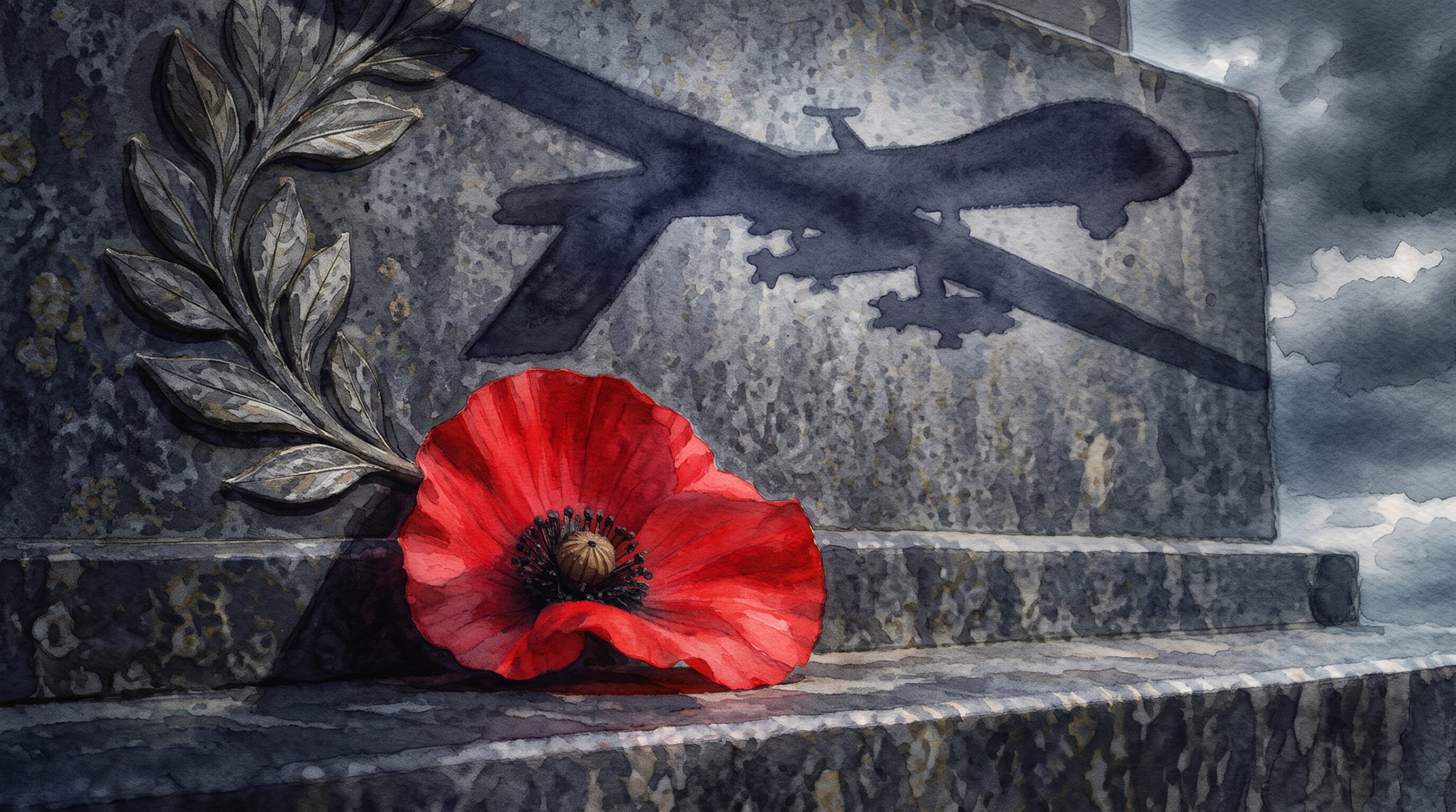
YORKSHIRE DALES, ENGLAND—This morning, on Armistice Day marking the end of World War I, an F-35 passed over me as I ran through country fields. In the spring of 1918, the famed war poet Wilfred Owen, soon to be killed in battle in France, was based at an army camp nearby in Ripon, in Yorkshire. Here, with vivid memories of what I have seen in Ukraine, reminders of wars are ever present.
We publish this newsletter every day at 9:05am NYC time / 4:05pm Kyiv.Your subscription fuels our work.
All of the UK has these past weeks been caught up in the act of “Remembrance.” Nearly everyone, from the Royal Family to gas station clerks, publicans to TV presenters, has been wearing red poppy pins to remember the war dead. On Remembrance Sunday, 8 November, veterans wore their service medals. On sidewalks and in pubs, I saw the visible manifestation of generations of service to Britain and the free world. Each medal a veteran pinned to his chest contained depths of memories painful, heroic, tragic, noble, patriotic, and personal.
Amid the pealing of bells, I watched a small Remembrance Sunday parade to Ripon Cathedral. I couldn’t shake the feeling of a darkening cloud spreading over Europe. Having lived in Ukraine through most of the full-scale invasion, I sense here in the serene British countryside that something wicked is approaching, as it was in Ukraine in the last months of 2021 and the first of 2022.
Some of my British veteran friends criticize the society-wide focus on wearing the poppies during these Remembrance weeks, saying it rings hollow: pomp and solemnity about the past while modern Britain, including its military, declines.
But I see hope in the fact of these Remembrance traditions: It means all is not lost. The embers are still alight. With so much else falling apart, the traditions serve to connect the nation. The key for the West to flourish, though, is to make Remembrance not an artifact but something present.
At Mass in a country chapel in Yarm on Remembrance Sunday, the priest said the English word “remembrance” does not do the idea full justice. He spoke about one Greek word: * anamnesis*. It is the word in the Greek version of the Gospel when Christ says at the Last Supper, “Do this in remembrance of me.”
True Remembrance means thinking about how we want to be remembered for our actions today. It means not just wearing a poppy, visiting graveyards, and keeping moments of silence, but learning the lessons of the past, so that we are strong and smart enough to keep its horrors from repeating.
Pete Hegseth, the US Secretary of War, is big on optics, on remembering past American heroes and glories. But he fails at true remembrance, at anamnesis. How do we know this?
Had Hegseth studied the arrogance of past American wars, he would have been wary of rushing into the Iran war. He would have been learning from the Ukrainians about modern warfare. He would have known that drones and electronic warfare have made our ideas of “air superiority” obsolete, a lesson learned lately, brutally, and swiftly when Iran answered with waves of drones and missiles throughout the Middle East on Saturday 28 February and beyond. Before striking Russian-allied Iran, he would have partnered with Ukraine’s defenders and engineers on the defense of the West, making US bases far harder for Iran to hit.
Precisely because Hegseth’s remembrance is the superficial sort that annoys my British veteran friends, he and the rest of America’s warring elite were not prepared. They did not remember the lessons of even the recent past.
But it’s not only the USA that fails to remember. For all the good the UK and Europe have done for Ukraine, Western leaders still live in denial-world, helping Ukraine stay afloat and conferencing about future reconstruction, but afraid of a decisive win, and too timid properly to arm themselves, and so allowing the Russian threat, with China behind it, to grow.
The British are perhaps the best in the world at remembrance ceremonies, but their military is fading. Its dwindling resources meant, for example, that after an Iranian-made drone struck a British air base in Cyprus in March, it took three weeks for the destroyer HMS Dragon to sail from Portsmouth and reach the eastern Mediterranean to defend it.
Remembering is the first step. Now, what do we do with that remembrance, and how do we make it alive today?
If we fail, we will be turning back to the poetry of Wilfred Owen, mourning an increasing and unnecessary loss of life, as in his “Anthem for Doomed Youth”:
What passing-bells for these who die as cattle?
— Only the monstrous anger of the guns.
Only the stuttering rifles’ rapid rattle
Can patter out their hasty orisons.
No mockeries now for them; no prayers nor bells;
Nor any voice of mourning save the choirs,—
The shrill, demented choirs of wailing shells;
And bugles calling for them from sad shires.
*JP Lindsley, an American journalist based in Ukraine, is co-founder and editor-in-chief of UnderFire.News. *
Under Fire News joins the Dzyga’s Paw charity to provide Ukraine’s Da Vinci Wolves 1st Assault Regiment with crucial life-saving equipment. This fundraiser’s goal is $10,000 out of our $250,000 overall target.
The funds collected—tax-deductible for U.S. donors—only go to the non-lethal parts of the fundraiser: drones to assist with essential recon, supply delivery, and evacuation to save lives and enable the Da Vinci Wolves to protect free people.
What else we’re watching today:
**Prisoner Swap Discussed in Abu Dhabi, as Territorial Disputes Loom—**Ukraine and Russia havediscussed a substantial prisoner exchange during renewed talks in Abu Dhabi, offering a possible humanitarian outcome from their first trilateral negotiations with Washington since February. President Volodymyr Zelenskyy described the November 10 session as constructive and substantive, identifying prisoner releases as a priority. Speaking separately in Denmark, he said potential exchanges of 1,000 or 1,500 prisoners on each side were under discussion.
Those figures were proposals, with no final terms or timetable publicly announced. Negotiators also examined security guarantees intended to prevent another Russian invasion, while territorial questions were scheduled for the second day. Washington is exploring NATO-like collective-defense commitments for Ukraine and seeking Moscow’s response. European representatives consulted American envoys beforehand and agreed to examine broader continental security arrangements as part of the process. Secretary of State Marco Rubio welcomed the discussions but cautioned that a settlement was not imminent.