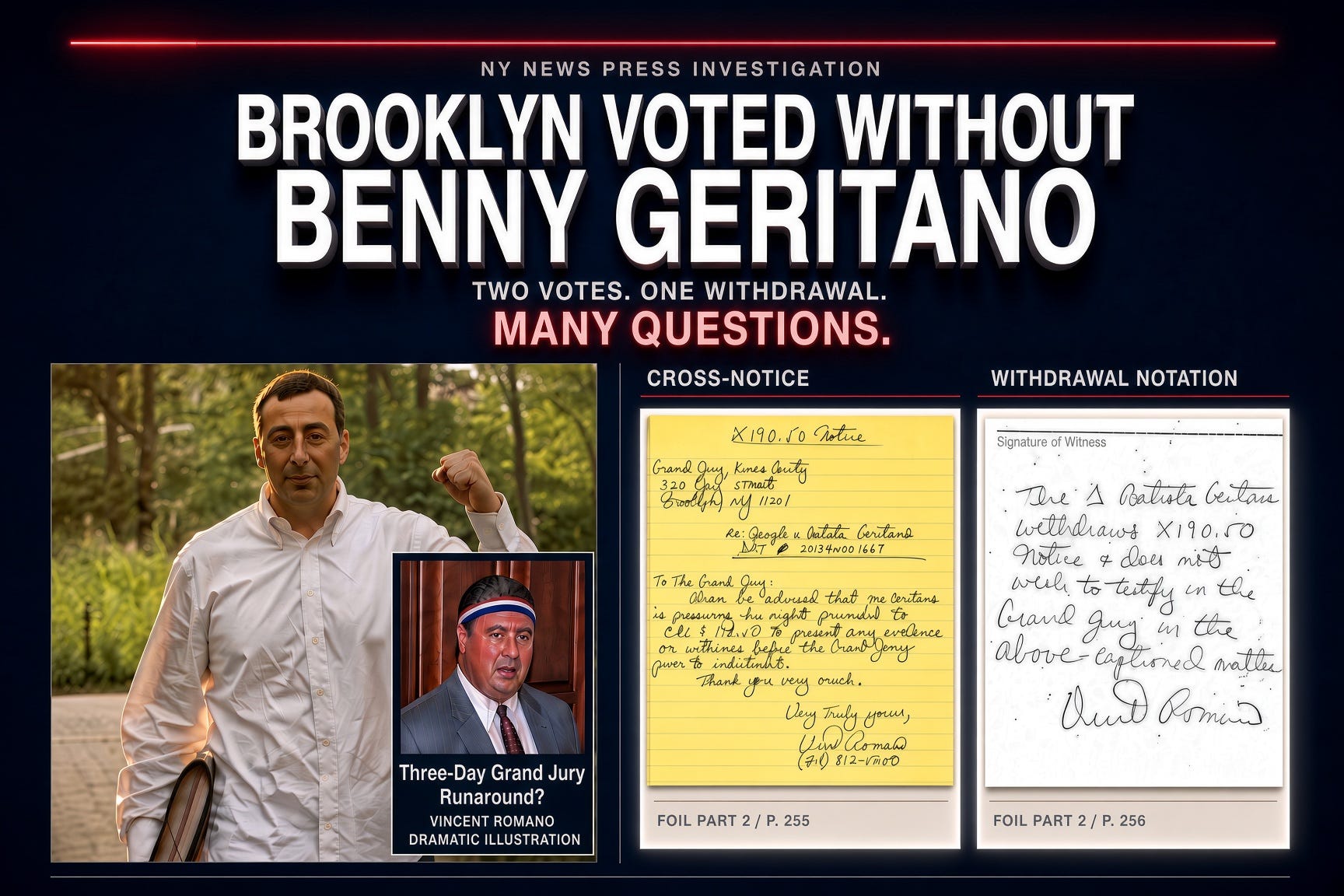
LUTHMANN NOTE: Brooklyn got twelve years out of Reformed Gambino Associate Benny Geritano. I’m asking the Kings County District Attorney’s Office for the time of day. The Government, adept at exaggeration, calls him “Benny the Blade.” The irony is that he says he was not the one with the knife at Club Nouveau in Bay Ridge. The old Joe Hynes crew had his cross-grand-jury notice. Attorney Vincent Romano swore he reaffirmed Benny’s wish to testify. When I put the withdrawal in front of him, he recognized his handwriting and signature. He says he would’ve had Benny’s consent. Benny says he never gave it. And the first vote and the withdrawal land on the same damn date, after three days of “the runaround.” These documents all come directly from a FOIL drop of the DA’s own files. When I’m being polite, I call those things irregularities. If George Carlin were still alive, he’d call them stunning bullshit. Eric Gonzalez, pull the logs. If your office voted while Benny was still entitled to speak and present witnesses with exculpatory testimony, move to vacate. Give him his say if Brooklyn goes again. Credit every day the law allows. Get the federal sentencing record on the table now. This piece is “Brooklyn Voted Without Benny Geritano,” first available on NY News Press.
BROOKLYN, NEW YORK. Nunzio Fusco knew who he’d fought. He couldn’t tell a jury who stabbed him. In the early hours of December 23, 2012, a fight at Club Nouveau on Third Avenue in Bay Ridge left him with two stab wounds to the abdomen. He later testified that three men were involved and that he didn’t know which one injured him.
His lineup identification put Battista “Benny” Geritano in the confrontation. The detective’s felony complaint had gone considerably further. Citing Fusco as his source, it said Geritano stabbed him twice in the stomach and slashed his shoulder.
Read the complaint and then Fusco’s testimony. There’s a whole prosecution in the distance between those pages.
The Brooklyn criminal justice machine had the man the tabloids called “Benny the Blade.” Geritano had pleaded guilty in 2004 to federal racketeering and bank-burglary conspiracies and was on supervised release when Fusco was stabbed.
In 2011, his name had made the papers over a separate knife fight involving Lucali owner Mark Iacono. That case was dropped after neither man cooperated.
In our March investigation, * Benny the Blade Battles Everybody*, Pressman and Luthmann followed the video and the witnesses behind the Nouveau conviction.
In * Benny No More*, this outlet reported on the man who describes himself today as a
The state’s own January 7 statement notice records his account of seeing the fight, picking up a knife, and handing it to someone. Club security chief Thomas Turner later told defense lawyer Vincent Romano that he personally saw Geritano pick it up from the floor. There was footage of what looked like a knife in Benny’s hand in the vestibule. There was no footage of the stabbing itself. Detective Brian Meyers preserved the vestibule view. The other downloaded views from inside and from the sidewalk were erased or overwritten. A trial judge told jurors they could draw an adverse inference. They convicted Geritano of attempted first-degree assault inside the club and third-degree weapon possession in the vestibule. Brooklyn got twelve years. Turner’s January 24 email, FOIL Part 4, p. 53 · The judgment on appeal
In * Brooklyn Still Owes Benny Geritano*, this outlet reported what came out of a 1,065-page FOIL production from the Kings County District Attorney’s Office. Now put yourself in the courthouse
On November 14, Luthmann interviewed Romano, prepared to ask whether Romano had sold Benny down the river; the Feds made it clear how Benny feels about Albert Brackley. Romano maintained he did not. He was adamant he was interim counsel, had gone to the club himself, lined up witnesses, and spent time preparing Geritano.
“We tried,” he said. “We, we, 100%, we tried to get witnesses and, and him in.” When I asked whether he withdrew Benny’s notice, his first answer was no, to the best of his recollection thirteen years later. I sent him two pages from the DA’s file while we were still on the phone. He recognized the yellow notice he scrawled on a legal pad and handed it to the ADA. (It’s actually common practice in New York State’s criminal courts, which, especially in the past under D.A.s like Joe Hynes, could operate like a zoo.)
Then he looked at the writing below the blank signature line on the other page. “That’s my handwriting. That’s my handwriting. That’s my signature.”
Romano’s February motion, obtained as part of the Kings County District Attorney’s file, showed what really happened.
Benny wanted to testify before the grand jury.
The entire Romano affirmation describes how the Kings County DA’s Office and ADA Gregory Basso spent DAYS giving Romano and Geritano the “run-around” on their witnesses, the exculpatory testimony, and the cross-grand jury notice. The grand jury never heard any of it; while the witnesses disappeared, the vote came back to indict, and Benny was whisked back to Rikers Island, never having said a word. Benny is adamant he never withdrew the notice, was never told, and nothing in the Kings County District Attorney’s files shows that he consented or was even aware of any purported withdrawal.
“If there was a 190-50 withdrawal, it was 100% with Benny’s consent.” He said this before examining the withdrawal on the call, describing how he handled decisions with Geritano.
“That’s my handwriting. That’s my handwriting. That’s my signature.” After seeing the document, he recognized the lower notation and signature. Asked whether he recalled the episode, he said he did not.
“If that’s the case, then he must have.” Romano’s response when asked whether Geritano had withdrawn the notice. Geritano disputes that he authorized it.
Romano says someone else wrote the caption at the top of the “Waiver of Immunity.” His own writing at the bottom names Geritano. The lower note is an authentic piece of the case record, with authorship Romano himself confirms. He says he would have consulted Benny.
Romano could recall no specific exchange in which Benny told him to withdraw. Asked if his client must have done so, he said, “If that’s the case, then he must have.” Benny told me he never authorized it.
Luthmann laid bare Benny’s initial accusation against Romano during the interview: that Romano had railroaded his client. His signed February affirmation gives us evidence of real defense work and a date for the withdrawal. It gives us neither the hour nor the conversation behind it. It also does not rule out attorney mistake, ineffective assistance of counsel, or prosecutorial shenanigans, which were commonplace in Joe Hines’s Brooklyn DA’s Office.
“It was the weekend when we spoke, so I gave Romano until Monday to review the documents and get back to me,” Luthmann said. “I’ll update the readership then. But the preview is that many prosecutors are sadistic fucks, and Romano’s no Charles Atlas. They ran the guy around the building for three days — from the eighth floor, to the sixteenth floor, to the back with corrections, all over the place. Shit, most of the Brooklyn lawyers I know would have signed their own mother away for a cheeseburger by that time, even the Jewish ones. Given what’s in the file and what we already know about Gerdes, Basso, and the Joe Hynes era, I expect to talk a lot about ‘stunning irregularities.’ Or as they sometimes say: Only-in-Brooklyn Bullshit.”
The cross-grand jury and related ineffective assistance of counsel issues have real bite. Brooklyn’s own scheduling form appears to put Benny down for January 11. The office’s intake sheet checks YES for service of the defense notice. Romano swore he reaffirmed Benny’s desire to testify that day. The office form directs counsel to contact the Grand Jury Bureau for a replacement date if a detained defendant extends the custody deadline and still wants to appear.
The case jacket records written withdrawals without clear receipt times. The disclosed papers leave a basic piece of chronology unaccounted for. What happened to Benny’s appointment once the dates started moving?
Romano says he went back and forth to the courthouse holding area to update Benny. He says he agreed to extend the custody deadline so the grand jury could hear the defense witnesses.
ADA Gregory Basso and his supervisor, Jeffrey Levitt, interviewed Turner on January 14. Another proposed witness, Harry Shasho, needed independent counsel before signing an immunity waiver. A third witness was unavailable by January 17.
ADA Basso maintains Turner had said nothing on January 14 about seeing Benny pick up the knife. Turner’s email describing the pickup came after the votes (see pages 52-53).
Benny’s own account was already in the prosecution file.
As for Shasho, his sworn statement says a woman accused him that night. He denied stabbing Fusco. ADA Basso said the woman denied identifying anyone, and he left the alleged accusation out of his grand-jury summary. That’s what grand jurors could have heard from him if his notice was still live.
On January 18, Romano says he went upstairs to Justice Guy Mangano. He says he left messages for Basso and heard Basso’s supervisor tell him to proceed with the vote. Romano’s affirmation puts him making a record at about 3:45 p.m. By about 4 p.m., he says he had been told the case had been voted out.
“I needed roller skates,” Romano said, leaving us to wonder whether a defibrillator was the device the prosecutors actually intended.
The Basso certification records a weapons vote on January 17 and an attempted-assault vote on January 18. It supplies no hour for either. The clock matters most on the first day, when the withdrawal and the first vote share a date. The withdrawal gave Brooklyn an answer to the absence of the accused. The records now show us that Brooklyn had the answer all along.
Unaware of the “hard strikes and foul blows,” Justice William Miller denied the motion to dismiss. He said the grand jury kept working after declining to hear Turner and Shasho and found the charge of deliberate delay unsupported. In 2018, the Second Department affirmed, finding no showing that ADA Basso knowingly misrepresented the witness proffers and holding he could omit the hearsay about who allegedly identified Shasho as the stabber.
The grand-jury rulings addressed the other witnesses, and the appellate court separately rejected the claim over preserving the footage as unpreserved and, in any event, without merit. Romano’s motion cited CPL § 190.50(6) for them. Benny’s chance to speak for himself came under § 190.50(5).
The extension of time in custody was still another matter. Miller recited the withdrawal as having happened “at some point” on January 17. It is that point, and what the DA did before it, that Brooklyn still owes us.
Charles “Joe” Hynes was still DA when his office prosecuted Benny in 2013. In a signed city ethics disposition, Hynes admitted to using his office computer and email for his reelection campaign. More than 5,000 campaign emails. He paid a $40,000 fine. The conduct ran through the same period his office was prosecuting Geritano.
In the years before that, Jabbar Collins fought for a different set of Brooklyn records. ProPublica documented how court-ordered disclosure turned up hundreds of pages he had been unable to get. Among the revelations was evidence that a key witness had recanted before trial. Collins walked out in 2010, after more than sixteen years in custody. Think about what those missing pages cost him.
Under Eric Gonzalez, the DA’s Conviction Review Unit has had to reckon with that institutional history. Its own 426 Years report examined twenty cases involving twenty-five wrongfully convicted people who collectively spent 426 years in prison.
In 2024, the office moved to vacate Arvel Marshall’s conviction after sixteen years. He had asked to see surveillance footage. His own lawyer, the prosecutor, and the judge failed him, according to the unit’s review. Brooklyn already knows what happens when nobody in the room insists on seeing the tape.
Today, in Benny Geritano’s case, it should insist on seeing the original paperwork, the footage, and the records showing how both moved through the government.
Then there’s Lindsay Gerdes. She was the Brooklyn ADA who acknowledged that Fusco never personally identified Geritano as the stabber.
In another case, * People v. Rowley*, the Second Department ordered a new trial because cumulative prosecutorial misconduct denied Marc Rowley a fair one. The decision leaves the prosecutor unnamed. The
A federal ruling in the separate Soto case names Gerdes as the presenter and recounts a state judge dismissing the indictment after finding the prosecutor had improperly intruded on the grand jury’s deliberative process. The DA ultimately dropped all charges against Rafael Soto. The federal court later granted summary judgment to the defendants on Soto’s civil claims.
We put questions to former ADA Gerdes for our May story. We reported at the time that we had received no response. We don’t expect a phone call from that woman unless it’s a cold day in hell.
In Benny Geritano’s case, the chronology puts ADAs Basso and Levitt in the January grand jury work. Gerdes’s name runs through the s…