If you missed yesterday’s newsletter on Substack troubleshooting and upcoming live events, catch up below.
I keep hearing that we won the Midterms. I’m told to stop fear-mongering. We should be able to relax.
We must still build democracy brick-by-brick, day-by-day.
Fascists never rest. We can’t rest, either.
Our communities are key to winning this marathon.
This interview with is still mandatory viewing for every person living in a US zip code. It’s even more important during a holiday week that is focused on gratitude.
For my fellow Gen Xers and above who can read faster than we can watch a video, I’ve included a downloadable transcript below.
Dr G is a professor of rhetoric, technical communication, and gender studies. They have over two decades of experience studying how to organize communities and seeing what works on the ground.
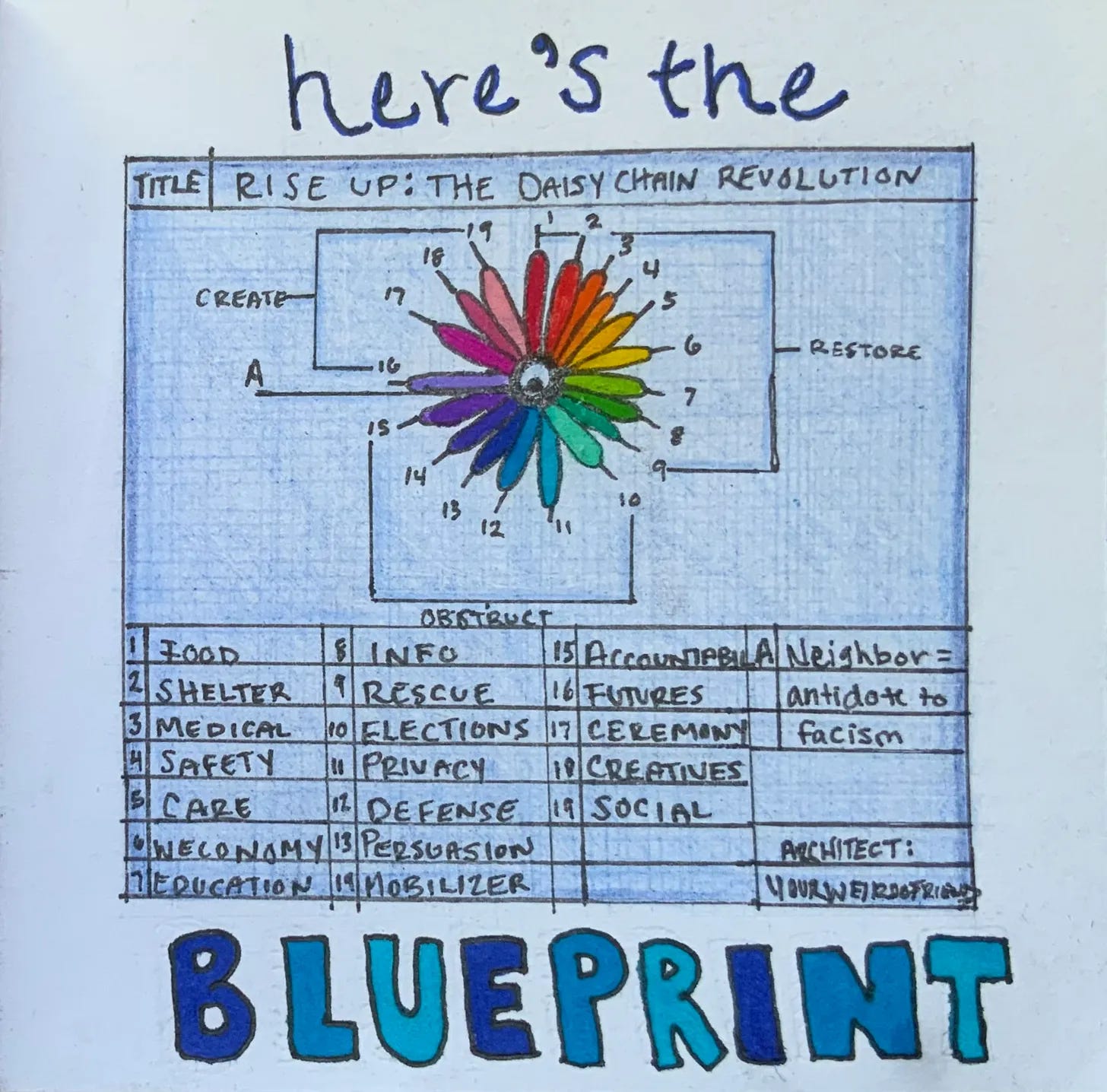
In this interview, we do a deep dive into their Substack newsletter “The Daisy Chain: A Neighbor’s Guide to Mass Cooperation.”
The Daisy Chain is primarily derived from Ghandi’s community efforts that ultimately defeated British colonizers in India. It organizes by ZIP CODE, including the 4-digits added to the end. This granularity gives users defined boundaries to form connections with people physically closest to them.
In the interview, Dr G discusses seven of the nineteen petals of the Daisy Chain. I love how they focus on play, passion, and creativity. They don’t make community organizing sound like work; they make it a blast.
Here are the seven petals we discuss in depth:
Food
Shelter
Health
Safety
We-conomics
Kinship
Creativity
Toward the end, we hit on a few of the other nineteen petals, including privacy, elections, and accountability.
It takes the guesswork out of organizing by tightly defining your community by zip code + four.
It separates tasks so that everyone can do something they enjoy and feel passionate about.
It focuses on play and fun, connection and creativity instead of making community involvement a chore.
It is flexible enough to adapt to any community.
So do what one of Dr G’s readers did: Print out the Daisy Chain graphic in their newsletter. Leave it on your neighbors’ doors with a note asking if they’re interested in talking about the Daisy Chain. Get started with everyone who says YES. In a few weeks, you’ll have a vibrant, active Daisy Chain to support and protect your community.
Even better. Dr G has provided a complete Daisy Chain Field Guide. Download it today and get started building your community Daisy Chain.
They work with groups who have an * active Daisy Chain* in place. Please do not contact them to say, “I want to make a Daisy Chain but I don’t know where to start.” Get started. Determine your community’s resources and skill sets. Reach out to them with questions as you weave your chain. Readers can find them on Substack at .
Type in your email below to subscribe to their very useful Substack.
To find your local Indivisible group (or to start one), GO HERE.
To find out more about community resources in your area, the ACLU might be a good place to start. GO HERE.
To see if there’s a Removal Coalition in your area, GO HERE.
If you’re in Michigan, Ohio, North Carolina, or Pennsylvania, you can connect with active Red Wine & Blue networks. GO HERE.