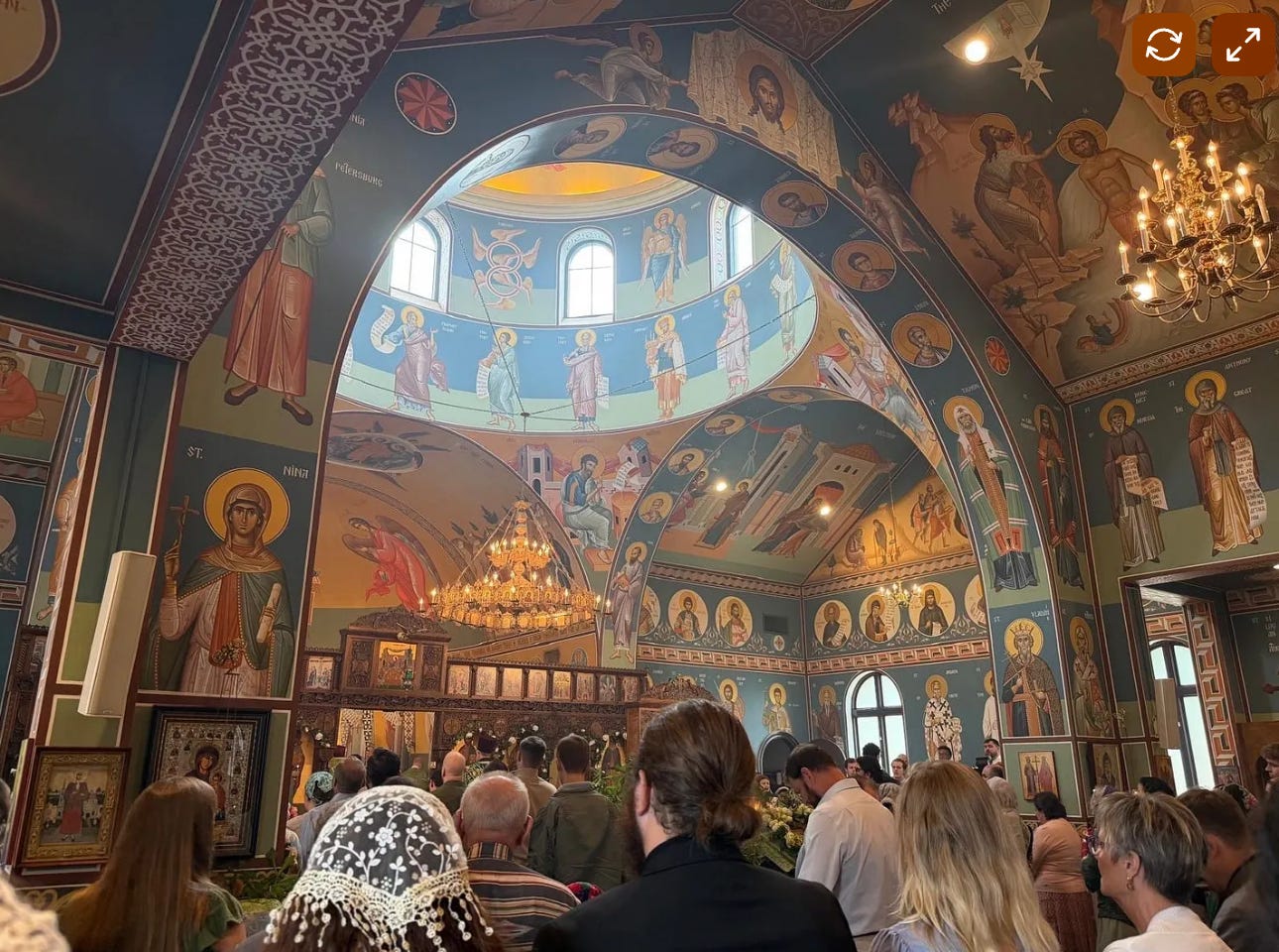
One of my college professor friends, a fellow Orthodox Christian, urged me to read a short book by the German-Korean philosopher Byung-Chul Han: * The Disappearance Of Rituals. *I did, and though it really is short, it took me longer than usual to read it. Han’s prose is clear, even austere, but his thinking is so deep that you can’t just breeze through it.
It’s a book about how so much of our confusion today has to do with the loss of ritual in our lives. In this essay by the Evangelical thinker Samuel James, “Why You Should Read Byung-chul Han,” James describes Han as a diagnostician of modernity’s ills. I learned from the James essay that Han describes himself as Catholic and reclusive. There is nothing overtly Christian in the Han book I just read, but as James points out, the discerning eye can pick up his Christian moral framework within his work. I think it probably makes Han’s writing more prophetic to modernity that you can’t see the Christianity so clearly in it. If what follows below interests you, please make a point to read James’s introductory essay to Han’s thought.
Here are some thoughts from the first chapter. My Kindle notes don’t indicate if these are successive sentences, note well:
Rituals are symbolic acts. They represent, and pass on, the values and orders on which a community is based. They bring forth a community without communication; today, however, communication without community prevails.
We can define rituals as symbolic techniques of making oneself at home in the world. They transform being in-the-world into a being-at-home. They turn the world into a reliable place. They are to time what a home is to space: they render time habitable. They even make it accessible, like a house. They structure time, furnish it.
Today, time lacks a solid structure. It is not a house but an erratic stream. It disintegrates into a mere sequence of point-like presences; it rushes off. There is nothing to provide time with any hold [Halt]. Time that rushes off is not habitable.
After reading those lines, I instantly knew why missing the Orthodox liturgy in my European life was so painful. (I did go to the liturgy every Sunday, but it was not in my language, and even though I knew what was happening, it didn’t land within me as it does in English.) I have been praying that liturgy on Sundays for over 20 years. It has become the basis of my life, and I didn’t quite understand that until I didn’t have it anymore, at least not in English. I have had so much tumult and unwanted change in my life, starting around 2013, and accelerating sharply after my wife filed for divorce.
Prayer is the main thing that has gotten me through it. And the liturgy is the strongest prayer. I don’t mean this in the sense of mere potency. I mean this in the sense that, without me quite realizing it, the Orthodox liturgy, which never changes, has become the sun around which my chaotic life orbits.
Sometimes one hears Protestants say that liturgical prayers are formalistic and dry, even the “vain repetition” that St. Paul warns against. Instead, this sort of Protestant (Evangelicals, charismatics) value immediacy and variation as more authentic. This is a big mistake. BCH:
Emotions are more fleeting than things; they therefore do not stabilize life. In consuming emotions we do not relate to things but to ourselves. What we seek is emotional authenticity. Thus, the consumption of emotions strengthens the narcissistic relationship to ourselves. The relationship to the world that we have by way of the mediation of things is thereby increasingly lost.
More:
The disappearance of symbols points towards the increasing atomization of society. At the same time, society is becoming increasingly narcissistic. The narcissistic process of internalization develops an aversion to form. Objective forms are avoided in favour of subjective states. Rituals evade narcissistic interiority. The ego-libido cannot attach itself to them. Those who devote themselves to rituals must ignore themselves. Rituals produce a distance from the self, a self-transcendence. They depsychologize and de-internalize those enacting them.
Rituals evade narcissistic interiority. Yes. They call you out of yourself. It’s not quite a ritual, but I’ll never forget standing with family and friends around the deathbed of my father, moments after he breathed his last. We had all just seen something profound: a man’s soul leaving his body after a long life. What to say? None of us were Shakespeare. I began reciting a Psalm I had committed to memory. The ancient words of King David allowed us mourners to rest, to be carried by the sacred lines, to focus on the man who had just passed from our midst, instead of rifling through our own minds in search of the appropriate things to say — because who among us ordinary people could possibly spontaneously produce words adequate to the enormity of that moment? It’s like that every Sunday, with the liturgy.
Every religious practice is an exercise in attention. A temple is a place of the highest degree of attention. According to Malebranche, attention is the natural prayer of the soul. Today, the soul does not pray. It is permanently producing itself.
How true that is! I feel it, and you do too. It’s the busy-ness of life, and most of all, the damn digitalization of life, which, as I wrote in * Living In Wonder,* is a powerful disenchantment machine
Ritual is the antidote to this poison. But a true ritual is not the same thing as following a mere routine, says Han:
Rituals are characterized by repetition. Repetition differs from routine in its capacity to create intensity.
… Rituals bring forth a community in which resonances occur, one that is capable of accord, of a common 3 rhythm: Rituals produce sociocultural axes of resonance along which may be experienced three different kinds of resonant relationship: vertical (e.g. to the gods, the cosmos, time, or eternity), horizontal (within one’s social community), and diagonal (with respect to things). Without resonance we are thrown back on to ourselves, isolated. Increasing narcissism works against the experience of resonance. Resonance is not an echo of the self; the dimension of the other is inherent in it. It means accord. Where resonance disappears completely, depression arises.
He’s using “resonance” in the sense that the German sociologist Hartmut Rosa uses it: to describe that ineffable sense of being connected to things outside ourselves. In Living In Wonder, I equate Rosa’s “resonance” with “enchantment”. (I wrote about Rosa’s ideas here.) You cannot experience resonance (enchantment) in the world unless you can sustain attention to something outside of your own head. If you try to possess the Thing Outside Your Head (a person, a place, a thing), and bring it under your dominion, resonance/enchantment disappears. It can only live in that space between. Ritual opens up that space between.
When we discard prescribed ritual, thinking that making up our own ritual is more authentic, we make ourselves prisoner to our own thoughts and passions:
The narcissistic cult of authenticity makes us blind to the symbolic force of forms, which exert a substantial influence on emotion and thought. We may imagine a ritual turn that re-establishes the priority of forms. It would invert the relationship between inside and outside, spirit and body. The body moves the spirit, not vice versa. Body does not follow spirit, but spirit follows body. We may also say: the medium produces the message. This is the force of ritual. External forms lead to internal changes. Thus, ritual forms of politeness have mental effects. The semblance of beauty produces a beautiful soul, not vice versa…
As I’ll mention below, this morning, when I prayed part of the Orthodox Akathist of Thanksgiving, I was startled to discover how quickly those words re-ordered my mind, and turned it outward in gratitude for God’s gift of the world. Man, I tell you, I make far too little use of the treasures my own Christian tradition gives me to deliver myself from the prison of overthinking, of interiority disconnected from the world outside.
Here’s something that some of you will find controversial, but which strikes me as true:
The profanation of culture brings about its disenchantment. Today, the arts are also increasingly rendered profane and disenchanted. Magic and enchantment – the true sources of art – disappear from culture, to be replaced by discourse. The enchanting exterior is replaced with the true interior, the magic signifier with the profane signified. The place of compelling, captivating forms is taken by discursive content. Magic gives way to transparency.
The imperative of transparency fosters an animosity to form. Art becomes transparent with regard to its meaning. It no longer seduces. The magic veil is cast off. The forms do not themselves talk. The language of forms, of signifiers, is characterized by compression, complexity, equivocation, exaggeration, a high degree of ambiguity that even reaches the level of contradiction. These suggest meaningfulness without immediately being reducible to meaning.
All these now disappear, and instead we are confronted with simplified claims and messages that are artificially imposed on the work of art. The disenchantment of art makes it Protestant in nature. It is de-ritualized, as it were, and stripped of its splendid forms:
Until the end of the 1980s, the spaces in which art was displayed still looked like Catholic churches, full of colourful forms and exuberant shapes. Since then, art societies seem to have become deeply Protestant, focusing on content and the spoken or written word.Art is not a discourse. It produces its effects through forms and signifiers, and not through the signified. The process of internalization destroys the arts, bringing them closer to discourse and forsaking the mysterious outside for the profane inside. The disenchantment of art is a symptom of narcissism, of narcissistic internalization.
What does he mean by this? Han is saying that in an older, enchanted world, we pay attention to “forms” — to style, to ritual, to the sensory presence of the work — as a way of introducing us to deeper meaning, indirectly. Some truths cannot be communicated adequately in straightforward prosaic terms. “Tell All the truth but tell it slant,” wrote the poet Emily Dickinson. We cannot access “all the truth” unless it, or some of it, is told “slant” — that is, indirectly.
I discovered this myself back in 2013-14, when I was sick as a dog with stress-induced chronic mono. Straight-up therapy wasn’t helping. The things that God used to deliver me was one hour of contemplative prayer every day (which helped calm my racing, anxious mind), and reading Dante’s Commedia, closely and attentively. After I was better, I realized that the healing truths that came to me through Dante’s poetry were more or less the same thing that my therapist was trying to convey to me in our conversations, but that I couldn’t accept in that form. Dante’s verse “seduced” me. He told it slant — and these truths were able to fly below my defenses. It still astonishes me to think about how that all worked; I wrote about it in this book, which remains my favorite of all those I’ve written.
Why does Han use the Catholic/Protestant analogy? Because Protestantism intentionally stripped ritual and symbolism from Christian worship and thought. This was for the sake of transparency, of clarity, free of what the Reformers took as superstition. When I read Carlos Eire’s great history of the Reformation(s), I understood what the Reformers were doing, and why they were doing it. They weren’t entirely wrong. But in my view, they reduced Christianity from poetry and ritual to an explanation. As Han suggests, removing the “magic veil” that ritual and symbolic forms impose on Christian worship makes that worship more about explaining than seducing. Similarly, he says, with contemporary art: it’s all message, talk, argument. There’s no mystery.
You know that great poem by Rainer Maria Rilke, “Archaic Torso Of Apollo”? Here it is:
We cannot know his legendary headwith eyes like ripening fruit. And yet his torsois still suffused with brilliance from inside,like a lamp, in which his gaze, now turned to low,
gleams in all its power. Otherwisethe curved breast could not dazzle you so, nor coulda smile run through the placid hips and thighsto that dark center where procreation flared.
Otherwise this stone would seem defacedbeneath the translucent cascade of the shouldersand would not glisten like a wild beast’s fur:
would not, from all the borders of itself,burst like a star: for here there is no placethat does not see you. You must change your life.
This poem describes the process of enchantment, of resonance. Rilke guides the viewer through attentive appraisal of a headless Greek statue. You do not stand there like an objective observer, but there’s something mysterious about the beauty emanating from it that draws you in. There is Presence here — a presence that we can’t name, but we can perceive, if we are sufficiently attentive. Notice how the gaze abruptly shifts in the final lines: the carved stone sees you, the viewer — and causes you to realize that you must change your life.
Rilke is telling us that the ancient Greek statue veils some mystery, and makes the meaning behind its beautiful form accessible to us, in the most intimate way.
That’s what Han is trying to tell us about ritual. How many times have I walked through museum galleries, looking at paintings and sculptures, just consuming them, not really seeing them. I recall, though, visiting the Prado in Madrid a couple of years ago, and stopping cold in front of Goya’s picture of a drowning dog. It enchanted me. I thought: that little dog is me, facing the waves of sorrow and loneliness and destruction; that dog is all of us, struggling in the human condition.
Again: what Han invites us to consider is that ritual, rightly considered, leads us to de-center ourselves, to be calmed, and to learn how to resonate with the world — and with the Holy Spirit. Ritual is a cure for the disease of modernity. Ritual saves us from the curse of being tourists, and turns us once again into pilgrims.
Here is Han on how ritual imposes narrative on life:
A narrative is a form of closure: it has a beginning and an end and is characterized by a closed order. Information, by contrast, is additive, not narrative. It does not combine into a story, a song, that could form the basis of meaning and identity. Information can only be endlessly accumulated.
He says this in context of his claim that the Internet is an endless torrent of information. The Very Online never find closure, and therefore meaning; life becomes endless surfing, processing more information, to distract us from the abyss.
This is profound:
Most of all, the abolition of rituals removes autonomous time [Eigenzeit]. This time is familiar to us from the various stages of life: We are all familiar…