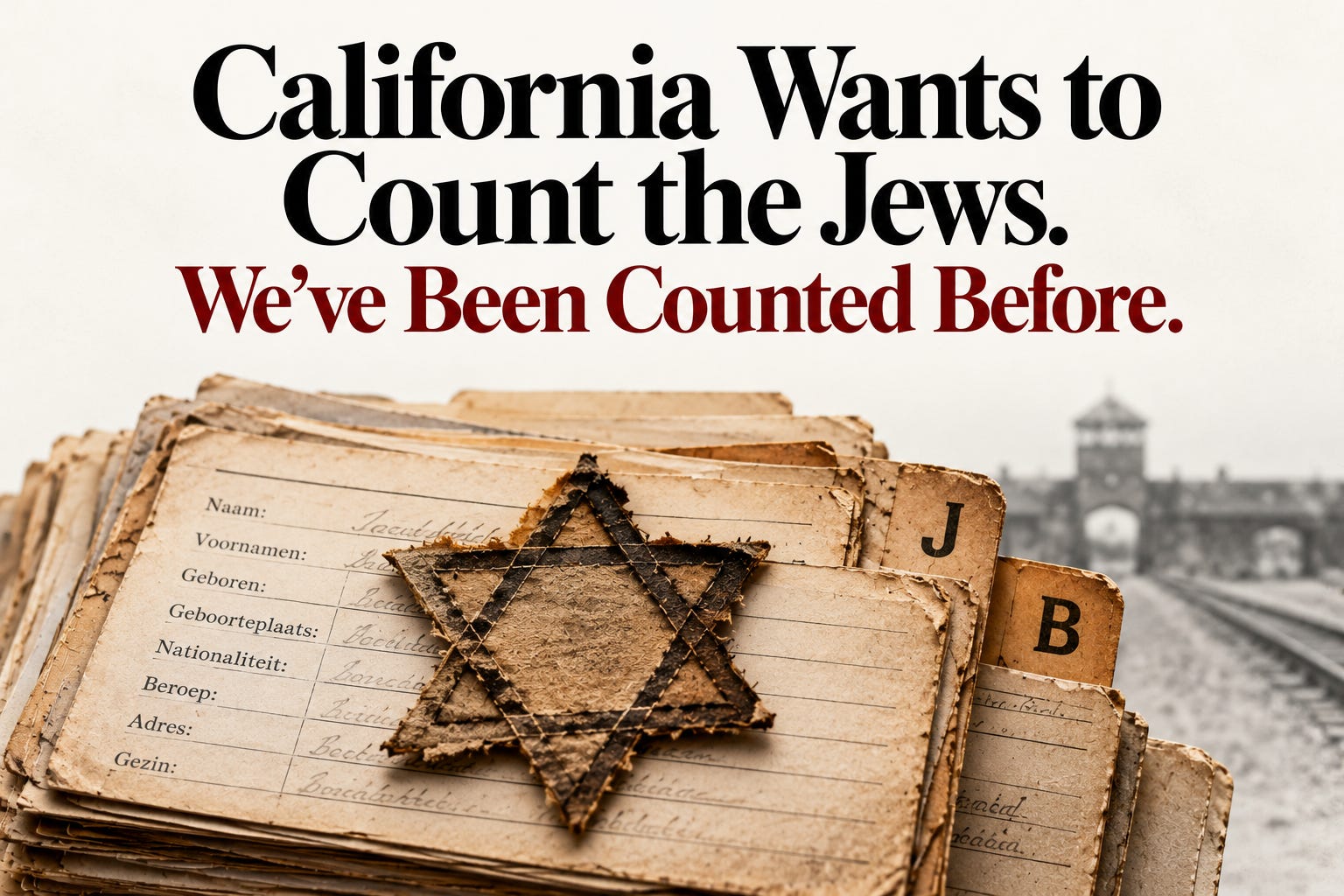
California has passed a law recognizing Jewish ethnicity. It comes with privacy protections, but Jewish history offers some uncomfortable lessons about what can happen to government records when the people controlling them change.
I’ll admit it. I’m guilty of knee-jerk reactions sometimes.
When I first saw the announcement that California had passed a law recognizing Jews as an ethnicity, I got excited. Finally, a government was acknowledging something Jews have been saying forever. We’re a people. Judaism is our religion, but being Jewish goes beyond religious belief. We have a shared history, ancestry, traditions, and a homeland.
And then someone mentioned a registry. And they weren’t talking about a bridal shower one.
I groaned inwardly because the lightbulb went off…we’ve seen this a few times before. We know from history what happens when governments decide they need to know who the Jews are, where they live, and how many of them there are. And…we’ve also seen what happens when those records end up in the wrong hands.
Maybe California’s intentions are purely innocent. Maybe this really is about protecting Jews and making sure we’re counted when governments measure discrimination. Dang, I certainly hope so.
But after a comment or two on the Note I shared, I couldn’t shake the thought of what Nazi Germany did when it decided to legally classify Jews by ancestry. And as we say…we know how that movie played out.
(AI helped me with this because, even though I understood the information, I had a heckuva time trying to write about it. Too much political legalese for me. So forgive me. I promise, after this part, the rest is me.)
On September 30, 2026, Governor Gavin Newsom signed Senate Bill 1387, introduced by Democratic state Senator Henry Stern. The bill passed the Assembly 74–0, with five abstentions, and received final Senate approval 39–0, with one abstention.
Jewish California sponsored the legislation. It had support from Jewish organizations such as the Anti-Defamation League, the American Jewish Committee, the Simon Wiesenthal Center, and Jewish Federations. They’d been pushing for recognition of something that existing government demographic categories often miss. A Jewish person can be an atheist, never enter a synagogue, and still be targeted for being Jewish. Antisemitism never, in the history of ever, depended on whether its victims observe Shabbat or keep kosher. A government that counts Jews exclusively as members of a religion can overlook discrimination directed at their ancestry.
SB 1387 adds a separate category for Jewish ancestry or ethnicity to certain state demographic forms. Under Government Code Section 8310.2, agencies that already collect ancestry or ethnic-origin information must provide a way for respondents to identify as Jewish. This requirement covers information collected directly by agencies and through contractors. The law becomes operative January 1, 2029, with qualifying agencies required to include the new information in demographic reports beginning in 2030. Still a few years away.
California’s correctional system is included. People entering, leaving, or held in state correctional facilities may voluntarily identify as Jewish. The legislation also addresses demographic reporting for disability and family-leave benefits. The University of California and California State University systems are excluded from the general state-agency provision, although the bill separately amends the Education Code.
The collected information will be used to measure disparities, guide policy decisions, and help determine where government services or funding may be needed. Agencies must also publish aggregated demographic information, including data organized by state, county, city, ZIP code, and census tract, subject to privacy protections. Census tracts are relatively small geographic areas defined by the Census Bureau, often containing only a few thousand residents. That could eventually give California a far more detailed picture of where Jewish residents live than a statewide population count.
Section 8310.2 expressly and absolutely prohibits creating any registry from the collected information. It also prohibits the use of the information for law or immigration enforcement and makes personally identifying information confidential. Agencies MUST protect individual identities when publishing reports through methods such as suppressing small counts or combining categories. For certain correctional reports, populations below 50 must be reported as fewer than 50.
The broader demographic provisions allow agencies to choose privacy methods appropriate for their datasets. The original information still has to be collected and processed. A person who checks the Jewish ethnicity box on a government form may have that response stored along with other information in an existing agency system. The prohibition against creating a separate registry DOES NOT automatically remove individual ethnicity responses from the records in which they were collected.
California’s Information Practices Act governs how state agencies collect, maintain, use, and disclose personal information. State records-management rules also govern retention and disposal. SB 1387 doesn’t establish a single deletion deadline that applies to every Jewish-ethnicity response collected by every agency. The practical consequences depend on which agency holds the information, what system it uses, whether a contractor processes the records, and how long the underlying documents must be retained.
The confidentiality provisions limit what an outside organization can obtain through an ordinary California Public Records Act request. An organization cannot simply demand a list of everyone who identified as Jewish and expect the state to release it. Subpoenas, court orders, and demands from federal authorities present separate legal questions governed by the applicable statutes, procedural rules, and constitutional protections.
Future lawmakers could also amend the law. A database maintained in 2029 may still contain records years later, after the officials responsible for creating the system have left office. Its security will depend on the people, systems, and laws controlling that information for as long as the records exist.