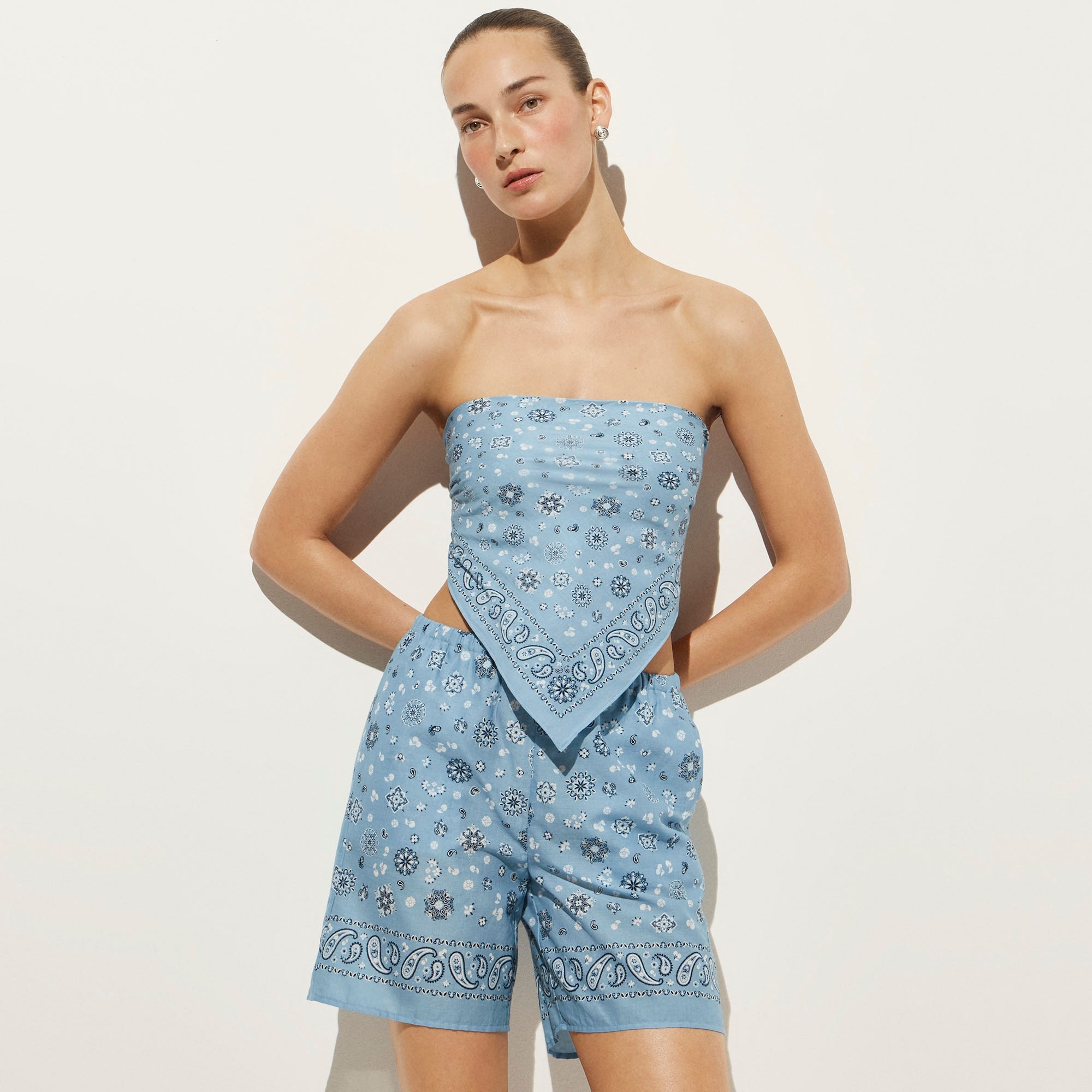
I was recently asked to start throwing hands because the fashion establishment was co-opting Indian design with impunity. I’m never one to shy away from a verbal argument. (At the size of a chihuahua, my literal hands would barely create a mark.) But I’d like to step back from accusations and the general tally-taking that the internet sometimes runs amok to redefine this discussion. Who owns what idea? Who polices that ownership? How does an intellectual abolition mindset play into these discussions?
Paisley is in for the spring, so let’s use this to frame today’s discussion. The history of the pattern, from a 9-year-old girl who died in China nearly 1500 years ago, to a craft that Iranian women are trying to keep alive today, as well as a scheming Scot, we’ll see how cultural appropriation and transmission play out over history.
As we think about this pattern over millennia, keep in mind that cultures interact and change. The issues arise around power inequalities. Richard A. Rogers, "From Cultural Exchange to Transculturation" (2006), explains: "Cultural appropriation [is] the use of a culture's symbols, artifacts, genres, rituals, or technologies by members of another culture… The four categories of cultural appropriation are exchange, dominance, exploitation, and transculturation."
In 608 CE, a 9-year-old girl, Li Jingxun, who was being raised in the capital by her grandparents, set out with her family to inspect some of their holdings. These were not average grandparents. Her grandmother, Yang Lihua, who was raising Jingxun, was the daughter of one Emperor and wife of another. It was an honor for Jingxun to join an official visit. The unseasonably hot weather had made the capital unbearable, so she was excited to travel.
When they were far from home, the little girl fell ill and quickly died. Her grandparents mourned, decreeing that music must not be played and that people must refrain from eating rich meals. He had her body returned to the capital with the honors of her position.
Jingxun was entombed in a Buddhist Nunnery near the Imperial Palace. She was dressed in fine silk garments with a glorious gold headdress, a gold necklace, gold bracelets, jade ornaments, and other jewelry. Her body was then placed in a stone coffin shaped like a miniature palace. Fine offerings, vessels for food, cosmetics, and daily use, as well as ceramic figures depicting horses and camels, encircled the sarcophagus. Every element of the tomb was hewn from the best materials, like gold, silver, white jade, porcelain, and glass. Many of the elements in this grouping reflected a belief in Pure Land Buddhism.
This little girl’s resting place remained undisturbed until 1957. On the lid of the coffin, there was a note warning of dire consequences if opened. The completeness and the quality of the offerings excited scholars. Scholars were particularly interested in the many items from around the world in the tomb.
Jingxun lived during a turbulent period in Chinese history. The Qin dynasty, most famous in the West for the first Emperor’s large tomb, had unified China, but its fall led to balkanization. The Han after him also unified China. The Sui Dynasty again restored that unity between 581 and 618 CE. Trade also brought people together across ethnic and religious divisions. The Silk Route made many Chinese merchants and artisans wealthy, but it also enriched the people of Central Asia and what is now Iran.
She was interred with a necklace that hailed from Iran, not China. Goldwork beads were common across Central Asia. The nomadic and sometimes bellicose Mongol and Turkic groups who occupied Central Asia were masterful at refined goldwork by the 7th century BCE. The arts of South Asia, Persia, and the Byzantine Empire all draw from this historic tradition. Her necklace also features a stag intaglio (carved stone). Deer imagery was common throughout Asian art. Some groups, like the Sassanians, showed deer as prey with a predator or a ruler at the moment of dispatching the poor beast. But her necklace has a deer standing peacefully alone. Scholars suggest this might be drawn from the Iranian Sogdian world. This area is now in Turkmenistan, Uzbekistan, and Eastern Iran. For the Sogdians, deer imagery often serves as a form of protection and guidance. Why did this Chinese Buddhist princess have this Sogdian necklace?
Li Jingxun’s mother was ethnically Han, the majority ethnicity in China today. Her maternal grandparents raised her in the Imperial Palace. But her father was Xianbei, a term that encompasses many Central Asian communities. Scholars posit she could have worn the fine necklace for its apotropaic properties. If so, was her father Sogdian?
The complex globalism of the time is evident in the variety of items in the tomb. Many items also have non-Chinese origins. Guardians with comic expressions were lined up to keep her safe in the afterlife. They’re dressed as lovely Xianbei (Northern Zhou) warriors. These soldiers are shown struggling with their jobs, as a bit of caricatured realism for the tomb. Their feelings about their work are apparent on their face. A silver ewer, likely of Iranian origin, depicts dancing figures in the Greek style. Silverwork is a hallmark of ancient Persian art. It’s the only Persian vessel of its kind found in a tomb in China from this period. A particularly surly camel also points to the Silk Route, as they were the beast of choice to move the works across the desert. Her tomb, interestingly enough, also contained a coin from the Sassanian Empire, now in Iran.
The most commonly praised item is her cicada or mothlike crown, made of gold and silver filigree. The individual elements were attached to a wire so they would sway when she moved. The central insect was hollow and likely held fragrant materials. Gemstones and pearls added additional visual interest. This type of complex ornamental goldwork is characteristic of Sui and later Tang craftsmanship. Similarly, elements, like the flowers, might have Buddhist symbolism.
Why both Han and Sogdian symbolism? In this little girl’s tomb, we see two possibilities. At this time, China was coalescing into a global culture. The wealthy understood that diversity had benefits, such as more peaceful trade. Acquiring products from other cultures also demonstrates their refinement, in this life and the next.
A second possibility is that this girl’s father, whose family was Central Asian, felt an affinity for the Zoroastrian faith of the Sogdians. This faith, which originated in Iran, also traveled along the Silk Route to India. While it was not really an evangelical faith like Buddhism, trade migration spread it across Central Asia. The paisley traveled the same path throughout Central Asia, likely deriving from the Zoroastrian cyprus tree motif, symbolizing life and eternity.
In another tomb in the period, another lost child, in this case the son of a prominent Sogdian military figure, Shi Shewu, had a stone with a lion and three stems with flowers. That very spare depiction of the plant is like a proto-paisley, a visualization of the tree of life.
In Jingxun’s tomb, she has a ceramic vessel depicting a Sogdian dancer performing the Sogdian whirl, which became a sensation at the Chinese court during the subsequent dynasty. The leafy form above her might also be a reminder of the tree of life.
Her tomb reflects a time in Chinese history where people intermarried and often held multiple views, not unlike American families that are interfaith. In being buried with Sogdian items, including potentially a tree of life, she’s honoring her heritage in the afterlife. Employing motifs from your own heritage is not cultural appropriation.
The Sogdians at the Sui court became rich as silk and silver merchants. Chinese consumers wanted finely finished work in the Sogdian style. They prized the exotic Central Asian styles. Just as people might buy something today that looks “Japanese”, many of the wealthy 7th-century Chinese people loved silks that looked Sogdian. The style was strikingly different from the Chinese looks of the era, with rich colors and bold roundels, or circles of circles, with an animal inside. In this fragment now at the Met, notice the teardrop or mango-like shapes in the passages around the roundels.
Why the tree of life gets transformed into a teardrop, called a boteh, isn’t conclusively known. Some suggest it was to show the original cypress bent in the wind. What is clear is that the form’s fluid asymmetry made it ideal as interstitial decoration. Those upright tree-like forms in Li Jingxun’s tomb, and on Shi Shewu’s funerary stone, would be awkward to fit into the borders and curves of a woven fabric. The tilted teardrop adds dynamism and visual interest to counterbalance the roundels.
The boteh proliferated across media, like silk, architecture, ceramics, metalwork, and carpets. In doing so, the form became more widespread. When Babur founded the Mughal empire in South Asia in 1526, his court brought its Central Asian aesthetics with it. (He himself was from the Fergana Valley, in modern Uzbekistan). The boteh filtered throughout South Asian arts and design.
In Kashmir, fine woven shawls became big business. These twill tapestry pieces were labor-intensive, sometimes taking two or three years to complete each. Mughal emperors like Akbar were enthusiastic patrons. Akbar reportedly had shawls sewn back-to-back in pairs so the plain underside would never show. When the market was confined to the Mughal court and its orbit, Kashmir’s weavers could keep pace. Junior weavers sometimes moved to other cities in the Empire to start new workshops, slowly expanding the trade.
This movement of a pattern out of its bounded cultural context into a wider style is cultural diffusion. By the time Kashmiri shawls became popular, more than a thousand years after Li Jingxun was entombed, the boteh had long since lost its religious meaning. It was an ornamental rather than a religious symbol.
In the 1800s, a different kind of revival was underway in Kerman, in southeastern Iran. The region was already known for its finely made carpets and its craftsmen, skilled at executing complex patterns. Women in Kerman carried some of the same colors and materials into their homes to make needlework for daily use. These pateh pieces use wool thread embroidered on thick woolen cloth, and the motif of choice is traditionally a tree of life with flowers bursting off stems, not unlike the form in Li Jingxun’s tomb. Like the little girl in Ancient China, though the women of the Kerman valley were using the earlier cypress form. Sadly, pateh has declined in recent years, with fewer young women taking it up.
So how does a pattern with this much history end up named for a town in Scotland? In the late eighteenth century, Kashmiri shawls began reaching European markets through the East India Company trade. By the Napoleonic era, they were a full-blown craze. Empress Joséphine is said to have owned hundreds, and a single fine shawl could cost as much as a townhouse. Demand vastly outstripped what the Kashmiri workshops could supply.
European manufacturers moved in to fill the gap. Weavers in Norwich, Lyon, Edinburgh, and Paisley (a town in Renfrewshire, Scotland) all began producing imitation shawls. Paisley’s weavers dominated. By the 1830s, with the Jacquard loom installed in the town’s workshops, they could turn out a mechanized version of a Kashmiri design in a week rather than years, at a fraction of the cost. The pattern used the town’s English name, and the name stuck.
Kashmir’s shawl industry collapsed. The European machine-made competition, the fall of the French Second Empire in 1870 (which ended the shawl as a fashionable object), and the devastating Kashmir famine of 1877–79, which gutted the weaving communities themselves. This is classic cultural appropriation. The original community suffers, materially, not just symbolically, while the colonial power gains both the pleasure of the style and the profits from making it.
So what can we take away from 1,400 years of paisley evolution? European paisley is certainly exploitation. In Susan Scafidi's Who Owns Culture?, she discusses the “use of cultural symbols, artifacts, genres, rituals, or technologies” from another group without permission, which, in this case, helped destroy the livelihoods of the people who had refined the pattern for centuries.
Li Jingxun’s tomb is likely a cultural evolution **of **Sogdian goldwork moving along the Silk Road into the hands of a Sui-era girl whose father’s people had made it. As communities grow and move, the way they see symbols changes. Pateh is also similarly about drawing on your history, so again, a cultural evolution.
I chose two very different cases to show how, without context, you could have seen Jingxun’s tomb as cultural appropriation. Often, the reasons symbols are employed need to be interrogated. Arjun Appadurai, in The Social Life of Things, puts it this way: “it is the things-in-motion that illuminate their human and social context.” With the original meaning, you cannot ascribe intentionality or blame.
Symbols are protean, often engaging designers' imaginations, transforming and evolving. As Kwame Anthony Appiah describes in Cosmopolitanism, “Cultural purity is an oxymoron.” The Sui Chinese Court, the Mughal court, and the women in the Kerman valley were all exploring ideas in their respective milieus, and their expressions are valid.
The difference between all of this and J.Crew is privilege and scale. Where hundreds and thousands of years occurred between the earliest trees of life and the pateh, JCrew will forget about paisley tomorrow. They’ll have stolen someone else’s ideas. The other issue is that J.Crew is replicating a classic of the colonialism model, harnessing ideas to concentrate wealth in the colonizer. The asymmetry of power is at issue. But to add to the complication, the paisley they’re using has been recycled through 19th-century Europe and then the 20th-century US.
I used the paisley because it is long-lasting and well-complicated. There are certainly many more egregious ways in which companies profit off the Global South. Appiah isn’t excusing this type of cultural transmission. He goes on to write, “We do not need, have never needed, settled ownership to value our traditions.” In stealing the ideas, they cannot steal the soul of the culture. Corporations are soulless machines, where innovation always errs on efficiency rather than creativity.
In calling out those instances, you might feel compelled to do so. I’ve certainly been so moved. But, also, in every instance where we use our energy against transgressions that, on the scale of things, are minuscule, we lose momentum. In policing thought and cultural appropriateness, we become intellectual jailers. I suggest in their discussions of who owns culture, you pick your battles, steel yourself up for the real fights, and then grab your verbal barbs.
As people of the world, in our very complex society, we need to remember that the answers will not be simple. If they seem binary, you’ve very often misunderstood the question. We will live in a half-tone world, but one mediated by the black-and-white thinking that makes technologists money. This same unnuanced thinking invades our minds and hijacks our sense o…