By Kerry Lutz | Financial Survival Network | May 10, 2026
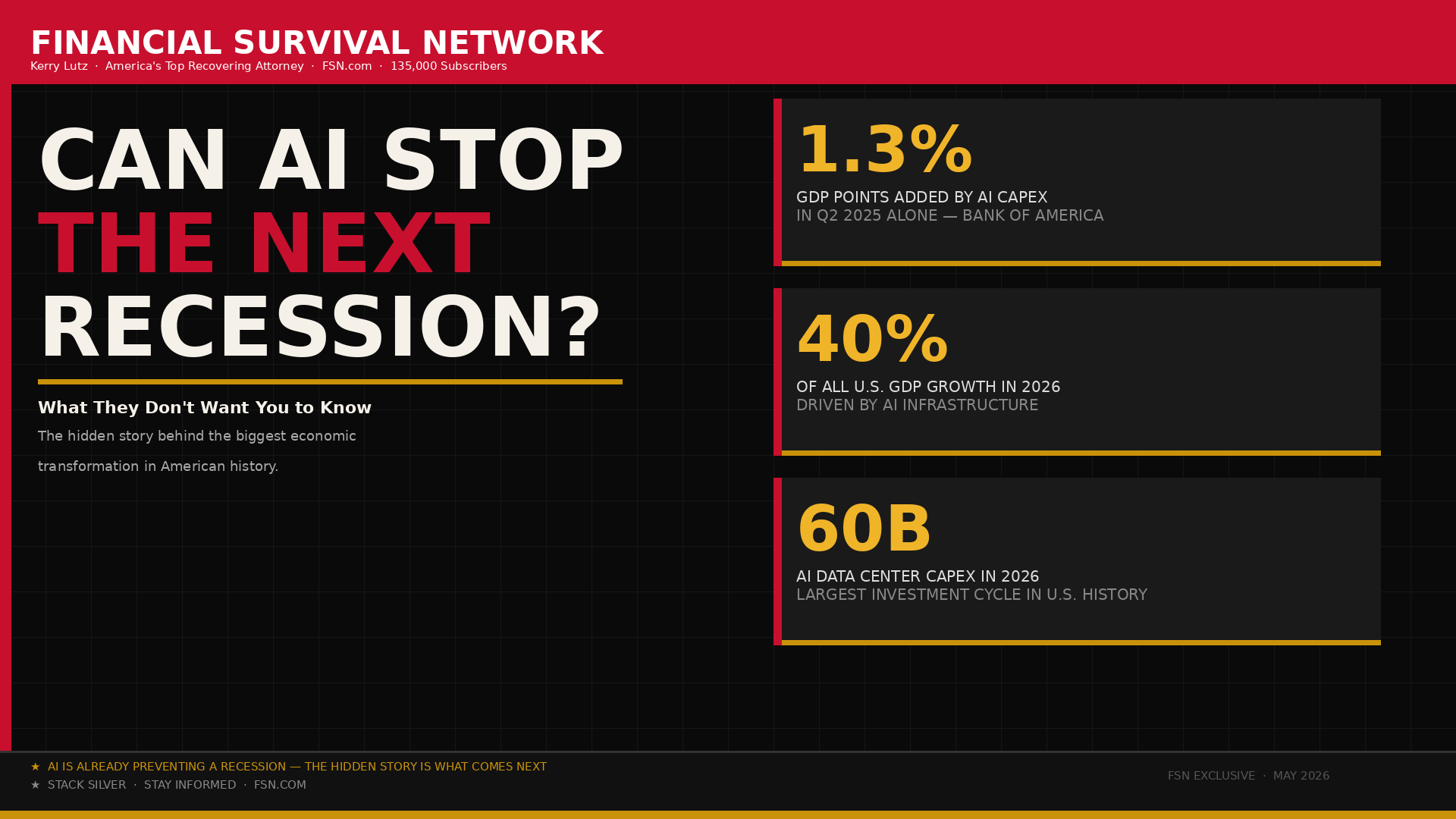
📊 BY THE NUMBERS:
• 1.3% — GDP points added by AI capex in Q2 2025 alone (Bank of America)
• 40% — of all U.S. GDP growth in 2026 driven by AI infrastructure
• $660B — AI data center capex in 2026 — largest private investment cycle in U.S. history
Let’s cut through the noise. The most important economic story in America right now isn’t tariffs, isn’t the debt ceiling, and isn’t whatever the Fed is pretending to manage. It’s this: artificial intelligence is the only reason the United States is not already in recession — and the very same forces keeping us out of one could trigger the next one.
BNP Paribas chief U.S. economist James Egelhof didn’t mince words: “AI has kept the economy out of a recession.” Deutsche Bank went further — without the AI-driven investment surge, America would already be in contraction. Goldman Sachs estimates Microsoft, Meta, Alphabet, and Amazon now account for more than a quarter of all S&P 500 capital expenditure, growing at a 75% annual clip.
But here’s what the mainstream financial press is missing entirely. The AI boom isn’t just propping up the economy through investment spending. It is simultaneously dismantling and rebuilding the entire regulatory architecture that would have blocked it — using AI itself to do it. That’s the hidden story. That’s what they don’t want you to know.
🔍 I. THE SECRET NOBODY’S CONNECTING
“AI is using itself to approve its own permits. The snake is eating its own tail at industrial scale.”
Hundreds of megaprojects — data centers, power plants, transmission lines, chip fabrication facilities — are being pushed through the federal approval pipeline right now. Projects that under the old system would have taken five to ten years to navigate. They’re moving in months. Three mechanisms, all operating simultaneously.
① The Executive Order. In July 2025, Trump signed “Accelerating Federal Permitting of Data Center Infrastructure” — declaring AI infrastructure a matter of national significance, effectively the same legal priority as interstate highways and military installations. Data centers are no longer private developments that happen to need federal sign-off. They are nationally significant infrastructure. Full stop.
② The Supreme Court. The May 2025 ruling in Seven County Infrastructure Coalition v. Eagle County — a self-described “course correction” — dramatically reduced the legal attack surface for project opponents after decades of lower courts policing NEPA so aggressively that critical projects were abandoned before they started. That era is over.
③ AI Reviewing Its Own Permits. The Department of Energy deployed PermitAI, built on the NEPATEC 2.0 dataset: 150,000 documents, 7 million pages of historical environmental records, trained into large language models that can now draft initial environmental reviews, categorize public comments, extract project impacts, and identify precedents across 60,000 prior federal projects — in hours instead of years.
AI is literally reviewing its own permit applications.
⚠️ The Loop Nobody’s Talking About: AI needs data centers → data centers need federal permits → permits take 5–10 years → AI deployed to shorten permits to months → more data centers built → AI gets more powerful → loop repeats. This is the single most consequential regulatory transformation in American infrastructure history — happening almost entirely below the media radar.
📈 II. THE PRODUCTIVITY PROMISE — REAL, BUT UNEVEN
The productivity gains are real and measurable — but not evenly distributed. Research published April 2026 found industries with higher AI exposure experienced a 10% productivity increase, 3.9% job growth, and 4.8% wage growth. The St. Louis Fed confirmed AI’s GDP contribution has now surpassed the dot-com IT boom in levels and as a share of GDP.
But PwC’s 2026 AI Performance Study exposed the catch: 74% of AI’s economic value is being captured by just 20% of organizations. The vast majority of American businesses are still stuck in pilot mode while the gains flow to hyperscalers and their investors.
JPMorgan calls this the “Hyper-Capex” stage. The next phase must be driven by using AI, not just building it. The productivity payoff has to arrive before the capex bubble exhausts itself. That’s the race. Nobody knows who wins it.
👻 III. GHOST GDP — THE RISK NOBODY NAMES
The most-read financial essay of 2026 described an economy where AI productivity drove record corporate profits but hollowed out the American consumer base. The author called it “Ghost GDP”: economic output that never circulates through the real economy, because machines spend nothing on discretionary goods. It was fiction. The dynamic it describes is now documented in real-time government data.
Claudia Sahm — inventor of the Sahm Rule, the most reliable recession indicator in modern macroeconomics — warns of three forces converging on the same population in the same quarter: 1) AI displacement of white-collar roles, 2) federal workforce reductions under DOGE, 3) uncertainty suppressing private-sector hiring. GDP growth driven by AI flows to shareholders. It does not automatically reach the worker whose coordination role just became unnecessary.
💣 IV. THE BUBBLE QUESTION
JP Morgan projects 122 gigawatts of new data center capacity built 2026–2030 at a cost of $5 to $7 trillion. The 2026 funding need alone is ~$700B — manageable. By 2030, annual needs exceed $1.4 trillion, surpassing current market capabilities. The financing is deeply circular: Nvidia invests in OpenAI, OpenAI buys Nvidia chips, OpenAI’s CFO floats government loan guarantees, Trump’s AI czar says a reversal “would risk a recession.” You are not looking at free market capitalism. You are looking at Washington and Silicon Valley co-writing each other’s survival plan.
Wharton projects AI could cut federal deficits by $400B over 2026–2035 — then adds: “There’s this belief that AI is going to solve everything. That’s simply not true. We’re not even close.”
⚖️ FSN VERDICT
AI is already preventing a recession — that part is settled. The buildout is the single largest investment cycle in American history and it is carrying the economy on its back. Simultaneously, AI is greasing the skids for hundreds of megaprojects that couldn’t have survived the old permitting gauntlet — by reviewing its own permits. Nobody in the mainstream press has connected this end-to-end. Until now.
But the risks are converging: gains flowing to capital not labor; financing math gets precarious after 2028; and if the capex boom stalls before productivity gains reach Main Street, the engine preventing the recession becomes the trigger for one.
Stack silver. Stay informed. Nobody survives this one on faith alone.
Be prepared. Two special reports are on their way one on Gold and the other on AI.