One of the most irritating features of American political life is the common tendency among influential commentators to confidently and proudly pronounce on subjects that they don’t know the first thing about. In many cases, it’s clear that the subject is just a proxy in some broader ideological war, and the commentator neither knows nor cares about any of the details they’re discussing. Often, despite wrongness so gobsmacking as to verge on the infinite, commenters blunder along, making error after error, never bothering to correct their basic butchering of the subject matter.
There are few better examples of this than the recent Lindsay Clancy case.
Here are the facts: Clancy, after the birth of her third child, faced severe mental health challenges. The defense is alleging that she experienced something called “postpartum psychosis.” This is psychosis that occurs in the wake of childbirth! It is not the same thing as postpartum depression, which is *depression *that occurs in the wake of childbirth.
Clancy claims she heard a voice that told her to kill her children and herself and was gripped by an irresistible urge to follow its advice, so that her body was taken over, puppet-like. Thus, she strangled her three children with exercise bands, slit her own wrists, and jumped out of a second-story window. Her ex husband, along with various others, testified that she was a caring mother who, in a normal state, would never, in a million years, kill her children.
So the dispute is about whether Clancy was psychotic in a way that would diminish culpability. Thinking that being wholly disconnected from reality when you commit violent acts diminishes culpability isn’t some newfangled 21st century liberal thing dreamt up by a blue-haired feminist professor in women and gender studies at Claremont who thinks math is racist. It has been recognized in some form for about a thousand years.
And it makes obvious sense. There are four standard reasons to punish people: deterrence, incapacitation, rehabilitation, and retribution. Those who are insane when they commit vile acts are not blameworthy, and they are not capable of being deterred. Nor do rehabilitation or incapacitation favor imprisoning a person over consigning them to a psychiatric institution. Ben Shapiro of all people has a pretty good video about the case.
There have been other similar high-profile cases, where people have been deemed not guilty by reason of insanity. Michael Laudor, a man suffering from schizophrenia, killed his pregnant fiancée Caroline Costello during a particularly severe bout of schizophrenia. He’s been in a mental hospital ever since. Is Laudor morally culpable for his crime in the same way as Ted Bundy? Should he have simply gone to an ordinary prison—when his debilitating mental condition is the sole cause of his killing.
So in other cases, people are capable of recognizing the basic reality that it’s neither wokeness nor “simping” that leads a person to suggest that one definitively in the grips of psychotic delusion shouldn’t be held criminally liable. Yet for some reason, as this case has become one of the major cases in modern American life, people’s ability to think rationally about criminal culpability has regressed incomprehensibly—and this tragic, horrible case has become a convenient piñata for people to virtue signal about how much they hate killing children. Wow, so stunning, so brave, thank you for this incisive addition to the conversation—that you think it’s bad when children die.
Take the recent comments from Redeemed Zoomer—a YouTuber who spends most of his time defending Protestant Christianity. He has pronounced on the case with a degree of sanctimony so gargantuan as to scare off any googologist trying to represent it numerically, yet still somehow surpassed by both his callousness and the poorness of his reasoning on the subject.
Should you also leave your girlfriend if she has sympathy for Michael Laudor? Is doing so “risking your kids’ safety?” My mother is currently reading Rosen’s “The Best Minds” about Laudor’s case, and feels sympathy for Laudor (after all, being schizophrenic and killing the love of your life in a state of severe delusion isn’t exactly a pleasant fate.) Does this mean that my mother is a risk to children?
It’s just so ludicrous! The people who feel sympathy for Clancy do not think that killing kids is a good thing. They do not feel sympathy for people who kill their kids. Maybe some morons on TikTok do, but the overwhelming majority of people who are sympathetic to Clancy do not. Rather, they feel sympathy for people who are psychotic, and commit terrible acts involuntarily without realizing what they’re doing is wrong—a bit like how you might have a dream where you do something terrible. Imagine waking up from such a dream and then learning that you really had committed the acts you dreamt of.
Now, one can debate whether Clancy really was psychotic. I’d think it’s plausible she was for basically the reasons lays out. But at the very least, it’s not overwhelmingly obvious that she wasn’t. Thus, if someone disagrees with Zoomer about whether to feel sympathy for Clancy, the reasonable thing to think isn’t that they love to murder. It’s that she, unlike Zoomer, actually knows a thing or two about the case.
Zoomer continues:
There’s no law that says you have to opine on topics that you literally don’t know the first thing about. The defense is not that her actions are okay because she had postpartum depression. It’s that she had postpartum psychosis! I realize this may be confusing because both begin with the word “postpartum” but they are different things. Nobody seriously—beyond, I’m told, some insane people on TikTok—believes that being depressed means you’re morally permitted to kill your kids. Being psychotic is a different thing entirely. And if you’re so ill-informed that you just saw the word “postpartum,” pattern-matched it to the postpartum condition you’re used to hearing about, and stopped reading, then you shouldn’t suggest publicly that the issue is so blindingly morally obvious that you should exile anyone who disagrees with you about it from your social circle.
I feel like I am explaining things to a five-year-old. The points I’m making are extremely basic. Yet for some reason, much of the esteemed American commentariat has been unable to grasp them. Honestly, this makes me a lot warier about trusting Mr. Zoomer on any subject. If he can’t get the facts right or reason at a basic level on a subject I know about, why would I think he’s able to correctly ascertain what the Church fathers thought?
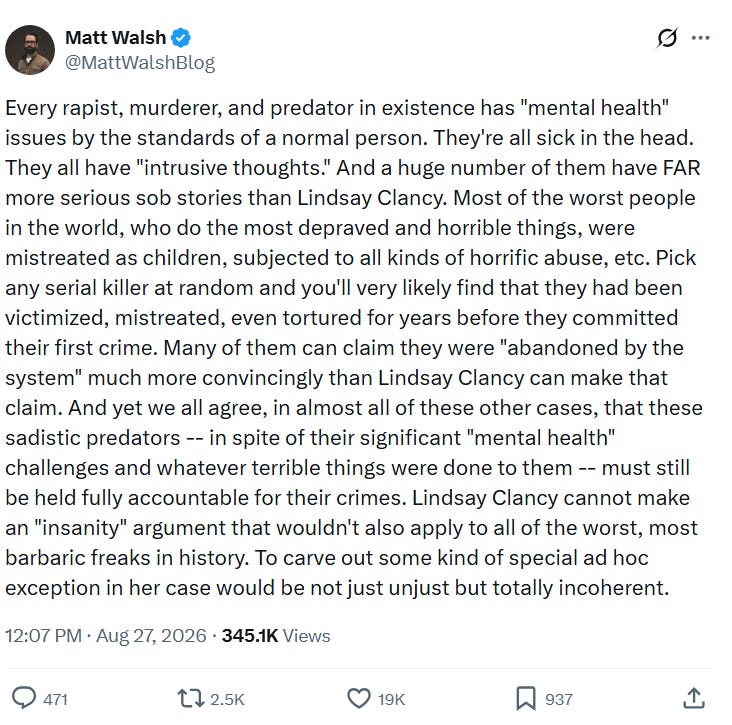
Zoomer is not the only person commenting on the case. Seemingly in an effort to outdo Zoomer in poorness of reasoning, Matt Walsh has also weighed in:
Again, he doesn’t appear to know the most basic facts of the case. First of all, she was not lacking in “sentience” when she committed the murders. She had conscious experience, but was psychotic, according to the defense. So talk of regaining “sentience” illustrates basic unfamiliarity with either the case, the meanings of words, or both. Second, Clancy claims she was still psychotic at the time she attempted suicide. So her actions there are also attributable to psychosis if the first ones are.
As for the “half assed suicide attempt,” she slit her wrists and jumped out of a second-story window. This left her paralyzed from the waist down. Furthermore, Walsh is Catholic, so his position, on pain of disagreeing with Catholic dogma, cannot be that any decent person would have committed suicide in her position. Catholics are dogmatically committed to the absolute wrongness of suicide.
He continues:
Again, she was allegedly psychotic when she attempted suicide. So this isn’t some unrelated action that occurred “after” she’d regained sanity. Nor is it true that whenever people kill those they love in a state of psychosis, they want the state to execute them. Laudor didn’t. Most people don’t. If you did something evil in a state of delusion for which you’re not morally culpable on account of insanity, it’s not particularly mysterious why you wouldn’t want the state to kill you! If someone murdered their child while sleepwalking, would it be dispositive evidence that they’re a cold-blooded killer if they didn’t want the state to execute them?
I realize I’m reading a lot of Matt Walsh Tweets, but I think it’s worth commenting on because one of the leading political commentators in America just can’t stop spouting totally moronic garbage evincing total unfamiliarity with anything. Clancy’s defenders are not saying that Clancy is innocent because she has a very sad sob story or was depressed. They are saying she was psychotic and that wrong actions taken in a state of total delusion eliminate moral culpability.
Does Walsh simply deny that a person can be not guilty by reason of insanity? Does he think this feature of American law, present since the 1830s, should be eliminated? There is a big difference between killing people voluntarily, knowing you’re doing something evil, and killing people when in a state of profound psychosis, where you are hearing voices and unable to resist what they suggest.
Regrettably, Walsh doesn’t stop there.
Walsh conspicuously omits the fact that she slit her wrists and was left paralyzed from the waist down. Seems like a pretty serious suicide attempt to me! It’s not that mysterious that a psychotic woman would be less than fully equipped to kill herself. Now, I realize Walsh has only minimal concern for the truth, but how the hell did he type the sentence “This is actually one of the most methodically planned murders we’ve seen in recent history,” without any embarrassment? One of the most? So Clancy’s decision to strangle her kids, slit her wrists, and jump out the window is supposed to be more methodically planned than nearly all deliberate, premeditated killings? There are about 15,000 murders annually—surely this isn’t one of the most premeditated of them all?
Andrew Kolvet decides to join the chorus of voices being obviously unreasonable about the case:
Was America in the 1830s, when Richard Lawrence was declared not guilty by way of insanity, a “society that’s looking for excuses not to punish criminals?” Has roughly every legal system in the developed world for centuries been this way? Again, this isn’t some recent woke development, but a very ancient practice.
Now, what about the claim that “most murderers are insane definitionally?” This isn’t true given the actual definition of the term. If a person has sexual fantasies that lead them to kidnap, torture, and kill an innocent stranger, they’re depraved and grotesque, but they’re not insane. They know what they’re doing and they know that it’s wrong.
Contrast that with Michael Laudor, say. When he murdered his fiancée, he thought that she was a wind-up doll trying to murder him. He then turned himself in to the police, saying, according to Rosen’s book “so I might have killed her or her windup doll, I’m not sure, can we check on her?”
Even if you want to say that both Ted Bundy and Laudor are insane in some sense, there is obviously a big difference between voluntarily, culpably, knowingly, killing someone in cold blood and what Laudor did. The kind of insanity relevant to a legal defense isn’t any kind that might lead you to call the killer crazy. There is a perfectly reasonable sense in which you might say that Ted Bundy was crazy. But it’s not the kind relevant to legal guilt. He knew what he was doing, he wasn’t psychotic, and he knew why what he was doing was wrong.
Again, there can be a real debate about whether Clancy suffered from postpartum psychosis or whether the kind of psychosis she suffered from is exculpatory. But what’s enraging is that this tragic and horrible case has become a convenient political football—leading mainstream political commentators to butcher the barest facts of the case, all in an attempt to score brownie points with the brave, heroic, and unpopular position that it’s immoral to kill children.