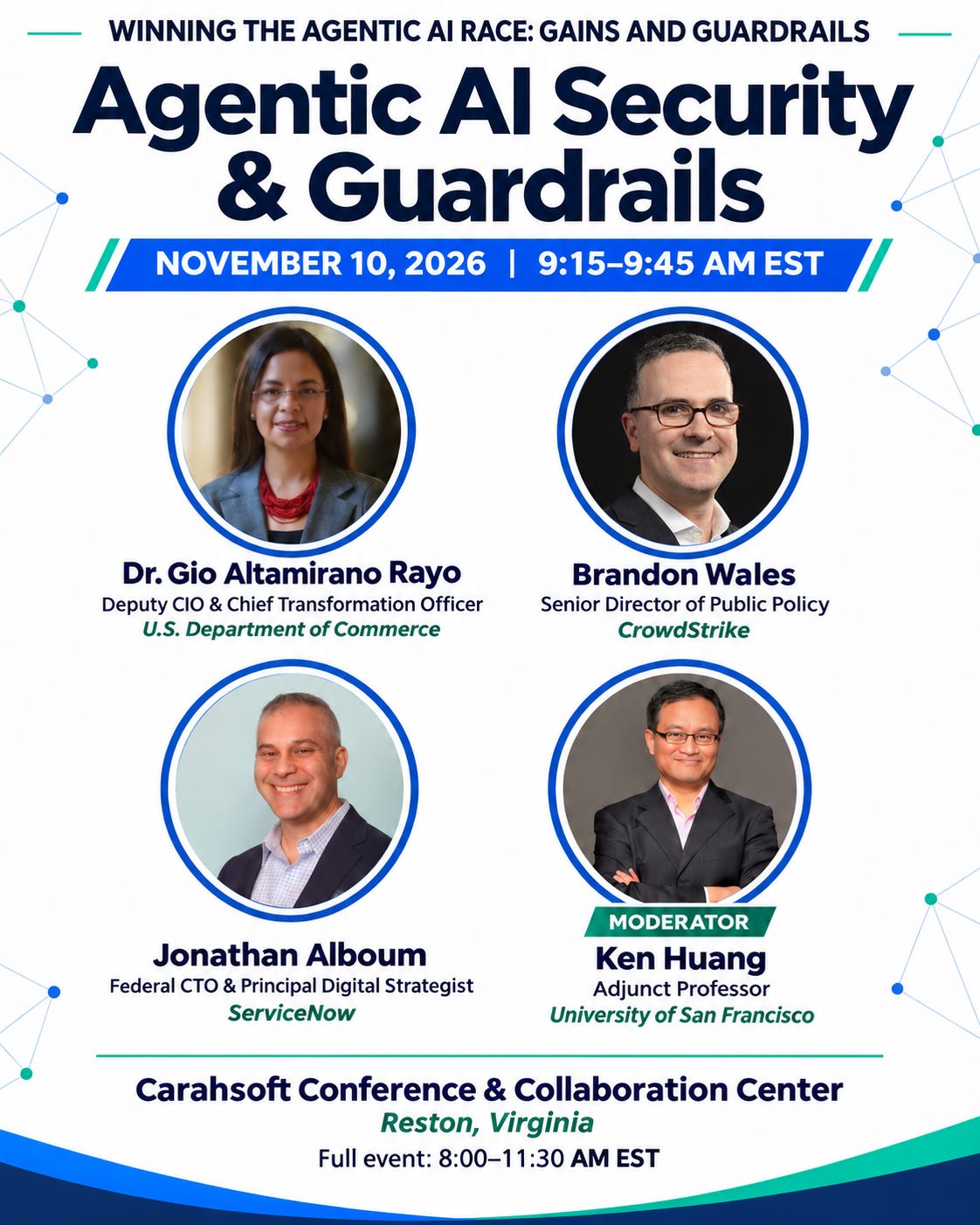
On November 10, 2026 (Tomorrow), I will moderate Agentic AI Security and Guardrails at Carahsoft’s Winning the Agentic AI Race: Gains and Guardrails event in Reston, Virginia. The panel runs from 9:15 to 9:45 a.m. EST, within a morning program scheduled for 8:00 to 11:30 a.m. EST at the Carahsoft Conference & Collaboration Center. The discussion brings together a federal transformation leader, a cybersecurity public-policy leader, and an enterprise workflow technology leader to examine a question that increasingly connects their work: how do we give AI agents enough authority to accomplish useful tasks while maintaining control over their consequences?
Joining me are Dr. Gio Altamirano Rayo, J.D., Ph.D., Deputy CIO and Chief Transformation Officer at the U.S. Department of Commerce; Brandon Wales, Senior Director of Public Policy at CrowdStrike; and Jonathan Alboum, Federal CTO and Principal Digital Strategist at ServiceNow. I will moderate as Ken Huang, an AI book author, Cloud Security Alliance AI safety working group co-chair, and adjunct professor at the University of San Francisco. The event registration page contains the public agenda, speaker profiles, and attendance details.
The broader program connects security with the economic and operational questions surrounding adoption. Its listed speakers include Brian Epley, Chief Information Officer and Chief AI Officer at the Department of Commerce; Lewis Shepherd, Federal CTO at VMware by Broadcom; Felipe Millon, who leads government go-to-market at OpenAI; and Asim Rasheed, Federal Sales Engineer at Abnormal AI. The additional panels feature David Shepherd, Lead for AI Risk and Resilience at the Department of Homeland Security Science and Technology Directorate; Ieshia Smith, Federal Solutions Engineer at Wiz; Ben Gould, Director of Federal Solutions at Klique; Brian Stancil, Head of Federal at Gray Swan AI; and Frank Rohrer, VP of Public Sector at Rolebotz. Together with our four-person panel, these thirteen speakers span government, enterprise platforms, and AI security.
The agenda’s combination of gains and guardrails reflects a practical dependency. An agent may complete a task quickly, yet create additional work through incorrect changes, unnecessary escalation, or an investigation into what it accessed. Productivity has to survive those costs. Security teams, meanwhile, need to explain how their controls support useful delegation instead of making every action wait for a person. Those two objectives belong in the same deployment decision.
I plan to explore how agencies define their system boundaries when agents invoke external services, how organizations preserve accountability across non-human identities, and how operators govern systems whose tools, memory, or code can change. Multi-agent coordination adds another dimension: a collection of individually permitted actions can create an unacceptable combined outcome. We should examine both the authority of each agent and the behavior of the workflow as a whole.
These are the questions I am bringing to the discussion, rather than conclusions attributed to panelists before they speak. My own starting point is that an organization should be able to connect a consequential action to an approved purpose, a bounded delegation, an enforcement decision, and an observable result. Below, I develop that position into practical deployment guidance and several directions I believe deserve attention over the coming years.