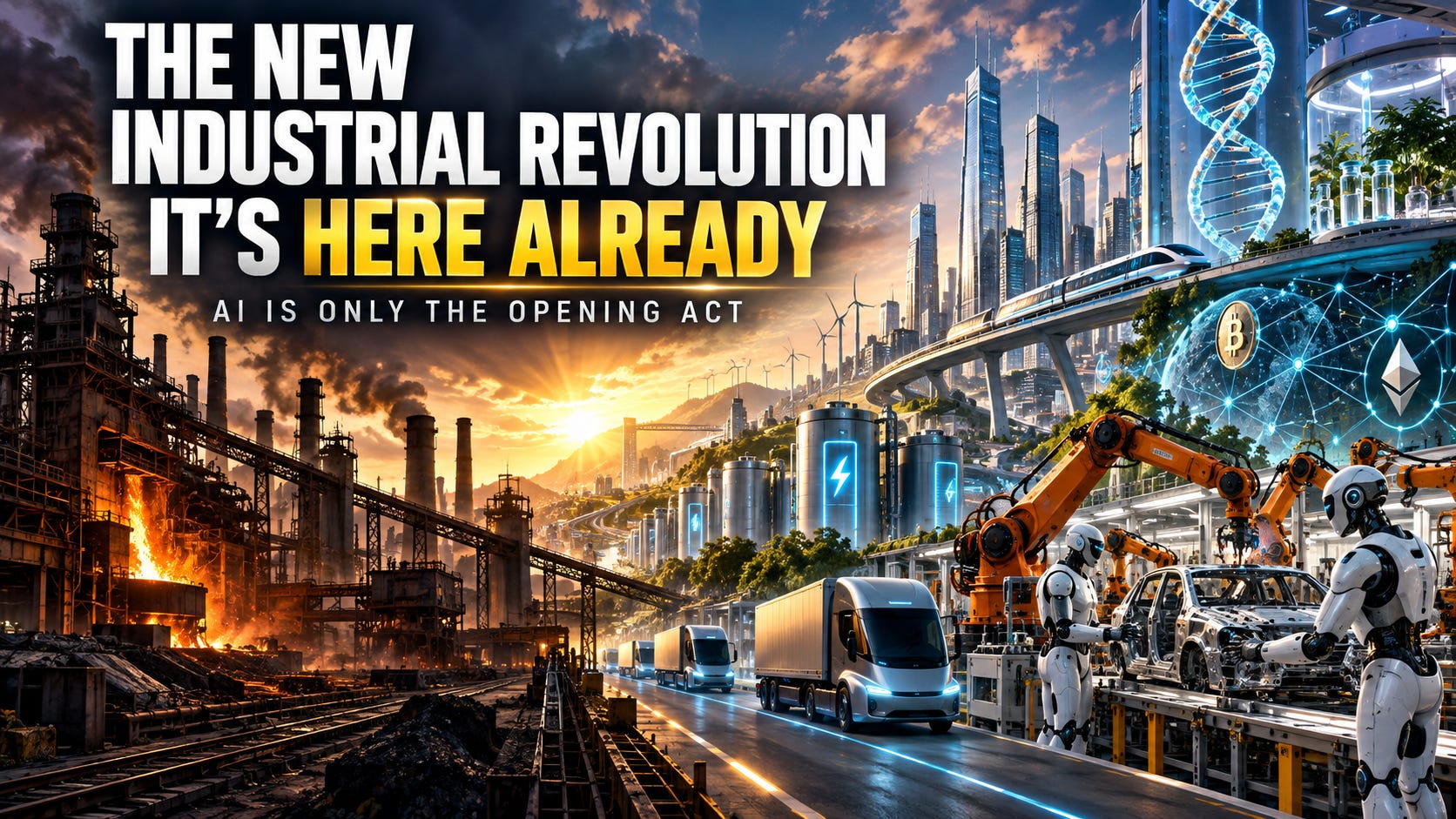
AI is only the opening act. What comes next will change the value of labor, money and nearly every asset you own.
Cathie Wood says we are on the brink of a new Industrial Revolution. I think she is right, although I would move the clock forward a little. We are not waiting for it to begin. We are already living through its opening stages.
I know Wood has made some predictions that required a strong stomach and a very patient brokerage account. She is often early, and early can look exactly like wrong for a surprisingly long time. But her central argument is hard to dispute. Several world-changing technologies are maturing at the same time, and they are starting to feed off one another.
Artificial intelligence makes robots smarter. Better batteries make those robots, electric vehicles and autonomous machines practical. AI is accelerating medical research, writing software and analyzing mountains of data that no human staff could process. Blockchain is creating financial rails that allow money and assets to move without the usual collection of toll collectors standing in the middle
ARK Invest calls this period “The Great Acceleration.” Wood’s firm believes artificial intelligence, robotics, energy storage, DNA sequencing and blockchain are converging into a new economic system. ARK even believes the resulting productivity boom could push real economic growth into the high single digits by the end of the decade. That is an aggressive forecast, but the basic mechanism behind it makes perfect sense.
I have been watching markets, technology and monetary insanity long enough to recognize when several powerful trends are colliding. This is one of those moments. It will create enormous wealth, wipe out entire business models and make a lot of supposedly safe careers far less safe. Most people will notice only after the damage and opportunity have already become obvious.
That is where the Insider Advantage comes in. The mainstream press will tell you AI is changing the world, usually six months after everyone else figures it out. Inside the Insider Advantage, we are going to follow the money, identify the bottlenecks and look at what this revolution means for gold, silver, energy, bitcoin, commodities and the purchasing power of the dollar. Knowing that the world is changing is interesting; knowing where the profits and landmines are located is valuable.
The First Revolution Replaced Muscle
The original Industrial Revolution replaced human and animal muscle with mechanical power. Steam engines, factories and railroads allowed one worker to produce what previously required dozens or hundreds of people. Electrification expanded that power, and computers eventually connected everything. Now intelligence itself is being mechanized.
The first Industrial Revolution replaced the horse. This one may replace the rider, his accountant and the middle manager supervising both of them. That sounds like a joke until you look at what today’s AI systems can already accomplish. We have barely left the starting gate.
The internet made information abundant, but information still required someone to read it, understand it and act on it. AI can increasingly perform all three jobs. It can analyze documents, compare alternatives, create a plan and execute much of that plan. Intelligence is gradually becoming a utility that can be purchased whenever it is needed.
That change is bigger than the chatbot on your phone. A one-person business can now conduct research, create advertising, produce videos, analyze customers and write software with tools that cost a few hundred dollars per month. Work that once required an office full of people can increasingly be done by one capable operator. For entrepreneurs, this is the greatest force multiplier ever invented.
It will be less pleasant for people whose jobs consist largely of moving information from one screen to another. AI does not need health insurance, paid vacation or another meeting to discuss the meeting held yesterday. Once an AI system learns a task, duplicating that worker costs almost nothing. That is when the economics become brutal.
Then Intelligence Gets Arms and Legs
AI can reorganize the office, but robotics will reorganize the physical economy. Traditional factory robots were expensive machines designed to repeat one narrow movement thousands of times. They worked well until the environment changed or somebody left a toolbox where it did not belong. Modern AI gives machines the ability to see, understand instructions and adapt.
That means robots are moving beyond welding automobile frames and stacking identical boxes. They are beginning to handle unfamiliar objects, navigate changing environments and learn by observing people. Warehouses, farms, construction sites, restaurants, hospitals and nursing homes are all potential markets. The long-promised age of general-purpose robotics is finally starting to look less like science fiction and more like a capital budget.
Transportation will follow the same path. A privately owned car sits unused most of the day while depreciating in the driveway and increasing your insurance bill. An autonomous vehicle can operate continuously, turning transportation into a service rather than a possession. When that model works reliably, the economics of cars, trucking, delivery, insurance, parking and real estate all change with it.
My Tesla already handles most of my driving, and each improvement makes the future easier to see. The car is becoming a computer with wheels, cameras and a rapidly improving understanding of the world around it. It still does things that occasionally remind you a human being should remain involved. Then again, so do most Florida drivers.
The Greatest Deflationary Machine Ever Built
Technology is deflationary because it lets us produce more with less. AI reduces the cost of intelligence, robots reduce the cost of labor and batteries reduce the cost of storing energy. Autonomous vehicles reduce transportation costs, while AI-driven medical research can reduce the time and money needed to develop treatments. Each technology attacks a different form of scarcity.
The government is working just as hard in the opposite direction. Washington creates more debt, the Federal Reserve creates more currency and the dollar buys less. Productivity pushes real costs down while monetary inflation pushes nominal prices up. We are headed toward a historic collision between technological deflation and monetary inflation.
This collision will make conventional economic statistics even more misleading than they already are. A product may become ten times more powerful while selling for the same dollar price. Government statistics can call that price stability, but the underlying economics tell a different story. You received far more value while the currency used to measure that value continued to deteriorate.
The Dollar Time Machine shows what government money has done to your purchasing power. This new Industrial Revolution shows what technology is doing to production costs. Both forces are accelerating at the same time. Understanding where they meet may be the most important investment question of the next decade.
Why Wood Has the Big Picture Right
Wood understands that the real story is convergence. AI combined with robotics is more valuable than either one alone. AI combined with genomics can shrink years of medical research into months. AI combined with autonomous transportation can turn a depreciating vehicle into a working asset.
Add blockchain, and software agents can eventually conduct business and exchange value without constant human supervision. One AI could hire another AI, purchase computing power, pay for electricity and deliver a finished product. That sounds strange until you remember that online advertising markets have already been conducting billions of automated transactions for years. The difference is that future systems will be far more capable and operate across much larger portions of the economy.
These technologies multiply one another’s value. Better AI produces better robots, better robots generate more data and more data improves the AI. Falling costs lead to wider adoption, which creates even more data and pushes costs down again. Traditional Wall Street models were not built for feedback loops like this.
Wood may still be wrong about which companies capture the prize. History is filled with revolutionary technologies that changed society while bankrupting most of the early companies competing in them. The automobile transformed America, but the country once had thousands of automakers that no longer exist. Identifying the revolution and selecting the winning investment are two very different skills.
That is why I am more interested in the bottlenecks than the latest AI darling. AI may become abundant, but the electricity, advanced semiconductors, copper, data centers and manufacturing capacity needed to run it will not. Robots still need motors, sensors, batteries and raw materials. The digital economy remains stubbornly dependent upon the physical world.
Follow the Bottlenecks
During a gold rush, everyone wants to own the mine. The steadier money often goes to the people selling picks, transporting ore and controlling the land. The same principle applies here. The most visible company may capture the headlines while an obscure infrastructure supplier quietly collects money from the entire industry.
Energy could become the biggest constraint of all. Data centers consume enormous amounts of electricity, and adding millions of robots and autonomous machines will increase demand further. Power generation, storage and transmission cannot be expanded with a software update. Whoever controls reliable and affordable energy will hold one of the keys to the revolution.
The monetary angle is equally important. If AI produces a historic productivity boom while governments continue creating debt and currency, capital will seek assets that cannot be manufactured at will. That points toward energy, commodities, precious metals, bitcoin and selected companies controlling scarce infrastructure. Abundant intelligence may make genuine scarcity more valuable, not less.
Gold and silver sit directly at the intersection of technology and monetary distrust. Silver is an industrial input as well as a monetary metal, while gold remains the world’s favorite vote of no confidence in government currency. Rising industrial demand, constrained mine supply and continued monetary debasement could become a powerful combination. That is one of the major themes we will be tracking for Insider Advantage members.
The Labor Market Is About to Be Repriced
Most white-collar professionals still think automation happens to factory workers and truck drivers. They assume a college degree, a license and a clean office will protect them. That assumption is about to become expensive. Routine intellectual labor may be easier to automate than many physical jobs.
AI does not need to eliminate an entire profession to cause major disruption. One lawyer, accountant, programmer or marketing executive using AI may eventually perform the work that required five people. The profession survives, but the staffing model collapses. Productivity gains are wonderful unless your salary was the inefficiency being eliminated.
Governments will respond with subsidies, regulations, taxes and promises to protect displaced workers. They will probably slow the transition in certain industries, but they will not stop it. Businesses have an overwhelming incentive to adopt tools that lower costs and increase output. Incentives matter more than intentions, and the economic incentive behind AI is enormous.
The Factory Whistle Is Already Blowing
History rarely announces itself with a press conference. The original Industrial Revolution appeared as a series of unrelated machines, businesses and productivity improvements. Only later did people understand that the entire structure of the economy had changed. The same process is happening again.
The chatbot writing an email, the Tesla navigating traffic, the warehouse robot moving packages and the computer analyzing a medical scan look like separate developments. They are pieces of the same system. The revolution becomes undeniable only after the infrastructure is built, costs collapse and old business models begin dying in public. By then, the best opportunities are usually gone.
Cathie Wood is right about the scale of what is coming. I simply think she is wrong about one word: coming. The new Industrial Revolution has already started. Most people just have not heard the factory whistle yet.
Insider Advantage members will hear it early and understand where it is leading. We will continue following the capital, identifying the scarce assets and separating genuine opportunities from companies that merely added “AI” to the investor presentation. If you want to understand the financial consequences before they become conventional wisdom, upgrade to the Insider Advantage today. The future is arriving whether your portfolio is ready or not.