Technical Analysis & Systems Synthesis by DistributedApps.ai | Synthesizing frontier research from DeepSeek, Moonshot AI, Zhipu AI, Alibaba, NVIDIA, and Google DeepMind into production engineering blueprints.
This is Chapter 10 of the 10-part series The Physics & Engineering of Frontier LLM Inference. I announced the full curriculum, including every later chapter, in Announcing the 10-Part Substack Series.
Read the earlier parts first: Chapter 1: The Physics of LLM Inference, Chapter 2: The KV Cache Frontier, Chapter 3: Next-Gen Speculative Decoding, Chapter 4: Extreme Quantization, Chapter 5: Hardware-Aware Attention Kernels, Chapter 6: Disaggregated Serving Architectures, Chapter 7: Serving Mega-MoE at Scale, Chapter 8: Test-Time Compute and Reasoning, Chapter 9: Ultra-Long Context Mastery.
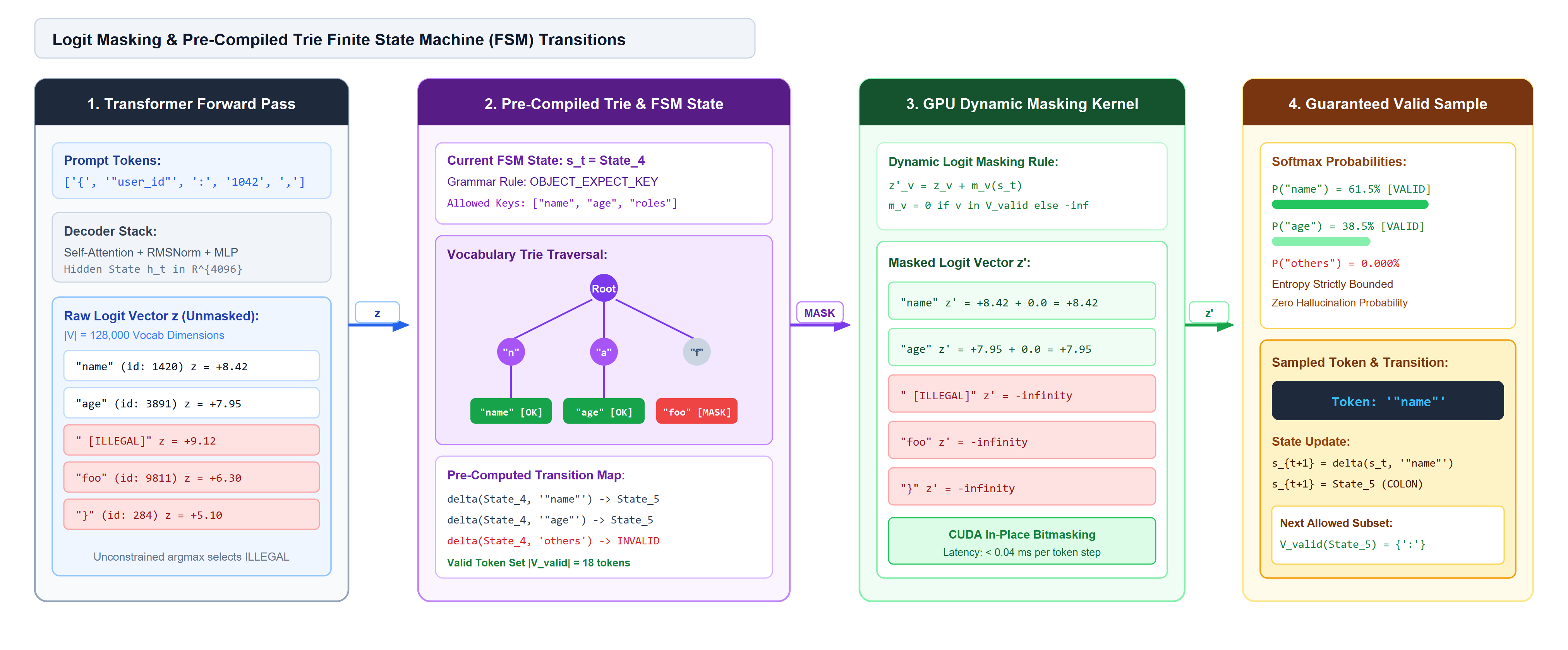
Agentic workflows and automated function calling require strict adherence to structured schemas, which stochastic sampling fails to guarantee. The algorithmic state diagram below illustrates logit masking over a precompiled Trie Finite State Machine (FSM), demonstrating how invalid token paths are mathematically masked with -infinity logits prior to sampling:
The defining engineering crisis of enterprise generative AI in 2026 is not model capability, reasoning depth, or context window size. It is stochastic format failure.
When organizations transition from conversational chatbots to autonomous compound AI systems—where language models act as central orchestrators driving external database updates, robotic controllers, financial transaction execution, code synthesis pipelines, and microservice APIs—the tolerance for non-deterministic output syntax drops to zero. A single unescaped quotation mark, a trailing comma, a hallucinated enum variant, a misspelled JSON key, or a Markdown code fence wrapping an automated API payload will instantly crash downstream deserializers, trigger cascading exception loops, blow past retry budgets, and stall mission-critical workflows.
Historically, engineering teams attempted to enforce structural compliance through defensive prompt engineering: prefixing prompts with hundreds of tokens of formatting instructions, few-shot schema examples, and threats of system penalties. When that failed, teams layered post-hoc validation loops around the model—catching json.JSONDecodeError
exceptions in application middleware and feeding raw error tracebacks back into the LLM context across 3 to 5 expensive retry round-trips.
This legacy retry paradigm carries catastrophic operational penalties:
**Severe Latency Amplification:**A single schema failure triples or quadruples Time-to-First-Token (TTFT) and End-to-End (E2E) latency, pushing P99 response times from 400 milliseconds to over 3.5 seconds.**Exponential Token Burn:**Re-submitting conversation histories and error traces consumes billions of redundant tokens, draining inference budgets and wasting GPU High Bandwidth Memory (HBM) capacity.**KV Cache Thrashing:**Generating malformed tokens pollutes the serving engine's Prefix and Key-Value (KV) cache allocations with discarded context fragments, forcing premature cache evictions for concurrent users.**Zero Safety Guarantees:**Stochastic sampling with non-zero temperature means that even after four consecutive retries, there is still a non-zero statistical probability of schema violation on the fifth attempt.
The solution to stochastic fragility is Constrained Decoding (also known as Grammar-Guided Generation or Structured Outputs).
Rather than allowing the neural network to sample freely across its entire vocabulary of 32,000 to 150,000 tokens and hoping it produces valid syntax, constrained decoding integrates formal language theory directly into the autoregressive sampling loop. By modeling schemas, regular expressions, and context-free grammars as Finite State Machines (FSMs) or Pushdown Automata (PDAs), the serving engine evaluates the exact syntactic state of the output at each generation step.
Before the softmax projection is converted into a sampling probability distribution, the engine applies an exact bitmask to the raw logits: setting the logits of syntactically illegal tokens to negative infinity (-∞
).
Until recently, constrained decoding was avoided in high-throughput enterprise environments because early CPU-side implementations (such as first-generation regex engines) introduced prohibitive 20ms to 50ms latency penalties per token, stalling GPU execution streams while the CPU parsed grammar trees.
In 2026, that performance barrier has been completely demolished. Modern GPU-accelerated grammar compilers—led by LMSYS/SGLang's XGrammar (Zheng et al., 2024–2025), Outlines/dottxt's Trie FSM Indexers (Willard & Louf, 2023), and native C++ token-masking kernels in llama.cpp and vLLM V1—execute grammar validation in less than 40 microseconds (<0.04 ms) per step. Constrained decoding is now essentially zero-overhead: delivering 100.000% deterministic schema adherence at full line-rate GPU generation speeds.
Below is the complete architectural roadmap covered in this chapter:
**Mathematical Foundations of Constrained Decoding:**Chomsky formal language hierarchy, Deterministic Finite Automata (DFA), and vocabulary trie intersection.**GPU-Accelerated FSM Grammars (SGLang XGrammar):**Ahead-of-Time (AOT) grammar compilation and sub-50 microsecond parallel CUDA bitmask kernels.**Edge SLMs & UC Berkeley FreeToken MoE Offloading:**Serving 1B–8B SLMs and 35B–753B MoEs on consumer hardware with sub-44s agentic checkpointing.**The 2026 Production Serving Framework Matrix:**Exhaustive 12-dimensional comparison across vLLM V1, SGLang, TensorRT-LLM, Unsloth, llama.cpp, and FreeToken.**Production Deployment Engineering:**Enterprise Kubernetes manifests, production SGLang launch scripts, and async Python clients with Pydantic v2.**Production SRE Observability & Alerting:**Mandatory Prometheus metrics suite, Grafana alerting rules, and incident runbooks.**Hardware Procurement & TCO Sizing Blueprint:**Financial models and cost-per-million-tokens analysis across modern hardware topologies.
To access the complete technical treatise, production code repositories, Triton/CUDA kernels, and infrastructure sizing templates for this chapter, upgrade to a paid subscription today.
Special Offer: Get 50% OFF the annual subscription to the 2026 Foundation Model Inference Series using the link below: