Technical Analysis & Systems Synthesis by DistributedApps.ai | Synthesizing frontier research from DeepSeek, Moonshot AI, Zhipu AI, Alibaba, NVIDIA, and Google DeepMind into production engineering blueprints.
This is Chapter 2 of the 10-part series The Physics & Engineering of Frontier LLM Inference. I announced the full curriculum, including every later chapter, in Announcing the 10-Part Substack Series.
Read the earlier parts first: Chapter 1: The Physics of LLM Inference.
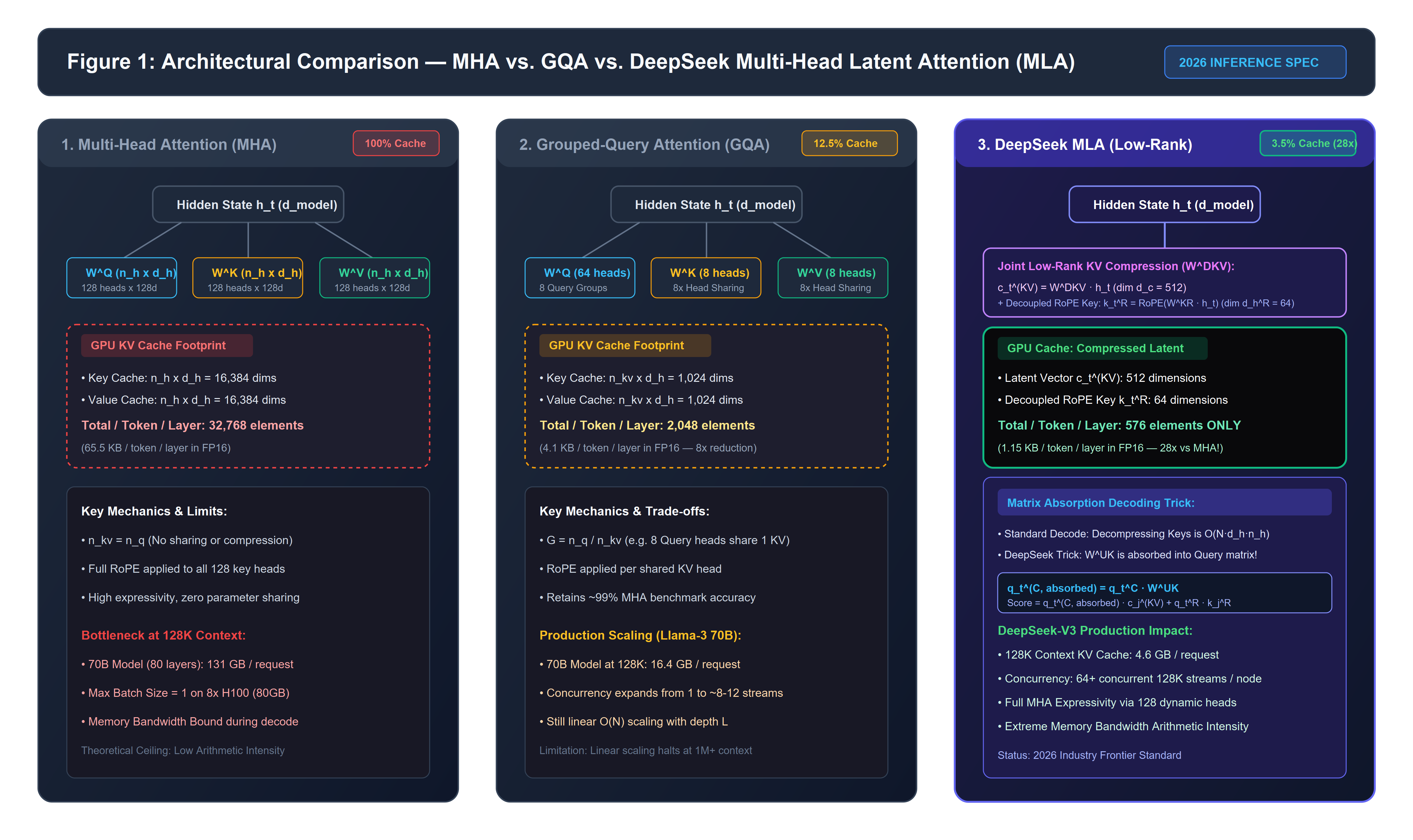
The key-value cache represents the single largest dynamic memory consumer during autoregressive generation. To overcome the prohibitive memory footprint of standard Multi-Head Attention (MHA) and Grouped-Query Attention (GQA), modern architectures employ low-rank compression. The architectural schematic below compares standard MHA, GQA, and DeepSeek Multi-Head Latent Attention (MLA), illustrating how MLA projects key-value states into a low-dimensional latent vector while decoupling positional rotary embeddings:
In the 2026 frontier of large language model inference, compute FLOPs are no longer the primary economic or structural barrier to scale. With the deployment of NVIDIA Blackwell B200 systems (delivering 4,500 TFLOP/s of dense FP4/FP8 compute per GPU) and custom ASIC accelerators, the operational bottleneck has decisively migrated to High-Bandwidth Memory (HBM) capacity and memory bus saturation during the autoregressive generation phase.
When serving frontier reasoning models, multi-turn coding agents, and 128k-to-1M token context windows, the static memory footprint of model weights is quickly eclipsed by the dynamic, explosive growth of the Key-Value (KV) Cache.
Consider the stark arithmetic of a standard Grouped-Query Attention (GQA) model like Llama-3-70B (8 KV heads, 80 layers, 128 head dimension) running in FP16 precision:
Per-Token Memory Cost: Each individual token requires2 × 80 layers × 8 KV heads × 128 dim × 2 bytes = 327,680 bytes
(327.68 KB) of VRAM.Single-Session 128k Footprint: A single active user stream generating or processing a 128,000 token context window consumes128,000 × 327.68 KB = 41.94 GB
of pure KV cache VRAM.Concurrency Collapse: On an 8x NVIDIA H100 (80GB) node offering 640 GB total VRAM, after allocating 140 GB for unquantized model weights and runtime workspaces, only ~450 GB remains for KV memory. In a 4k-token dialogue regime, the cluster comfortably sustains340+ concurrent streams. But the moment enterprise users submit 128k-token coding repositories or document analysis tasks, maximum batch concurrency violently collapses to just10 concurrent streams—a devastating 97% degradation in serving density.
To solve this existential economic wall, frontier AI labs have abandoned naive KV allocation in favor of four revolutionary architectural and systems breakthroughs:
Hybrid Compressed Sparse Attention (DeepSeek-V4 CSA/HCA) & MLA: Pioneered by DeepSeek-V2 and DeepSeek-V4, MLA compresses Key and Value projections into a shared 512-dimensional low-rank latent vector (c_t^{KV}
) coupled with a 64-dimensional decoupled Rotary Position Embedding (k_t^R
), unlocking a93.3% reduction in per-token KV footprintwhile maintaining the multi-head expressiveness of 128 attention heads.Global Prefix Caching & RadixAttention: Formalized in SGLang and productionized across frontier API gateways (such as Anthropic's 5-minute prompt caching TTL), representing KV caches as dynamic Radix Trees where shared system prompts, codebase trees, and few-shot examples are cached, reused, and managed via Least Recently Used (LRU) eviction.Cross-Layer KV Cache Sharing (KVShare): Exploiting high cosine similarity and functional redundancy across intermediate layers in 60+ layer transformer topologies, reducing KV memory by an additional 50% to 75%.Dynamic Attention Sparsification & Sink Eviction: Leveraging StreamingLLM attention sinks, H2O (Heavy Hitter Oracle), and SnapKV observation clusters to maintain stable, bounded KV cache memory pools during infinite-horizon generation.
This chapter provides a complete, mathematically rigorous, and production-tested deep dive into the engineering foundations of next-generation KV cache management:
Part I: The Mathematical Anatomy & Scaling Limits of MHA, MQA, and GQA
- Exact per-token memory derivations across precisions (FP16, FP8, INT4). * Arithmetic intensity in the decode phase: Why KV cache fetch throttles Tensor Core utilization to <5%. * The expressive capacity degradation curve of high-group GQA.
Part II: Hybrid Compressed Sparse Attention (DeepSeek-V4 CSA/HCA) & MLA — DeepSeek-V2/V3 Architectural Revolution
- Mathematical formulation of low-rank KV compression (
W^{DKV}
) and query compression (W^{DQ}
). * The RoPE Incompatibility Problem: Why non-commutative positional rotations break low-rank absorption. * The Decoupled RoPE Solution: Separating content vectors (c_t^{KV}
) from positional keys (k_t^R
). * Inference-Time Matrix Absorption: Pre-multiplying up-projection matrices into query projections to eliminate intermediate high-dimensional KV tensor reconstruction.
Part III: Global Prefix Caching, RadixAttention & 5-Minute TTL Dynamics
- Trie vs Radix Tree mechanics for token sequence representation. * SGLang RadixAttention algorithms: Prefix matching, node splitting, reference counting, and LRU eviction. * Economic analysis of Anthropic prompt caching (1.25x write cost, 0.1x read cost, 5-minute sliding TTL, break-even calculus).
Part IV: Cross-Layer KV Cache Sharing (KVShare)
- Representation similarity across Transformer layer depths (GLM-5.2 / GLM-5.3 / DeepSeek layer profiling). * Anchor layers vs follower layers: Topologies for 1:2 and 1:4 cross-layer sharing. * Memory savings vs quality retention trade-offs.
Part V: Dynamic Token Eviction & Sparse Attention Mechanics
- Softmax normalization pressure and the Initial Attention Sink phenomenon (StreamingLLM). * Heavy Hitter Oracle (H2O) cumulative attention tracking. * SnapKV prompt observation clustering.
Part VI: Production Simulation Suite & Benchmarking Engine (Python)
- Full, runnable Python implementation of MLA, RadixAttention Tree, KVShare Manager, and comparative benchmark suite.
Part VII: Production Failure Modes, Quantization Hazards & The 2026 Serving Blueprint
- Radix tree memory fragmentation under high-frequency chat churn. * Numerical overflow and scaling challenges in FP8/FP4 low-rank dequantization. * Architectural decision matrix for 2026 LLM inference engines.
Part VIII: Verified Academic Citations & Industrial Post-Mortems
Below is the complete architectural roadmap covered in this chapter:
**The KV Cache Memory Crisis & Scaling Invariants:**Mathematical derivation of KV cache growth across multi-head attention (MHA), grouped-query attention (GQA), and multi-head latent attention (MLA).**DeepSeek Multi-Head Latent Attention (MLA) Architecture:**Low-rank compression of key-value projections into a 512-dimensional latent vector and decoupled rotary position embeddings.**Global Prefix Caching Systems:**Anthropic 5-minute sliding TTL caching versus SGLang RadixAttention dynamic radix-tree hash structures.**Zhipu AI KVShare & Cross-Layer Deduplication:**Sharing KV projections across adjacent transformer layers to cut memory traffic by up to 50%.**Dynamic Cache Eviction & Attention Sinks:**StreamingLLM initial token sinks, Heavy-Hitter Oracle (H2O) cumulative budgeting, and SnapKV landmark clustering.**Production Implementation & Benchmarks:**End-to-end PyTorch modules, memory scaling matrices, and serving benchmarks.
To access the complete technical treatise, production code repositories, Triton/CUDA kernels, and infrastructure sizing templates for this chapter, upgrade to a paid subscription today.
Special Offer: Get 50% OFF the annual subscription to the 2026 Foundation Model Inference Series using the link below: