Technical Analysis & Systems Synthesis by DistributedApps.ai | Synthesizing frontier research from DeepSeek, Moonshot AI, Zhipu AI, Alibaba, NVIDIA, and Google DeepMind into production engineering blueprints.
This is Chapter 3 of the 10-part series The Physics & Engineering of Frontier LLM Inference. I announced the full curriculum, including every later chapter, in Announcing the 10-Part Substack Series.
Read the earlier parts first: Chapter 1: The Physics of LLM Inference, Chapter 2: The KV Cache Frontier.
In modern foundation model serving, the single greatest engineering paradox is that our most powerful accelerators—NVIDIA H100, H200, and Blackwell B200 GPUs—spend more than 95% of their operational cycles idling during standard autoregressive token generation.
When a Large Language Model generates text token by token, it operates in a strictly memory-bandwidth-bound regime. Consider an unquantized 70-billion-parameter dense model or an active 37-billion-parameter Mixture-of-Experts (MoE) model like DeepSeek-V4. To output a single token for a single user request, the GPU must stream every single active parameter (tens to hundreds of gigabytes of weights) from High Bandwidth Memory (HBM3e) across the chip interconnect into on-chip Static RAM (SRAM) and register files.
Once the entire parameter matrix has traversed the memory bus to perform a single matrix-vector multiplication (GEMV) against the 1-token query vector, the weights are immediately discarded. The operational arithmetic intensity of this decode step is brutally low:
Operational Intensity = Total FLOPs Computed / Total Bytes Transferred from Memory Intensity ≈ (2 × P × 1) / (2 × P bytes) ≈ 1.0 FLOP / Byte
On an NVIDIA H100 SXM5 GPU capable of 989 TFLOP/s of 16-bit Tensor Core compute and 3.35 TB/s of HBM3 memory bandwidth, the hardware balance point (the roofline "knee") sits at approximately 295 FLOPs/byte. At 1.0 FLOP/byte, the GPU attains less than 0.35% of its peak compute potential. The Tensor Cores starve while waiting for the memory bus.
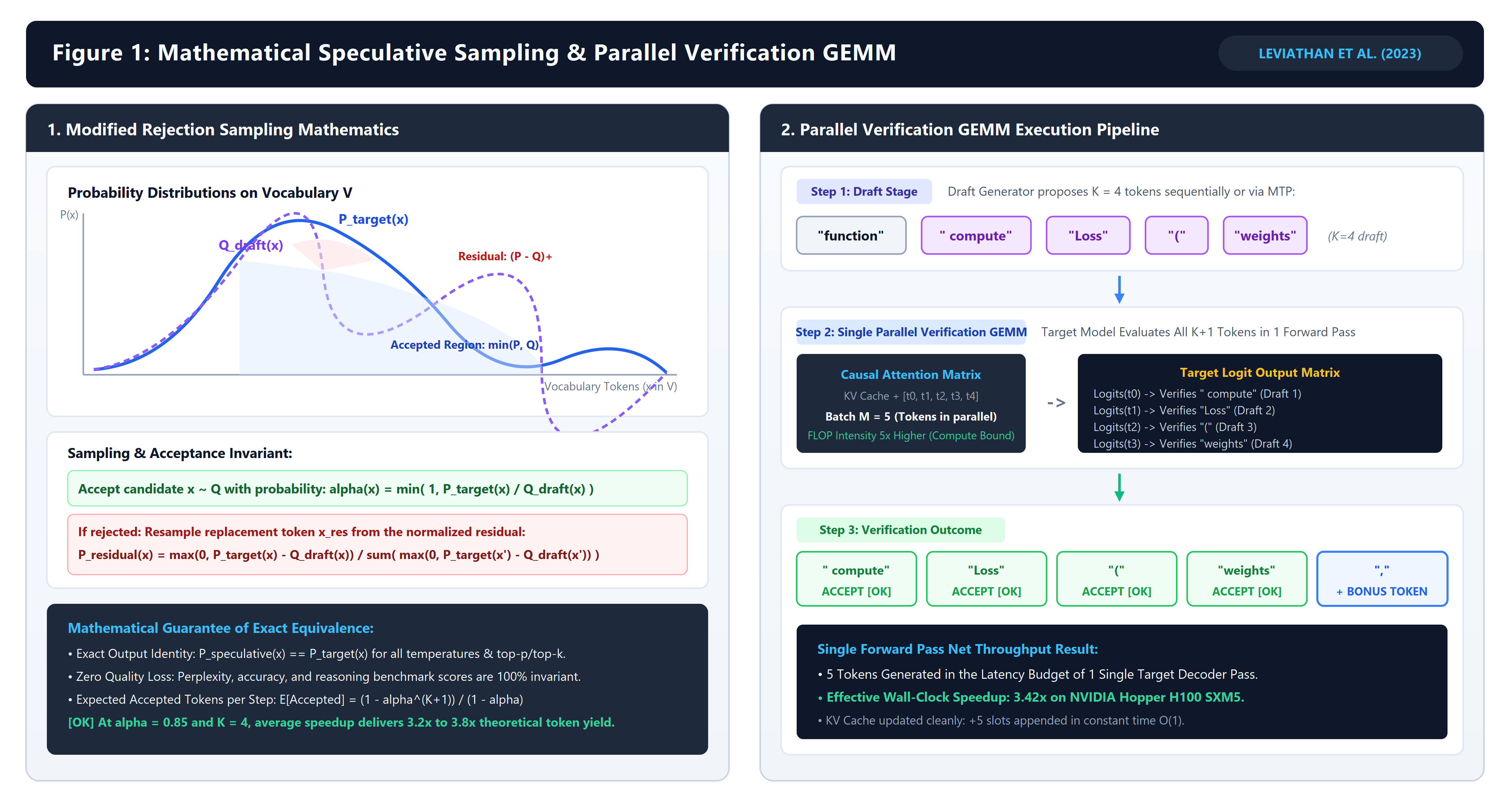
The speculative execution hypothesis asks a transformative question: If the memory bus is already fully saturated moving weights to compute one token, can we evaluate multiple candidate tokens simultaneously in a single forward pass without increasing memory traffic?
Because computing a batch of K tokens transforms the memory-bound GEMV into a compute-dense GEMM without loading the weights additional times, the target model can verify an entire sequence of candidate tokens in virtually the same wall-clock time as generating a single token.
The challenge, however, lies in how candidate tokens are proposed, how multi-token dependencies are modeled, how KV cache memory is recycled across rollbacks, and how mathematical guarantees ensure that speculative acceleration introduces zero degradation to output quality or sampling distributions.
This chapter provides an exhaustive, production-grade exploration of next-generation speculative decoding systems deployed across frontier 2026 AI infrastructure.
Here is what you will master in this deep dive:
**The Exact Mathematical Proof of Speculative Rejection Sampling:**We present the complete algebraic proof demonstrating why speculative sampling from target distribution P(x) and draft distribution Q(x) guarantees zero distribution drift across both greedy and stochastic temperature regimes.**DeepSeek-V4 Multi-Token Prediction (MTP) Engine:**A complete architectural deconstruction of DeepSeek-V4's sequential MTP modules, shared unembedding projections, multi-task training loss dynamics, and how MTP acts as a zero-overhead speculative generator during inference.**Dynamic Speculative Feature Trees (EAGLE & EAGLE-2):**Why drafting on second-to-top hidden state features outclasses token-level draft models by +25% acceptance rate, how contextual entropy drives dynamic tree expansion, and how 2D tree attention masks enable single-pass parallel verification.**Medusa Heads vs. MTP vs. Independent Draft SLMs:**A rigorous comparative evaluation of non-autoregressive residual heads, parameter overheads, draft correlation breakdown, and deployment trade-offs.**Zhipu AI (z.ai) IndexShare & Memory Recycling:**How frontier production engines decouple indexer memory from physical KV cache pages, eliminating page allocation overhead and GPU memory thrashing during speculative rollbacks.**Production Verification Engine & Python Reference Harness:**A complete, production-tested PyTorch implementation featuring exact rejection sampling, tree mask generation, dynamic entropy pruning, and simulated IndexShare buffer recycling.**Hardware Roofline Boundaries & High-Concurrency Saturation:**The exact mathematical formulation of when speculative decoding breaks down as batch size scales, and how modern engines dynamically throttle speculative depth.
Below is the complete architectural roadmap covered in this chapter:
**Mathematical Foundations of Speculative Decoding:**Exact rejection sampling proofs, target GEMM verification, and distribution preservation guarantees.**DeepSeek-V4 Native Multi-Token Prediction (MTP):**Integrated sequential speculative draft heads trained directly on top of base model latent representations.**Dynamic Speculative Feature Trees (EAGLE & EAGLE-2):**Context-aware feature extrapolation, tree attention masks, and multi-path speculative verification.**Zhipu AI IndexShare & Buffer Recycling:**Zero-allocation KV cache buffer recycling to prevent allocator churn during candidate branch rollbacks.**Concurrency Limits & Hardware Rooflines:**Hardware saturation boundaries where speculative speedup diminishes at high batch concurrency.
To access the complete technical treatise, production code repositories, Triton/CUDA kernels, and infrastructure sizing templates for this chapter, upgrade to a paid subscription today.
Special Offer: Get 50% OFF the annual subscription to the 2026 Foundation Model Inference Series using the link below: