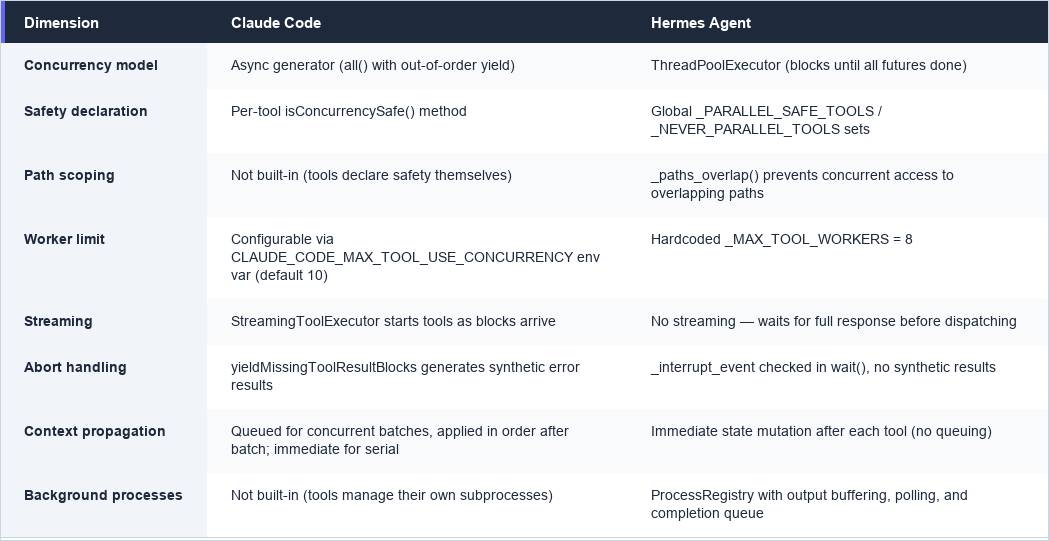
Tool orchestration is the layer between "the model wants to call 5 tools" and "those 5 tools actually execute safely and efficiently." It decides which tools can run in parallel, which must run serially, and what happens when a tool fails mid-batch. Without it, an agent either serializes everything (slow) or parallelizes everything (dangerous) — orchestration is the logic that threads the needle between those two failure modes, and it's what separates a production harness from a weekend prototype.
Claude Code's orchestration layer lives in toolOrchestration.ts
and is built around a single key insight: group tool calls into batches by concurrency safety, then run each batch either fully parallel or fully serial.
The partitioning function uses a reduce over the tool_use blocks, calling isConcurrencySafe()
on each tool's parsed input. Adjacent safe tools get merged into the same batch; any unsafe tool starts a new serial batch.
// src/services/tools/toolOrchestration.ts
// Groups tool_use blocks into concurrent or serial batches.
// Conservative: if parsing fails or isConcurrencySafe() throws, defaults to serial.
function partitionToolCalls(
toolUseMessages: ToolUseBlock[],
toolUseContext: ToolUseContext,
): Batch[] {
return toolUseMessages.reduce((acc: Batch[], toolUse) => {
const tool = findToolByName(toolUseContext.options.tools, toolUse.name)
const parsedInput = tool?.inputSchema.safeParse(toolUse.input)
const isConcurrencySafe = parsedInput?.success
? (() => {
try { return Boolean(tool?.isConcurrencySafe(parsedInput.data)) }
catch { return false }
})()
: false
// Merge into the last batch if it's also concurrent; otherwise start a new one
if (isConcurrencySafe && acc[acc.length - 1]?.isConcurrencySafe) {
acc[acc.length - 1]!.blocks.push(toolUse)
} else {
acc.push({ isConcurrencySafe, blocks: [toolUse] })
}
return acc
}, [])
}
For a sequence like Read, Read, Write, Read, Bash(rm)
, this produces four batches: [Read, Read]
concurrent, [Write]
serial, [Read]
concurrent, [Bash]
serial. Two reads run together; the destructive command runs alone.
Concurrent batches use an all
async generator that yields results out-of-order as they complete — so a 1-second tool doesn't wait behind a 5-second tool.
// src/services/tools/toolOrchestration.ts
// Runs all tools in the batch simultaneously, up to CLAUDE_CODE_MAX_TOOL_USE_CONCURRENCY workers.
// Results stream out as each tool finishes, not in input order.
async function* runToolsConcurrently(
toolUseMessages: ToolUseBlock[],
assistantMessages: AssistantMessage[],
canUseTool: CanUseToolFn,
toolUseContext: ToolUseContext,
): AsyncGenerator<MessageUpdateLazy, void> {
yield* all(
toolUseMessages.map(async function* (toolUse) {
// Mark as in-progress for UI tracking
toolUseContext.setInProgressToolUseIDs(prev => new Set(prev).add(toolUse.id))
yield* runToolUse(toolUse, /* ... */, canUseTool, toolUseContext)
markToolUseAsComplete(toolUseContext, toolUse.id)
}),
getMaxToolUseConcurrency(), // reads CLAUDE_CODE_MAX_TOOL_USE_CONCURRENCY, default 10
)
}
Serial batches apply context modifiers immediately after each tool, so the next tool sees the updated state (e.g., a changed working directory).
// src/services/tools/toolOrchestration.ts
// Runs tools one at a time. Context changes (like cwd updates) apply before the next tool.
async function* runToolsSerially(/* ... */): AsyncGenerator<MessageUpdate, void> {
let currentContext = toolUseContext
for (const toolUse of toolUseMessages) {
for await (const update of runToolUse(toolUse, /* ... */, currentContext)) {
if (update.contextModifier) {
// Apply immediately — next tool in the loop sees this change
currentContext = update.contextModifier.modifyContext(currentContext)
}
yield { message: update.message, newContext: currentContext }
}
}
}
The StreamingToolExecutor
starts executing tools as their blocks arrive during streaming, rather than waiting for the full response. When the user interrupts mid-execution, yieldMissingToolResultBlocks
generates synthetic tool_result
error blocks for any tool*use that never completed — maintaining the invariant that every tool*use has a matching `
tool_result`.
// src/query.ts
// Generates error tool_results for any tool_use that was interrupted before completing.
// Without this, the model would see orphaned tool_use blocks and get confused.
function* yieldMissingToolResultBlocks(
assistantMessages: AssistantMessage[],
errorMessage: string,
) {
for (const assistantMessage of assistantMessages) {
const toolUseBlocks = /* filter content for tool_use blocks */
for (const toolUse of toolUseBlocks) {
yield createUserMessage({
content: [{
type: 'tool_result',
content: errorMessage, // e.g. "Interrupted by user"
is_error: true,
tool_use_id: toolUse.id,
}],
})
}
}
}
The design choices here are deliberate: concurrency is opt-in per tool (via isConcurrencySafe
), the worker limit is externally configurable, and context propagation is deferred for concurrent batches to keep ordering deterministic.
Hermes takes a heuristic approach: instead of per-tool declarations, it maintains global sets of known-safe and known-unsafe tool names, then adds path-overlap detection for file tools.
# hermes-agent/run_agent.py
# Tools that must never run concurrently — interactive or user-facing.
_NEVER_PARALLEL_TOOLS = frozenset({"clarify"})
# Read-only tools with no shared mutable session state — safe to parallelize.
_PARALLEL_SAFE_TOOLS = frozenset({
"ha_get_state", "ha_list_entities", "ha_list_services",
"read_file", "search_files", "session_search", "skill_view",
"skills_list", "vision_analyze", "web_extract", "web_search",
})
# File tools that can run concurrently only when targeting independent paths.
_PATH_SCOPED_TOOLS = frozenset({"read_file", "write_file", "patch"})
# Hard cap on concurrent worker threads.
_MAX_TOOL_WORKERS = 8
def _should_parallelize_tool_batch(tool_calls) -> bool:
"""Return True when a tool-call batch is safe to run concurrently."""
if len(tool_calls) <= 1:
return False # No point parallelizing a single tool
tool_names = [tc.function.name for tc in tool_calls]
# Any never-parallel tool in the batch forces serial execution
if any(name in _NEVER_PARALLEL_TOOLS for name in tool_names):
return False
reserved_paths: list[Path] = []
for tool_call in tool_calls:
tool_name = tool_call.function.name
try:
function_args = json.loads(tool_call.function.arguments)
except Exception:
return False # Unparseable args → default to serial (safe)
if tool_name in _PATH_SCOPED_TOOLS:
scoped_path = _extract_parallel_scope_path(tool_name, function_args)
if scoped_path is None:
return False
# Reject if this path overlaps with any already-reserved path
if any(_paths_overlap(scoped_path, existing) for existing in reserved_paths):
return False
reserved_paths.append(scoped_path)
continue
if tool_name not in _PARALLEL_SAFE_TOOLS:
return False # Unknown tool → serial
return True
# hermes-agent/run_agent.py
# Prevents two file tools from running concurrently if one path is a prefix of the other.
# e.g., read_file("/etc") and read_file("/etc/passwd") would overlap.
def _paths_overlap(left: Path, right: Path) -> bool:
"""Return True when two paths may refer to the same subtree."""
left_parts = left.parts
right_parts = right.parts
common_len = min(len(left_parts), len(right_parts))
# If one path is a prefix of the other, they overlap
return left_parts[:common_len] == right_parts[:common_len]
When _should_parallelize_tool_batch()
returns True, Hermes dispatches all tools to a ThreadPoolExecutor
and waits for all futures to complete before processing results.
# hermes-agent/run_agent.py
# Parallel execution path — all tools in the batch run simultaneously.
max_workers = min(num_tools, _MAX_TOOL_WORKERS) # Never exceed 8 workers
with concurrent.futures.ThreadPoolExecutor(max_workers=max_workers) as executor:
futures = []
for i, (tc, name, args) in enumerate(parsed_calls):
# Each tool call is submitted as an independent future
f = executor.submit(_run_tool, i, tc, name, args)
futures.append(f)
# Block until all tools complete (errors captured inside _run_tool)
concurrent.futures.wait(futures)
# Results are collected in order after all futures finish
For tools that spawn background processes (via terminal(background=true)
), Hermes uses a ProcessRegistry
singleton that tracks every spawned process across the agent's lifetime.
# hermes-agent/tools/process_registry.py
# Global registry — thread-safe, survives across agent turns.
class ProcessRegistry:
"""In-memory registry of running and finished background processes.
Provides: output buffering (200KB rolling window), status polling,
blocking wait with interrupt support, kill, and crash recovery via
JSON checkpoint file.
"""
def __init__(self):
self._running: Dict[str, ProcessSession] = {}
self._finished: Dict[str, ProcessSession] = {}
self._lock = threading.Lock()
# Processes with notify_on_complete push here on exit,
# triggering a new agent turn automatically.
self.completion_queue: queue.Queue = queue.Queue()
def spawn_local(self, command: str, ...) -> ProcessSession:
# Spawns via subprocess.Popen with a reader thread for live output
...
def poll(self, session_id: str) -> dict:
# Non-blocking status check — returns output preview + exit code
...
def wait(self, session_id: str, timeout: int = None) -> dict:
# Blocking wait with interrupt support (checks _interrupt_event)
...
The completion_queue
is particularly useful for long-running background tasks: when a process exits, it pushes a completion event that the CLI loop drains to auto-trigger a new agent turn with the results.