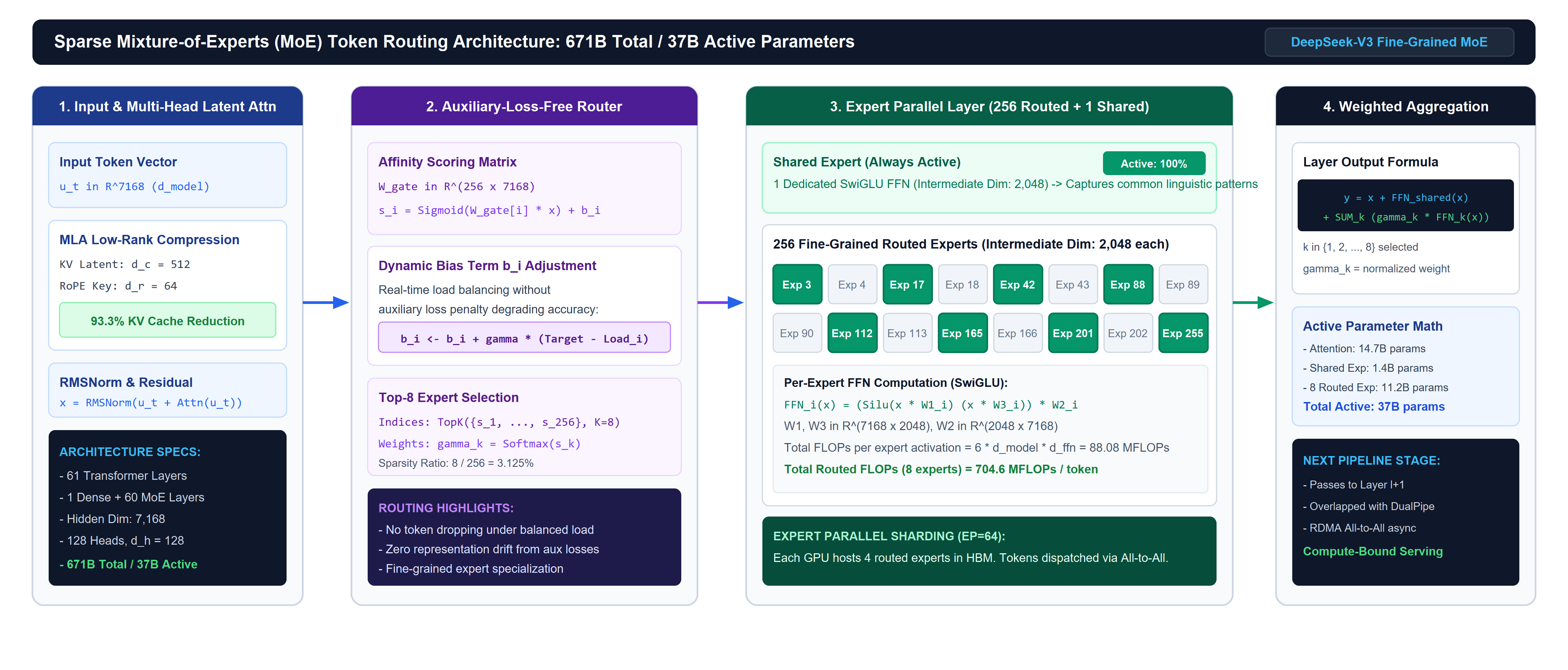
Auxiliary-Loss-Free Bias Routing, 4D Parallelism (TPxPPxEPxDP), Bidirectional DualPipe Overlap, and 100k+ GPU Non-Blocking Clos Interconnects
*Technical Analysis & Systems Synthesis by *DistributedApps.ai | Synthesizing frontier research from DeepSeek, Moonshot AI, Zhipu AI, Alibaba, NVIDIA, and Google DeepMind into production engineering blueprints.
This is Chapter 7 of the 10-part series The Physics & Engineering of Frontier LLM Inference. I announced the full curriculum, including every later chapter, in Announcing the 10-Part Substack Series.
Read the earlier parts first: Chapter 1: The Physics of LLM Inference, Chapter 2: The KV Cache Frontier, Chapter 3: Next-Gen Speculative Decoding, Chapter 4: Extreme Quantization, Chapter 5: Hardware-Aware Attention Kernels, Chapter 6: Disaggregated Serving Architectures.
Executive Summary & Free Preview
Serving trillion-parameter Mixture-of-Experts (MoE) architectures—such as DeepSeek-V4-Pro (1.6T total / 37B active), Moonshot AI Kimi K3 (2.8T MoE), and Alibaba Qwen 3.8-Max (2.4T MoE)—requires solving the extreme network and memory scaling challenge of 2026.
This chapter dissects auxiliary-loss-free bias routing, 4D Parallelism grids (TP × PP × EP × DP
), the DeepSeek DualPipe bidirectional chunk overlapping algorithm, and 100k+ GPU non-blocking Clos fabric interconnects.
Free Edition: Comprehensive Chapter Roadmap
Below is the complete architectural roadmap covered in this chapter:
Architectural Foundations of Trillion-Parameter Sparse MoE Models: Fine-grained expert allocation, top-k gating, and auxiliary-loss-free bias routing in 1.6T models.
Multi-Dimensional Parallelism Grid (TP x PP x EP x DP): Mapping 4D parallelism across thousands of accelerator nodes.
DeepSeek DualPipe Bidirectional Overlapping Pipeline: Concurrently executing computation GEMMs with inter-node All-to-All communication phases.
xAI Colossus Infrastructure & 100k GPU Clos Interconnects: Multi-tier Clos fabrics, non-blocking spine-leaf routing, and Spectrum-X Adaptive Routing.
Edge & Consumer MoE Serving (UC Berkeley FreeToken): Heterogeneous PCIe/CPU bandwidth-proportional offloading for 35B–753B models on consumer hardware.
Cluster Sizing, Latency Benchmarks & Cost Engineering: Sizing trillion-scale MoE clusters across NVIDIA H100 and B200 topologies.
⚡ Subscriber-Only Deep Dive Beyond This Point
To access the complete technical treatise, production code repositories, Triton/CUDA kernels, and infrastructure sizing templates for this chapter, upgrade to a paid subscription today.
Special Offer: Get 50% OFF the annual subscription to the 2026 Foundation Model Inference Series using the link below:
👉 Unlock Full Access with 50% Off Annual Pass 👈
Read more