Technical Analysis & Systems Synthesis by DistributedApps.ai | Synthesizing frontier research from DeepSeek, Moonshot AI, Zhipu AI, Alibaba, NVIDIA, and Google DeepMind into production engineering blueprints.
This is Chapter 8 of the 10-part series The Physics & Engineering of Frontier LLM Inference. I announced the full curriculum, including every later chapter, in Announcing the 10-Part Substack Series.
Read the earlier parts first: Chapter 1: The Physics of LLM Inference, Chapter 2: The KV Cache Frontier, Chapter 3: Next-Gen Speculative Decoding, Chapter 4: Extreme Quantization, Chapter 5: Hardware-Aware Attention Kernels, Chapter 6: Disaggregated Serving Architectures, Chapter 7: Serving Mega-MoE at Scale.
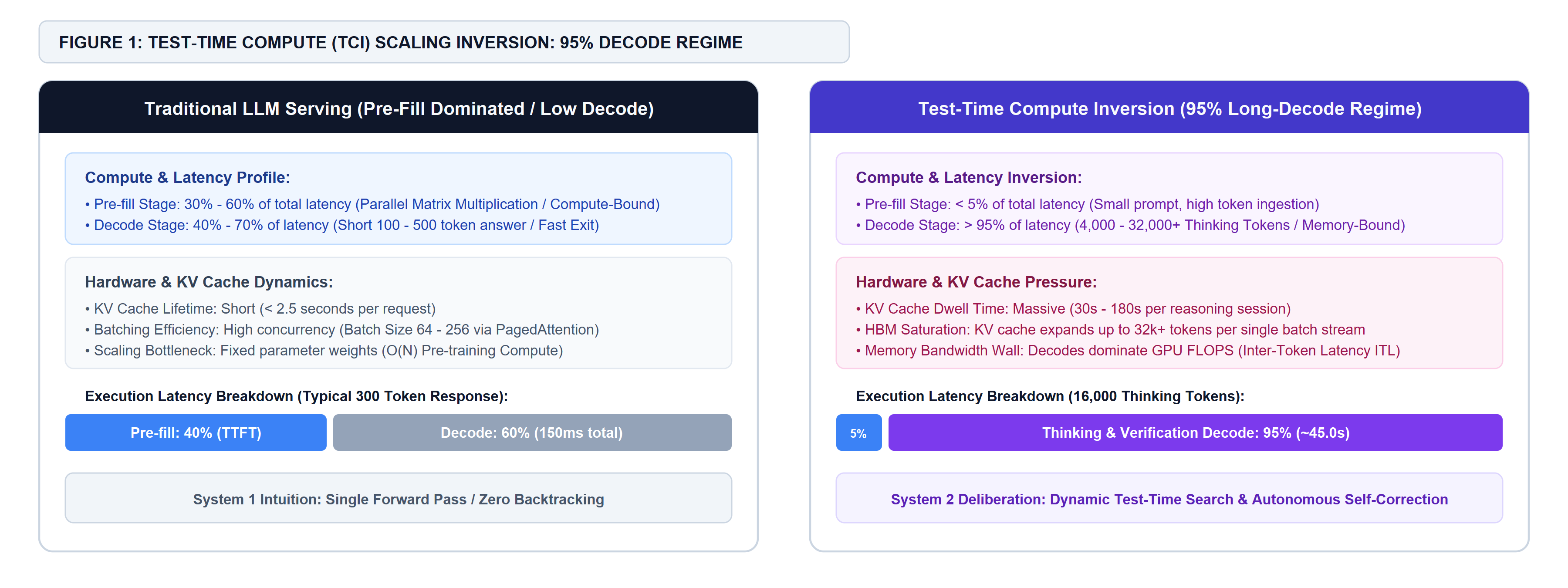
The emergence of extended reasoning models fundamentally inverts the computational profile of large language model serving. The visual comparison below illustrates the Test-Time Compute (TCI) workload shift, contrasting historical short-generation queries against modern reasoning workloads where 95%+ of total cluster compute is spent in deep autoregressive reasoning loops:
The year 2026 marks the formal transition from static autoregressive generation to dynamic test-time compute (TCI). Across production clusters worldwide, inference workloads have inverted: while historical LLM workloads spent 75% to 80% of cluster time processing input prompt prefill, frontier reasoning systems—led by DeepSeek-V4-Pro, Zhipu AI (Z.ai) GLM-5.3, Moonshot AI Kimi K3, and Alibaba Qwen 3.8-Max—spend 90% to 95% of cluster GPU cycles in long-chain autoregressive decode loops.
In these frontier architectures, single requests generate between 16,000 and 128,000 internal thinking tokens before emitting the final answer. This creates an unprecedented systems crisis:
**Model FLOPs Utilization (MFU) Collapse:**Decode operations operate at single-digit arithmetic intensity (1.0 to 2.5 FLOPs/byte), turning multi-million-dollar clusters into memory-bandwidth-bound machines.**KV Cache Monopolization:**A single reasoning request spanning 64k tokens can consume over 18 GB of GPU VRAM under standard Grouped-Query Attention (GQA), starving multi-tenant nodes.**Execution Stochasticity & Infinite Loops:**Long reasoning trajectories risk recursive backtracking loops and runaway token consumption.
To solve this, 2026 reasoning systems deploy three groundbreaking infrastructure pillars:
**DeepSeek-V4-Pro Group Relative Policy Optimization (GRPO):Eliminating the memory-heavy Value/Critic network in reinforcement learning by normalizing rewards across intra-group sampling rollouts, coupled withCompressed Sparse Attention (CSA)andHeavily Compressed Attention (HCA)**to compress reasoning KV caches by ~90%.**Zhipu AI GLM-5.3 Mandatory Reasoning & IndexShare:**A unified multi-effort reasoning engine (reasoning_effort
:low
,high
,max
) sustaining up to 128,000 output tokens and 1M context, usingIndexShareto reuse sparse attention indexers during Monte Carlo tree search and PRM verification.**Moonshot AI Kimi K3 & Qwen 3.8 Dynamic Budgeting:**Hybrid linear attention (Kimi Delta Attention) combined with token watchdogs and entropy-driven dynamic thinking budgets to terminate search at optimal confidence boundaries.
Below, we provide the complete chapter roadmap.
Below is the complete architectural roadmap covered in this chapter:
**Foundations of Test-Time Compute (TCI) Scaling:**Structural inversion where 95%+ of cluster execution is spent in deep autoregressive reasoning loops.**Search Topologies & Process Reward Models (PRMs):**Comparing Best-of-N sampling, Monte Carlo Tree Search (MCTS), and step-level PRM verification.**Dynamic Thinking Token Budgeting & Adaptive Controllers:**Entropy monitoring, confidence tracking, and heuristic early-exit controllers.**DeepSeek-V4-Pro Pure RL & Emergent Self-Correction:**Group Relative Policy Optimization (GRPO) inducing self-correction without supervised demonstrations.**Reasoning Infrastructure Economics & Hardware Sizing:**Mitigating 32k–128k token KV cache bloat, memory offloading, and cluster capacity planning.
To access the complete technical treatise, production code repositories, Triton/CUDA kernels, and infrastructure sizing templates for this chapter, upgrade to a paid subscription today.
Special Offer: Get 50% OFF the annual subscription to the 2026 Foundation Model Inference Series using the link below: