Technical Analysis & Systems Synthesis by DistributedApps.ai | Synthesizing frontier research from DeepSeek, Moonshot AI, Zhipu AI, Alibaba, NVIDIA, and Google DeepMind into production engineering blueprints.
This is Chapter 9 of the 10-part series The Physics & Engineering of Frontier LLM Inference. I announced the full curriculum, including every later chapter, in Announcing the 10-Part Substack Series.
Read the earlier parts first: Chapter 1: The Physics of LLM Inference, Chapter 2: The KV Cache Frontier, Chapter 3: Next-Gen Speculative Decoding, Chapter 4: Extreme Quantization, Chapter 5: Hardware-Aware Attention Kernels, Chapter 6: Disaggregated Serving Architectures, Chapter 7: Serving Mega-MoE at Scale, Chapter 8: Test-Time Compute and Reasoning.
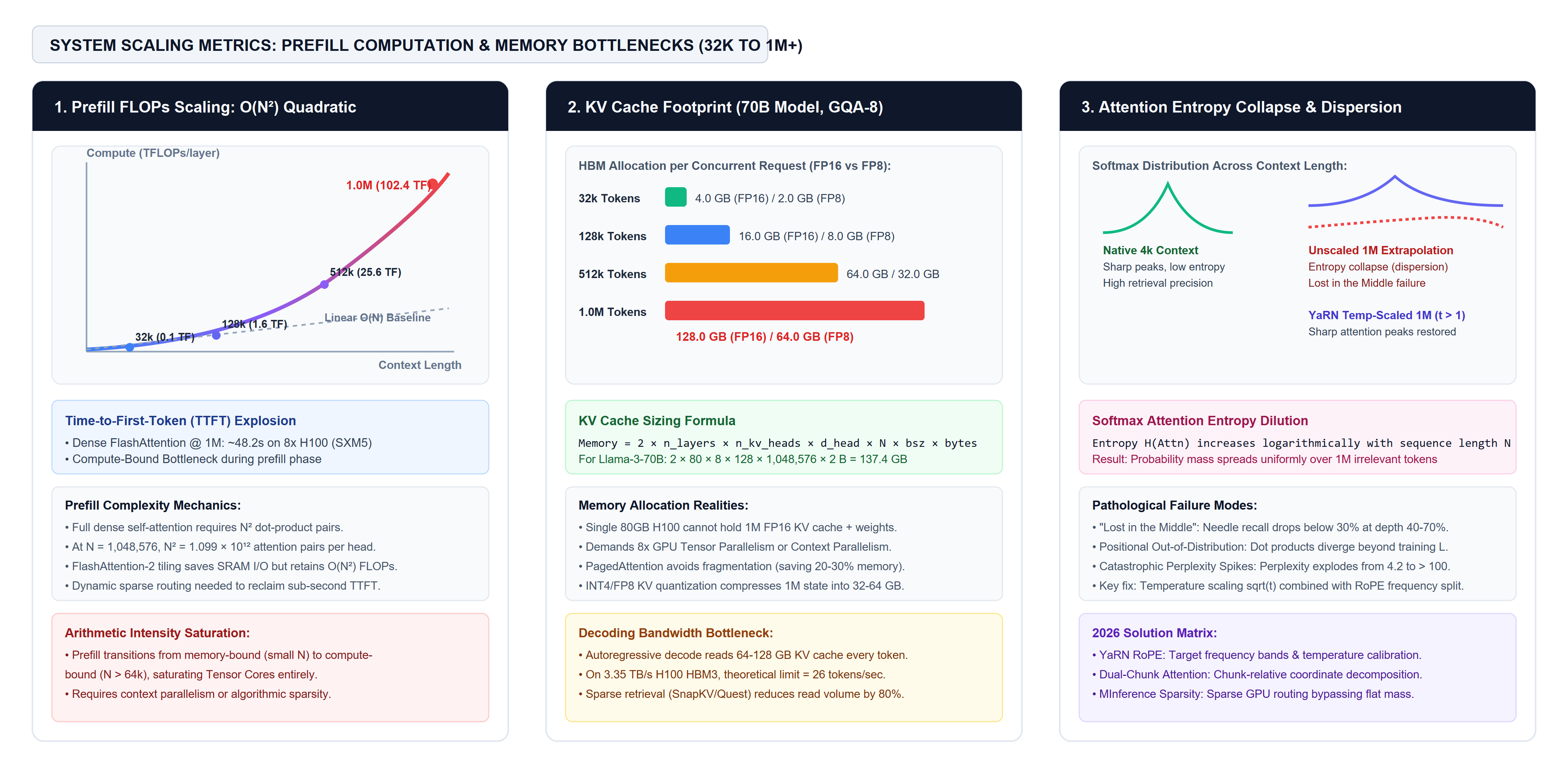
Scaling context windows to millions of tokens challenges the fundamental quadratic complexity of standard self-attention prefill. The complexity curve below plots compute FLOPS and memory bandwidth requirements as sequence lengths scale from 4k to 1,000,000 tokens, illustrating the compute and memory wall that necessitates chunked and sparse attention mechanisms:
In modern enterprise artificial intelligence infrastructure, the effective operational context window of frontier Large Language Models (LLMs) has undergone a dramatic paradigm shift—advancing from the 2,048-token and 4,096-token boundaries of the initial Transformer era to 1,048,576 (1M) and up to 10,000,000 (10M) tokens in 2026 production architectures.
Today's production deployments no longer treat ultra-long context as an experimental novelty or a synthetic benchmark exercise. Enterprise applications regularly execute multi-repository code refactoring across hundreds of source files, synthesize whole-library legal discovery corpuses spanning thousands of regulatory filings, perform full-fidelity multimodal reasoning over multi-hour video and high-resolution audio streams, and sustain lifelong autonomous agent memory trajectories that persist across millions of sequential tool invocations.
However, scaling sequence length by two to three orders of magnitude is fundamentally not a matter of simply provisioning more High Bandwidth Memory (HBM) modules or extending pre-training compute budgets. Standard dense self-attention architectures suffer from catastrophic physical, algorithmic, and statistical breakdowns when operated past their native pre-training envelopes:
**Quadratic Prefill Computational Explosion:**Ingesting a 1,000,000-token prompt requires computing pairwise inner products across N² = 1.0995 × 10¹² query-key dot-product pairs per attention head per transformer layer. In an 80-layer architecture such as Llama-3.1-70B, a single prefill pass demands over 5.62 × 10¹⁵ floating-point operations exclusively for the attention core, driving Time-to-First-Token (TTFT) latencies from hundreds of milliseconds to tens of seconds.**Key-Value (KV) Cache Memory Wall:**Storing uncompressed 16-bit Key and Value activation tensors for an 80-layer, 70-billion-parameter model at 1,048,576 tokens requires 137.44 GB of dedicated VRAM for a single user stream. An entire 8x NVIDIA H100 SXM5 GPU node (640 GB total HBM3) can host barely 2 to 3 concurrent active streams before exhausting all available GPU memory.**Softmax Attention Dissipation & Entropy Smear:**Across 1,000,000 keys, the cumulative exponential baseline noise of irrelevant background tokens causes the attention distribution to disperse toward maximum theoretical entropy (ln(N) ≈ 13.86 nats). This creates the catastrophic "Lost-in-the-Middle" pathology, wherein an LLM successfully recalls information placed at the extreme edges of a prompt, but exhibits catastrophic retrieval failure (accuracy dropping below 30%) across the middle 10% to 90% of the context window.
To conquer these compounding bottlenecks without compromising retrieval recall, 2026 frontier inference engineering has established a unified triad of foundational breakthroughs:
**Frequency-Domain Spectral Modulation (YaRN):**Preserving local high-frequency syntactic resolution while interpolating low-frequency macro channels alongside temperature-calibrated softmax sharpening.**Sequence Chunk Decomposition (Alibaba Qwen 3.8-1M DCA):**Slicing million-token sequences into discrete macro chunks (C = 8,192) and decoupling intra-chunk local attention from inter-chunk macro coordinate routing to completely eliminate continuous positional drift.**Dynamic Content-Aware Sparse Routing (MInference 2.0):**Dynamically identifying empirical attention topologies (Vertical-Slash, Block-Sparse Cluster, and Slash-Only) at runtime to evaluate only the top-k high-affinity KV tiles directly inside GPU SRAM via custom fused Triton kernels.
Below is the complete architectural roadmap covered in this chapter:
**The Physics and Economics of Million-Token Pre-filling:**Quadratic prefill complexity, KV cache scaling walls, and softmax entropy dispersion.**Frequency-Domain Positional Encoding (RoPE & LongRoPE):**Complex plane geometry, frequency decomposition, and wavelength spectrum modulation.**YaRN Spectral Modulation & Temperature Calibration:**Wavelength-aware frequency ramp functions and entropy-preserving temperature scaling.**Alibaba Qwen 3.8-1M & Dual-Chunk Attention (DCA):**Decoupled intra-chunk localized attention and inter-chunk sparse coordinate routing.**Dynamic Sparse Attention Routing (MInference 2.0):**Vertical-slash and block-sparse pattern compilation for 10x faster million-token prefill.**Distributed Context Parallelism & Quantization:**Ring-P2P attention, DeepSpeed Ulysses All-to-All, and 4-bit KV quantization.**Empirical Benchmarks & Production SRE Playbook:**1M-token retrieval accuracy, TTFT latency benchmarks, and cluster deployment manifests.
To access the complete technical treatise, production code repositories, Triton/CUDA kernels, and infrastructure sizing templates for this chapter, upgrade to a paid subscription today.
Special Offer: Get 50% OFF the annual subscription to the 2026 Foundation Model Inference Series using the link below: