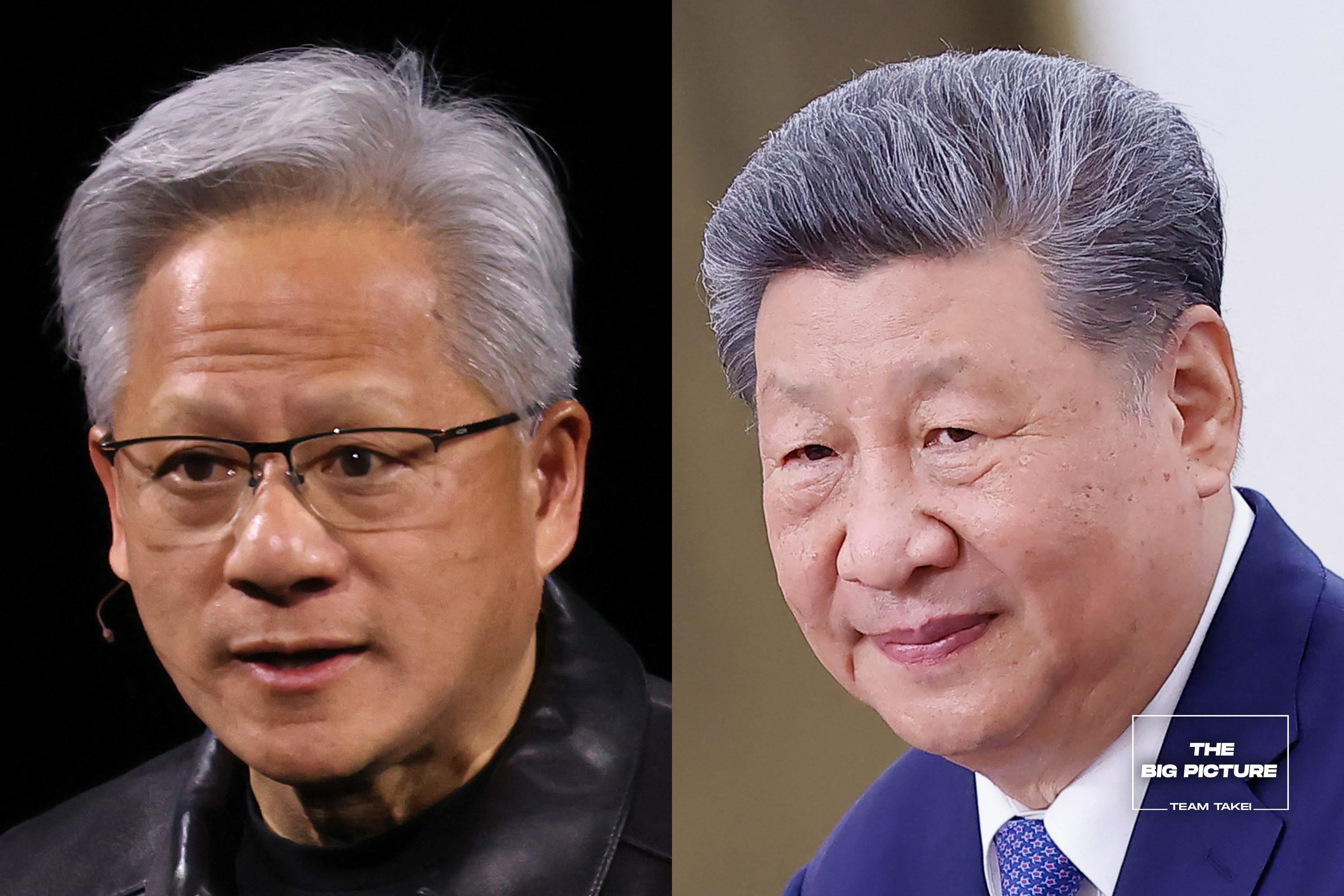
*With an alleged Chinese AI chip honeypot spy in the news, Beijing still buying Tehran’s oil, and a big APEC summit where Xi, Trump and Putin will all be present, it seemed a good time to check in with one of the world’s leading observers of China, * (who also happens to be my brother). Kaiser is host of the Sinica podcast and has decades of experience in Sino-U.S. relations. I caught up with him right before he hopped on his flight from Mexico City back to his home in Beijing.
The Jensen Huang scandal has been top of the news in the U.S. for many days, not only because of Nvidia’s centrality to the AI industry, but also because of reports that the Trump regime failed to act when it first learned of the risks. Now Commerce Secretary Howard Lutnick is in the barrel, and daggers are out inside the administration over the alleged diversion of restricted Nvidia AI chips to China through Megaspeed, the Singapore-based firm founded and briefly run by Alice Huang, the alleged Chinese honeypot who targeted Jensen Huang. So break it down for our readers in plain, non-techie speak. What are you hearing on the other side of the Pacific about this scandal, Jensen Huang’s resignation and the potential complicity of parts of the Trump administration in helping China get banned AI chips? Are the Chinese laughing at us, taking this seriously or somewhere in between?
Nothing in the Chinese response has surprised me. The Foreign Ministry has been quite disciplined, speaking only to allegations that directly implicate Beijing, like the claim that Alice Huang was a Chinese intelligence asset, which it has officially denied from the podium. It has only answered questions from foreign journalists in their briefings, and hasn’t volunteered anything. It has called the spy allegations “unfounded accusations and slander,” but hasn’t pointed fingers or speculated on motives. It has left that to the semi-official, stridently nationalistic Global Times, a newspaper which often plays bad cop to the Foreign Ministry’s good cop. And with Trump due in Shenzhen for the APEC summit this week, officials have been careful not to discuss any role Trump might have played.
Meanwhile, the unofficial response to Jensen’s downfall has been all over the map. Even among those familiar with the China discourse in Washington — who know who the hawks and doves are, how various tech figures line up on semiconductor export controls, and what role the media plays in that debate — the theories span a broad spectrum.
The most cynical theories, which are not uncommon, suggest that the whole thing was a conspiracy, usually one hatched by “China hawks,” people pushing for a more confrontational approach to China. They are in both Washington and Silicon Valley, and in both parties, and they agree that the U.S. needs to “win” the AI “race” against China.
By “winning,” they typically mean creating AI that can improve itself by writing its own code—the holy grail that promises rapid improvement, leaving the other country in the dust. Some call this AGI, or artificial general intelligence.
Chinese analysts get the hawks’ argument: We’re the good guys; they’re the bad guys. We love democracy; they’re totalitarians who will use AI to take down our critical systems, build superweapons, and enslave us all… if they get there first.
They also get that your attitude toward China lines up with whether you support “closed” models like those run by OpenAI and Anthropic — which act like a black box you can access only through their apps — or “open-weight” models, which release their underlying blueprints so anyone can download, customize, and run them on their own computers. Anthropic CEO Dario Amodei is on the closed side and Jensen Huang on the open-weight side. Not only did Huang support selling Nvidia chips to China, but he also championed the open-weight approach favored by China’s labs, like DeepSeek, Moonshot, Alibaba and Zhipu.
One sophisticated Shanghai-based observer cites two $20 million donations Anthropic made to Public First Action in February and July. He says these funded an ad campaign to support GOP congressional candidates who backed tougher tech export restrictions on China, including Brian Mast, who chairs the House Foreign Affairs Committee, and John Moolenaar, who chairs the House Select Committee on China. The two then joined Rick Crawford, the GOP chair of the House Intelligence Committee, in signing a Nov. 4 letter asking Jensen Huang to appear at a closed-door briefing on his relationship with Alice Huang.
Much of that checks out: Anthropic gave Public First Action $20 million in February and another $20 million in July, and Mast, Moolenaar and Crawford did sign the Nov. 4 letter. He goes on to suggest that someone in the Anthropic/China hawk camp leaked the intelligence community’s belief that Ms. Huang was a Chinese intelligence asset — an “alleged spy,” as we keep hearing. (He also believes that The New York Times, the Financial Times, The Economist and other publications were part of the plot. There, he’s entered the realm of speculation and left me behind, but I agree that a China hawk likely leaked the spy assessment.)
The timing of the leaks, in this telling, came down to two things. The first was the midterms: A blue wave — if not the tsunami we got — was expected, which would leave a lame-duck president unable to protect Huang. The second was the APEC meeting in Shenzhen, where the scandal might prevent Trump from agreeing to any Chinese demands.
If this sounds familiar, it’s not far off from what Jensen Huang’s defenders — David Sacks among them — have circulated on social media. Some parts seem beyond doubt: the alignment of hawks with closed models, and doves with open-weight models; and Jensen Huang as the most effective advocate for keeping the China market open.
These Chinese accounts often assume racial or Sinophobic factors are in play. They point to the ready acceptance in the U.S. that Alice Huang is a spy, which still rests on people briefed on an intelligence memo. They also point to suspicions that Jensen Huang favors selling the most advanced AI chips to China because he, himself, is ethnically Chinese.
In another theory, Beijing really is laughing at us. A real “spy” — someone trained and deployed by the Ministry of State Security — wouldn’t have had such risibly bad tradecraft, unless the idea all along was to get caught. China’s history is full of examples of driving a wedge between an enemy and his most potent assets, whether crafty strategists or indomitable generals, sowing distrust until he abandons them. Could Beijing have wanted* *Jensen Huang’s apparent affair with Alice Huang to come to light? To see this singular pillar of American AI prowess alienated from the U.S. government and perhaps even from the company he co-founded? Wouldn’t that set the U.S. back? Might it even burst of the AI bubble on which the health of the U.S. economy depends?
It’s a wild theory, and if that’s what Beijing intended, I’d be surprised. Beijing understands better than anyone how interconnected the global financial system is.
It also presumes that Beijing had settled an essential question that no one can answer yet: More than four years after the first massive round of semiconductor export restrictions, championed by Biden national security adviser Jake Sullivan, does Beijing even *want *them lifted? Those restrictions, as many have argued, lit such a fire under China’s formidable tech ecosystem that autarky — self-reliance — in this notoriously globalized supply chain and famously challenging technology is within sight.
It does look like Beijing has stopped caring much about restoring access to Nvidia’s Blackwells and other cutting-edge chips. Chinese labs have managed inference — running trained models — using domestic chips, mostly Huawei Ascends. For the more compute-heavy work of training AI models, they’ve relied on smuggled chips and remote access to Nvidia-equipped data centers in Southeast Asia. Now, according to The New York Times, the Trump administration will move to close this loophole, but it’s not clear how it’s going to stop Southeast Asian data centers from “loaning” chips to customers in China remotely.
The Chinese labs have made clear that in the short run, to stay competitive with their domestic rivals more than with U.S. labs, they’d rather have Nvidia chips — ideally imported directly and legally, but via Southeast Asian or other data centers if need be.
Opponents of AI regulation, including Donald Trump, often cite the “China threat” as a reason the industry should be allowed to move faster and with fewer rules. What do you make of claims that China threatens the U.S. lead in AI? And what is the state of the Chinese AI and advanced semiconductor industries?
The whole “But China!” argument rests on projection: the assumption that because *we *would leverage a huge lead in AI to deal a crippling blow to China, surely China would do the same to us if it got there first. Projection is a false cousin of cognitive empathy, the ability to see and, more importantly, to feel as another does. Admittedly, that isn’t easy with China.
But the answer isn’t just to reach for projection. We’re now in a classic security dilemma, in which one side’s purely defensive moves look offensive to the other side. I see no reason to believe China would behave as the “But China!” crowd suggests. Exercising even a tiny bit of cognitive empathy — asking yourself, “If I were in China’s shoes, would I just bend over as the U.S. tries to stymie my technological development and prevent me from enjoying the benefits of advanced AI?” — should bring things into focus.
China’s AI labs are numerous and releasing good models, but they remain, by estimates from people I trust, four to six months behind the U.S. frontier models. On semiconductors, the fire lit by the “Sullivan Doctrine” has accelerated the drive toward autarky, and China has made progress on many fronts.
The big challenge is extreme ultraviolet, or EUV, lithography, the chip-printing technology monopolized by the Dutch company ASML. The U.S. has strong-armed ASML into complying with its export controls. In response, China has rejiggered older deep ultraviolet, or DUV, machines, and coaxed them into printing the microscopic circuitry needed for the most advanced chips. I wouldn’t bet against China on this front. Already, Huawei, by many accounts, has managed good-enough performance for AI model training. It uses stacked or folded chips that may not be at the low single-digit nanometer scale of the most advanced Nvidia chips, but with enough of them deployed and with energy abundant in China, that matters less and less.
One thing I think we should all keep in mind about the “But China!” crowd: These same folks — think Amodei — are some of the biggest advocates for AI safety, which on its face laudable. But think about this: If the race against China is paramount, the first thing to go by the wayside is safety. If a Chinese lab is about to release a powerful new AI model that was much cheaper to train, is freely downloadable and costs users far less than your current model, you’ll be tempted (just as OpenAI was in January 2025, in response to DeepSeek) to release your latest model without all the safety testing you had initially planned. That’s a huge danger, and a good reason to question the logic of racing.
Let’s switch gears. We’re now in the ninth month of the war with Iran, and despite overwhelming military advantage and an on-again, off-again ceasefire, the U.S. and Israel have failed to force a surrender. The U.S. naval blockade has choked off most of Iran’s oil exports, most of which went to China. Chinese suppliers have reportedly kept dual-use components and missile-fuel chemicals flowing to Iran’s military, though Beijing denies providing weapons. From your vantage point in Beijing, how do the Chinese view the war? Will they stand by their partner Iran? And how has the war changed Beijing’s basic assumptions, especially about U.S. power projection?
To be clear, I haven’t seen the intel on claims that China is supplying dual-use tech or war materiel to Iran, so I won’t comment on that. It wouldn’t surprise me if it were true, but neither would it if China had been careful not to cross any lines that might incur secondary sanctions. If the U.S. really thought Beijing was helping Tehran, it didn’t show it: The Treasury Department didn’t sanction a single major Chinese entity when it launched Operation Economic Outcast on Aug. 24. It named minor Chinese and Hong Kong players, but no one involved in the main business or financing of Iranian oil imports.
On whether China will stand by its partner, I’d start by questioning the word “partner.” Iran sells China oil. As experts on China and the Middle East keep saying, nothing in the “comprehensive strategic partnership” the two signed obliges Beijing to do anything. China does vastly more business with the Gulf monarchies than with Iran, and those are the countries Iran has been lobbing missiles at. So when Beijing sat on its hands in March while the U.N. Security Council condemned Iran’s attacks on its neighbors, nobody who follows this was shocked.
That’s why two takes that circulated early in the war struck me as deeply silly. One held that the whole thing was really about China — cutting off its Persian Gulf oil. (Venezuela, in this telling, was part of the same master plan.) If so, it’s an odd plan that ends with the White House appealing to Beijing for help reopening the Strait of Hormuz. Beijing declined, of course.
The other held that China had shown itself a paper tiger by failing to ride to Tehran’s rescue. But you can’t flunk a test you never signed up for. I think what Beijing saw was its chief rival making a colossal mistake and, following Napoleon’s famous advice, it had the good sense not to interrupt.
Look at where things stand. China’s second-quarter crude imports ran 30 percent below a year earlier, and the Chinese economy barely noticed. Roughly half the drop was Beijing easing off on filling its reserves, so I wouldn’t oversell it, but the cushion was there to be used. March and May were both record months for Chinese EV exports, as the rest of the world got religion about oil dependence. Meanwhile, the Center for Strategic and International Studies, a Washington think tank, reckons the U.S. has burned through roughly two-thirds of its prewar Patriot interceptors and half its THAAD (Terminal High Altitude Area Defense) interceptors and puts the rebuild at three years or more. South Korea’s THAAD battery, which Beijing objected to so strenuously when it arrived, has been raided for interceptors for the Gulf. And the “Pivot to Asia,” which three U.S. presidents have sworn was really happening this time, is on hold again.
As for assumptions about American power: no one in Beijing doubted the U.S. could wreck things at will. What nine months have shown is how hard it is for Washington to convert that into an outcome and how shallow its magazines are. The PLA brass — or what’s left of them after Xi Jinping’s big shakeup — have taken note.
But I’d be careful about calling this a Chinese victory. Beijing would much rather none of it had happened. Its diplomacy has been busy but has moved Tehran not at all; Islamabad, not Beijing, got the two sides to a ceasefire. Gulf capitals are, however grudgingly, leaning even harder on Washington for security, since nobody else can provide it at scale. China isn’t about to inherit the Gulf, and it doesn’t want the job.
There’s a big APEC summit coming up. What do you think Xi gains from hosting Trump and Putin together at the summit, and how is the image playing inside China? Washington wants China in a nuclear arms pact. Is there any scenario in which Beijing accepts limits on its nuclear arsenal?
Xi — and by extension the…