Claude can automate evaluation design and propose application changes using /claude-api build-eval and /claude-api hillclimb, but a higher score supports a deployment decision only when the measurement remains trustworthy. The engineering work starts with representative cases, calibrated grading, and an explicit decision rule. It continues with a separation between the evidence you use to improve the application and the evidence you use to approve its release.
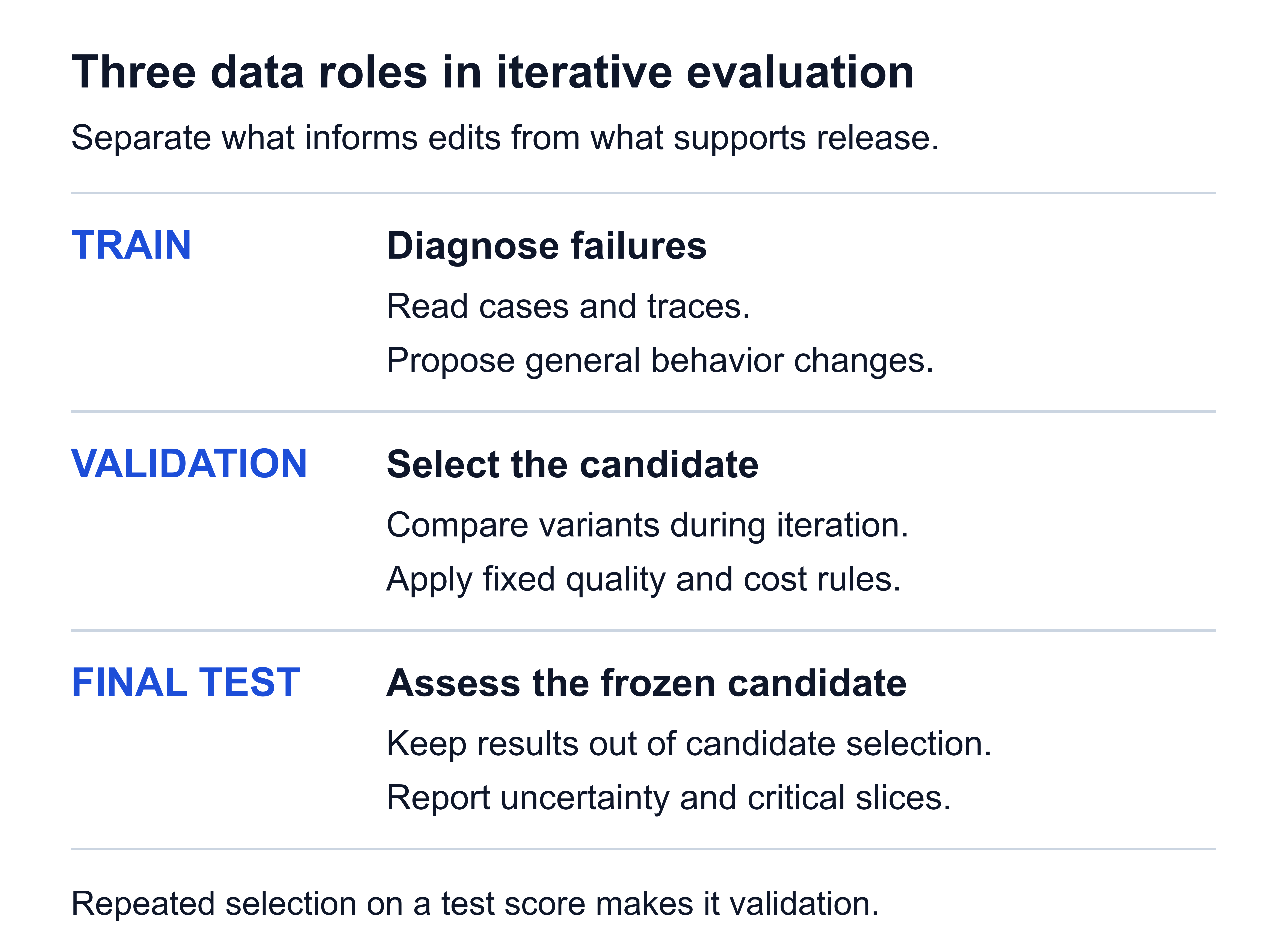
**Separate measurement from optimization.**The first section separates evaluation design from application improvement and defines the version boundaries that keep their results interpretable. The stake is attribution: you need to know whether a better score reflects a better application, a different grader, or a different task population before you spend another iteration on the candidate.**Turn production behavior into reviewable cases.**The next section develops a support-routing example with four destinations and an abstention outcome. It examines representative traffic, difficult cases, and prohibited actions. The stake is coverage: a routing benchmark can reward accurate labels while overlooking the customer interactions that carry the highest operational cost or require the application to decline an action.**Check the grader before trusting the score.**We compare deterministic checks, model judges, and human calibration using the distinctions in Anthropic'sevaluation documentation. The stake is validity: a repeatable verdict can still reward incorrect behavior, while an unstable judge can obscure a useful product improvement. Both defects require attention before automated search begins.**Use the Claude commands with a bounded experiment.**We examine the documented/claude-api build-eval
and/claude-api hillclimb
workflows and distinguish their setup requirements from the decisions your team still owns. The reference is Anthropic'sclaude-api skill. The stake is control over the editable files, evaluation budget, acceptance rule, and stopping condition throughout the experiment.**Separate validation from the final test.**The article compares a two-way split with a three-way design for iterative selection. It also examines what repeated trials can establish when the underlying case set remains small. The stake is credibility: you should know which score supports development decisions and which score can support a claim about performance on tasks that did not influence the selected configuration.**Measure uncertainty at the level of the task.**An explicitly illustrative calculation shows why six additional passes do not settle a release decision. We distinguish repeated attempts from distinct cases and examine protected categories separately from the aggregate. The stake is decision quality: a narrow-looking interval can mislead when the analysis counts related observations as independent evidence about future traffic.**Reduce cost under a quality constraint.**We scrutinize the support-routing results in Lance Martin'sSeptember 28, 2026 article, then define an operational cost measure that includes unsuccessful attempts. The stake is economic relevance: a lower token bill does not automatically mean a lower cost per successfully completed customer task.**Make the release decision reproducible.**The final section provides a reusable review procedure for configuration records, failure evidence, uncertainty, and deployment monitoring. The stake is accountability: another engineer should be able to reconstruct why you retained a change, which checks it passed, and which conditions would justify reverting it after deployment.