There’s a special kind of frustration in paying for an entire app because you love one tiny thing it does. The rest could disappear tomorrow. You’d barely notice. But that one feature? You keep renewing for it.
I think that’s where Fable 5.2 gets interesting. Because the thing keeping you subscribed might be much smaller than you think.
That one feature has nowhere to hide
Say you love how a video editor handles captions. Click a word, and the video jumps to that moment. Change the sentence, and the caption updates.
You want that. You have no use for its stock footage, team accounts, or twenty export options.
With Fable, you can study that small experience, work out the pieces it needs, and build your own version around them.
Screenshots help. A short screen recording helps more. A few examples of what happens when you click, edit, and undo give Claude something it can reason about.
This is the useful side of reverse engineering: understanding how something behaves well enough to build your own implementation.
Fable 5.2 is particularly interesting here because it combines coding, visual understanding, and reasoning about difficult technical problems. Anthropic positions it for ambitious work, while recommending Opus 5.5 for many everyday tasks. It isn’t a guarantee that any product can be rebuilt from a picture. But it gives you a strong model to investigate the parts you can observe.
Let’s use the caption feature as our example. You can follow the same process with something else you want to build.
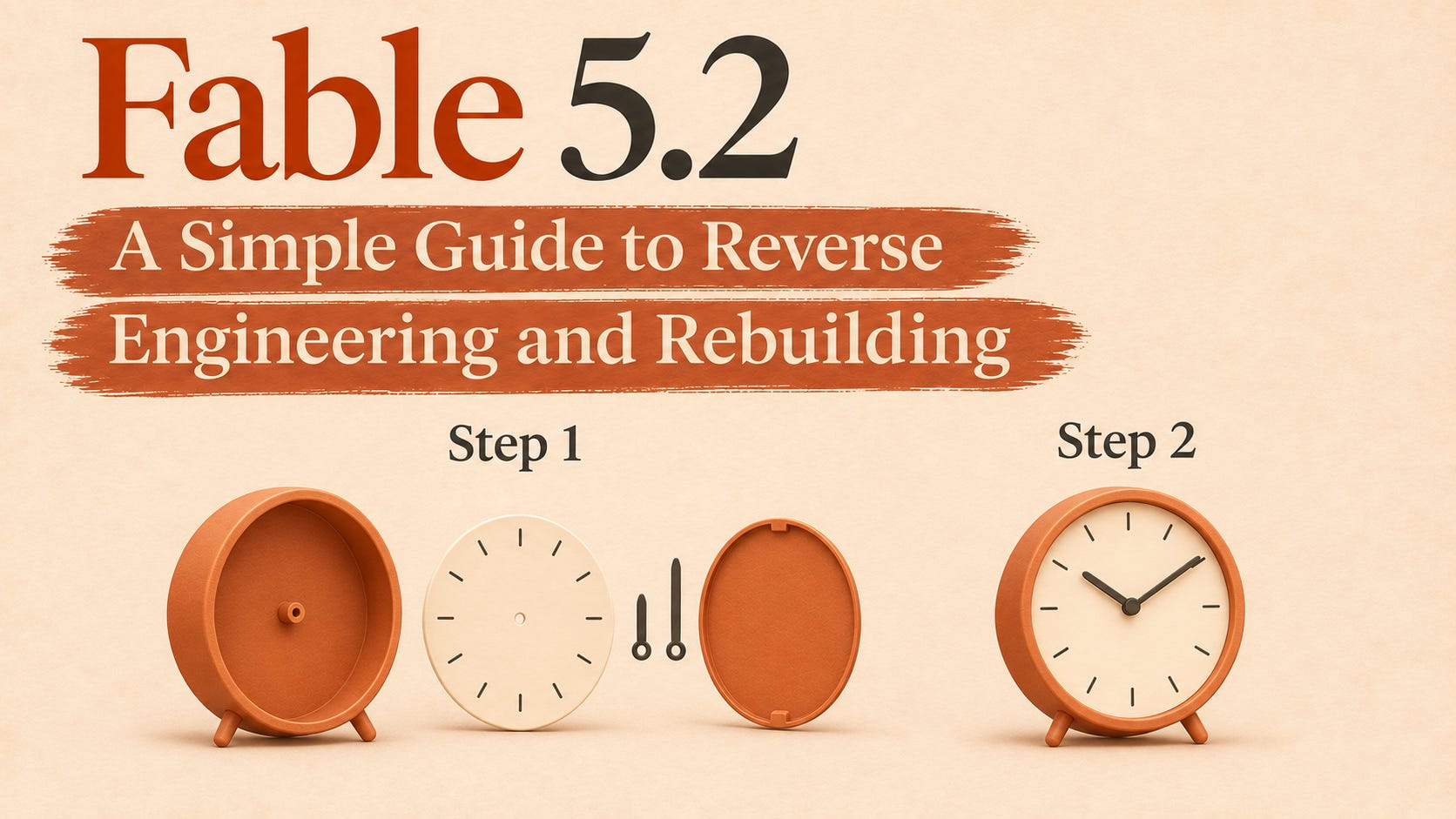
That one feature you keep paying for? Below, I will teach you how to pull it apart with Claude and build a version of your own.
Read more