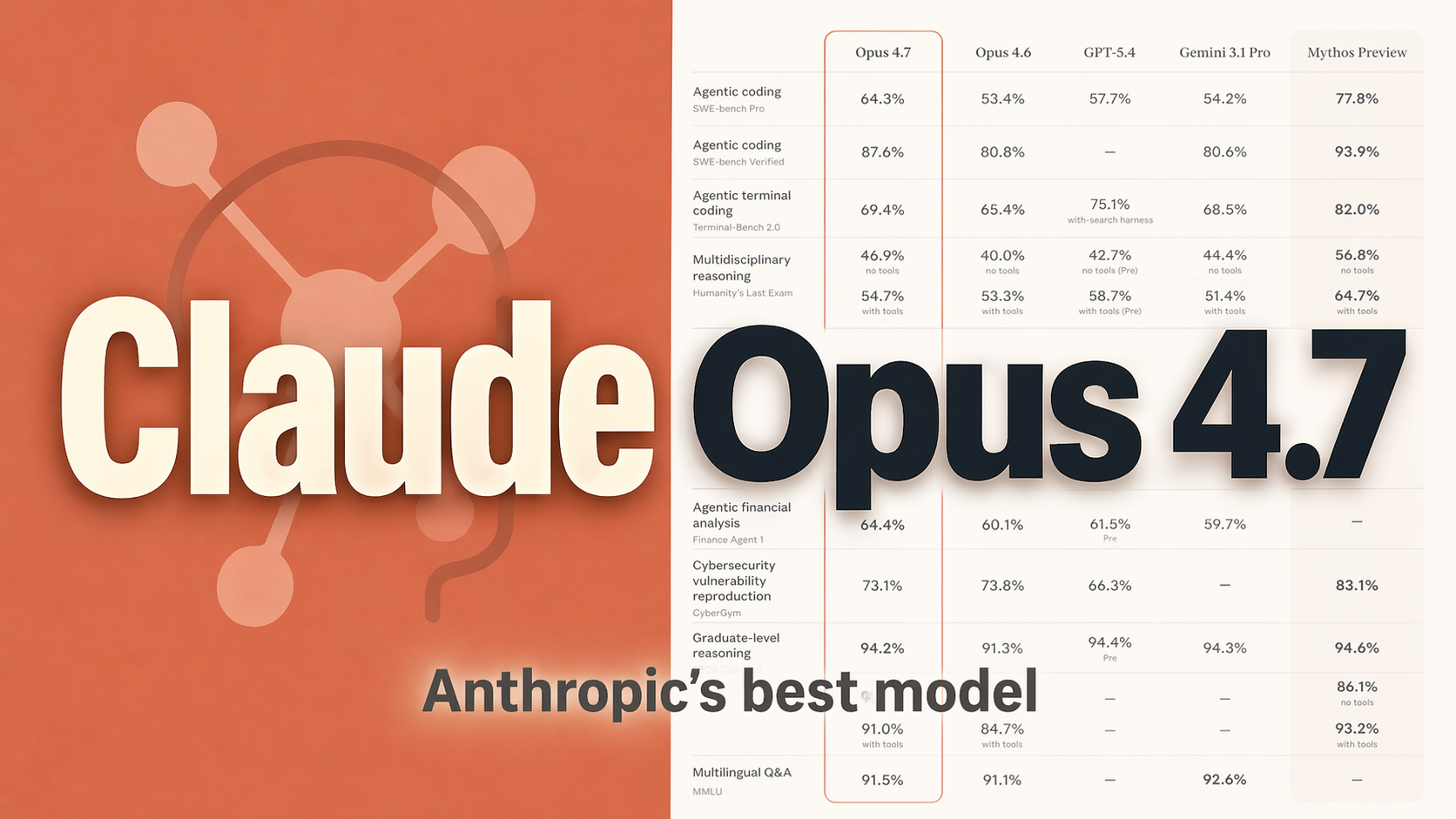
Anthropic dropped Claude Opus 4.7 last week. If you only read the announcement, it sounds like a normal model update with a few new bars on a chart. It’s not. The way you actually use Claude has shifted, and if you keep doing things the old way you’ll either get worse results or pay more for the same work.
This guide is the plain English version. No jargon. No marketing fluff. Just what changed, why it matters, and how to use the thing without burning money or pulling your hair out.
Subscribe now
Claude Opus 4.7 is not just a smarter Claude. It is a different kind of working model. The big change is not only that it got better at hard coding, long-running tasks, and dense visual work. The bigger change is that it follows instructions more literally, checks its own work more often, and rewards clear delegation much more than back-and-forth babysitting. Anthropic released it on April 16, 2026, made it available across Claude products and the API, and kept pricing the same as Opus 4.6 at $5 per million input tokens and $25 per million output tokens.
That means this model is great when you want to hand over a real job. A messy debugging task. A multi-file refactor. A screenshot with tiny UI text. A long work session where the model has to stay consistent. It is less about chatting cleverly, and more about finishing the work cleanly. Anthropic’s own release language leans hard into that: long-running tasks, rigorous instruction following, self-verification, and better high-resolution vision.
The easiest way to understand Opus 4.7 is this: stop treating it like a smart intern you correct every minute, and start treating it like a capable engineer you brief properly at the start. That shift shows up again and again in Anthropic’s docs and in the field notes you attached.
Subscribe now
The locked section goes much deeper: the real gains in coding, vision, and memory, the prompt style Opus 4.7 responds to best, the xhigh setting most people will misuse, the Claude Code workflow that actually works, CLAUDE.md mistakes, Auto mode, /ultrareview, adaptive thinking in the API, token cost traps, and the trade-offs you should know before switching fully.
Read more