Clavicular, Hotness, and how Patriarchy Hurts Men
Clavicular doesn’t care about being hot. He’s yearning for male acceptance, and it’s killing him. Yesterday, I posted a video about the male gaze, patriarchy, and Clavicular. A couple of hours later, he OD’d on meth live. His story is a sad tale of how patriarchy hurts men.
Clavicular doesn’t care about being hot. He’s yearning for male acceptance, and it’s killing him. Yesterday, I posted a video about the male gaze, patriarchy, and Clavicular. A couple of hours later, he OD’d on meth live. His story is a sad tale of how patriarchy hurts men.
If you’ve had the pleasure of missing out on Clavicular, let me give you the shortest of explanations. In the last six months, this 20-year-old streamer has undergone numerous surgeries to enhance his appearance, a practice commonly called looksmaxxing. The Looksmaxxing community has steadily grown from its roots in the incel community over the last decade. Millions of teenage boys watch these slightly older people create “perfect” faces and live “perfect” lives. As Louis Theroux’s Manosphere documentary showed, it’s mostly an imperfect mix of men’s insecurities and loneliness with a heavy dose of need for validation.
Clavicular had been keeping trim by microdosing meth, which, while I’m not a medical professional, doesn’t strike me as a long-term solution for health and wellness. His OD seems to have made a lot of people wake up to the harm social media has had on men’s self-esteem.
How did we get to the point where watching dismorphia became entertainment for some, and even worse, a handbook for young boys? It’s obviously a 1-2 punch of patriarchy and capitalism.
Patriarchy has long roots in Western history. Many scholars see the pernicious systemic hierarchical organizing principle going back to property ownership. As people “owned” land, they began to see the need to retain it. Birth rights come into play. Men start exerting authority over women and their agency to ensure the children born are their own. Others suggest patriarchy comes out of tribal movements. When people from the central plains of Asia start moving into Europe, it’s often just men. They then set up systems that benefit them in their new communities.
In art, we see patriarchy in how power is depicted. Men are depicted as hierarchically larger, as in the Sumerian inlaid work, and as visually assertive, as in depictions of Gudea. These are people who could stare you down for eternity with their (literally) stony gaze. What’s interesting is that physical attractiveness doesn’t play into these early depictions.
With patriarchy woven into society as an organizing force, it becomes invisible. It’s in the same way as accents. If you only talk to people from your hometown, you feel like you don’t have an accent. Without comparison, you accept this as norms. As such, people support and reinforce patriarchy by being normative.
Think of women’s work. I wrote a long essay about this. In short, historically, women kept house, cared for children, worked in the family business, and also often kept folk arts alive. This uneven distribution of labor has existed for millennia. (Elizabeth Wayland Barber’s book Women’s Work is a great source on this.) We have images from ancient Egypt and Greece, for example, depicting women at work. These women worked for the men in their family's business. The system had them subservient to men.
After wage labor began, women still usually did all those things and left the home to earn less than men. Women in many nations, like the US, still don’t make equal wages as men. In the US, 47% of women voted for Trump, who doesn’t believe they should have protections or equal pay. Women uphold patriarchy rather than change norms.
Therefore, in this naturalized system, patriarchy is a stealth force on people’s conceptions of all elements of society, including the self. Historically, for men, conforming to patriarchy was easy, as the system was made for them. By working in the family business and reproducing, they’d largely made good on society’s desires.
The real shift is when the system is no longer propping them up. After Title IX and civil rights reforms, women can own property, have credit cards, and earn degrees to work in higher-paying jobs. The system shifted, but many men’s mindsets haven’t. This is partly because cultural shifts are harder when you perceive change happening to you (rather than by you). And the fact that you largely never thought about patriarchy as you are a man, and it’s a double whammy of surprise and loss.
These cultural shifts significantly altered our ability to notice patriarchy, but they didn’t change its impact. Why? Because the patriarchy is alive and well. Again, go back to the election results. But nowhere is this clearer than in the changes in the roles of men’s looks.
Historically, power is what made you hot. It’s worth remembering that it’s very hard to break your own cultural mindset to judge attractiveness. Think of 90s hot guys. Many would not be attractive now (Denzel is still evergreen hot, but still). So, when I say Philip here was considered handsome, you wouldn’t be able to look at him and get into the mindset of the women of his day. But in reading about people of this period, many men considered attractive had light hair and a strong nose. He’s got half of that equation. What he actually had was the title of a Habsburg heir to parts of the Netherlands and Spain.
Men who weren’t rulers largely didn’t need to worry about their looks for work or marriage. People weren’t being judged on either, partly as there wasn’t a proliferation of imagery, but also because the social order was not structured that way. Wives were made of women whom your family picked. Jobs were done based on your father’s. Looks were a nice-to-have at best.
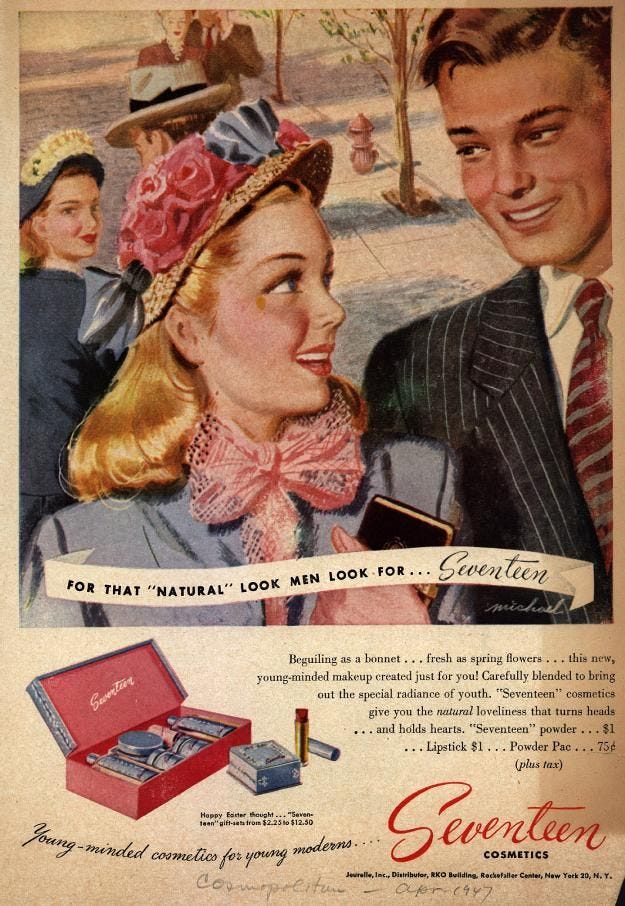
Beauty for women is incredibly important in finding a husband when we move to free market marriage, as I call it. With wage labor, more women work outside the home, and slowly, more women begin getting an education. In the West, arranged marriages through families wane, and when marriage becomes a choice, attractiveness plays a large part in finding a mate. Buss, Shackelford, Kirkpatrick, and Larsen's 2001 paper in the Journal of Marriage and Family ("A Half-Century of Mate Preferences: The Cultural Evolution of Values") analyzed six waves of data and found that across the 57-year span (from 1939-1996). The study showed that men had always placed importance on women’s beauty, but by the end of the century, women were beginning to find looks increasingly important. They also found a major shift in women’s desires toward a man who is basically emotionally capable, rather than someone who solely provides financially. Men also showed a marked increase in expecting women to earn money outside the home. Basically, men always wanted a beautiful woman, and now they wanted one with a job. Women now want a good-looking, emotionally capable husband.
That seminal paper was published before the onset of dating applications. But clearly, the impact they note comes into play in people’s experience with finding love via algorithms. By making the choice first based on someone’s picture, the UX prioritizes looks. Writing short-form text is a skill in itself, and so, without it, even a bright person can come off as unintelligent. In these apps, our existing nature to prefer looks is exacerbated. A 2024 conjoint analysis in * Computers in Human Behavior Reports* using 5,340 real swiping decisions (N = 445) found that a one standard deviation increase in physical attractiveness raised selection success by about 20%, while the same increase in intelligence raised it by only about 2%.
Now, here’s the patriarchal part. Women have had centuries to hone our understanding of attractiveness and beauty. Even if physical unattractiveness didn’t squash marriage prospects, if you had a dowry, beauty was prized. Men do not have this generational knowledge. They can’t judge themselves accurately. Research by Sim and colleagues (2022) shows that men who rate themselves as more attractive also substantially overestimate women's sexual and romantic interest in them — the self-perception bias propagates into misreading signals. Add the fact that many men haven’t actually gained the emotional tools women prize, and many men in society end up emotionally and sexually frustrated.
One of the earliest forms of conspicuous consumption was the beauty market, which emerged just as marriage shifted to choice-based partners. But at that time, women needed men who could earn to support their survival. Maximizing your looks could be a matter of life or death. Makeup becomes the norm for women, and quickly.
Algorithmic social media changes things. Men’s self-esteem is already waning at the turn of the millennium with the rise in women’s fortunes. Queer Eye taking off at the end of the aughts signals a shift in men’s appearance. You can’t just work a job to get a date. As social media is picking up at the end of the aughts, more and more men start talking to each other about their insecurities. Companies start taking notice of the financial gains to be had by capitalizing on men's emotional drawbacks.
By 2019, approximately 81.6% of Americans owned a smartphone (up sixty percent from 2010). Additionally, most people were using at least one social app. This went from a society of communities to a society of online communities. The shift also translated into more time indoors and more reports of loneliness.
This translated to big money for some industries. An 18-year analysis in the Aesthetic Surgery Journal (Dorfman et al., 2023) documented an approximately 55% increase in male plastic surgery from 1997 to 2018. Bigorexia, or the desire to look big and muscular, has emerged as a specific clinical concern. Men are being more often treated for disordered eating.
But men’s beauty norms are not calibrated to one another. Historically, money and power defined men’s attractiveness. Of course, that system was for male validation, since women historically had relatively low agency in relationships. But then, while attractiveness had become important for women, these norms were defined collectively in society. Women were part of the loop in confirming attractiveness. The early 20th-century actor Douglas Fairbanks was said to be debonair. The golden age of Hollywood hunks all had their own vibe. Their appeal, translated into ticket sales, trickled through society. Men’s attractiveness was often about being generally appealing, not about conforming to a particular, specific visual appearance. Good-looking guys only needed a certain outfit or haircut. (Again, this was before women could have credit cards. The bar was low.)
Looksmaxxing emerges among the generation that followed the initial users of dating apps. Those boys had already heard how mean girls can be. So in their basements, alone, they start to decide what women want. Their definition is largely not tested on any human woman. Instead, they validate each other. Their aesthetic is largely based on half-readings of theory, such as the idea that women prefer symmetry and that taller men are more likely to get dates. But it’s also influenced by the media they consume, like superhero movies.
Here’s where we really have a problem. Patriarchy has come up against capitalism, and together they’re short-circuiting each other. Patriarchy does, in fact, still need men and women to reproduce. Capitalism has made men into a market to be the perfect man for each other; at the same time, birth rates in the US are dropping precipitously.
Which takes us back to Clavicular. Peters has gotten a great deal of press for his quick rise. His numbers don’t even break into the top 1000 streamers. Why has he gotten a lot of attention? Some people suggest he’s been getting money from Theil, the billionaire nut whose obsession with the anti-Christ and purity is wrecking the world. However, this has happened, there’s a reason Clavicular is everywhere, and in our society, that means someone is making money. An insecure 20-year-old boy is being sacrificed for profit, but even worse, he’s caught in a patriarchal quagmire. He’s trying to be the best boy, and women in society want the kindest man. He’s really a cautionary tale in how algorithmic social media, beauty, consumerism, and patriarchy can destroy our society.
Send this story to anyone — or drop the embed into a blog post, Substack, Notion page. Every play sends rev-share back to Artlust.
We’ve simplified responses to 👍 / 👎. Past comments are archived but no longer visible.