Welles Crowther was 24 years old and worked as an equities trader on the 104th floor of the South Tower of the World Trade Center. He volunteered as a firefighter back home in Nyack, New York, and he kept a red bandana in his pocket that his father had once given him. When United Airlines Flight 175 hit, Crowther made his way down to the 78th floor sky lobby, where people were burned and broken and had no idea where the stairs were. He tied the red bandana over his face, put an injured woman on his back, and carried her down 17 floors. Then he climbed back up, and did it again and again and again. They found his body the following March in the lobby next to firefighters. Welles Crowther saved at least 18 people.
We are twenty-five years removed from that day. My daughter Evelyn texted me this week with a question I have not been able to let go of. She had noticed people who need to feel miserable today as a way to honor the day, and she thought there was something macabre in it and idolatrous about it. The subtext to her question is the one worth answering: where is the line between grieving and honoring? I don’t know that I have the right answer. But this is what I’ve come up with.
Grieving what we lost and honoring what was sacrificed are not the same thing, though we treat them as one. Grief looks at the hole. Honor looks at those who filled the hole. Grief can be public, but is more often private, carried in a person’s heart and mind and body and soul. It fades, which is a mercy God gives us through time. Time is distance for memory, a horizon over which we still remember what is there, even when we can no longer see it clearly. Honor is always public, and is a choice a people make about what they owe their dead. Grief fades with the distance of time. Honor is the signpost that reminds us to revere what we can no longer see clearly but know is there, across the horizon of time. Evelyn is right that a country that only knows how to grieve on September 11th has made the day an idol. We were never commanded to manufacture sorrow on a schedule, but we were commanded to remember certain days.
How long we remember is a fair question, and other people have answered it before us. In 1913, 50 years after Gettysburg, more than 50,000 old men returned. Confederate veterans walked up the slope again, and Union veterans waited at the stone wall. When they met, they shook hands instead of firing. The British have worn poppies every November for more than a century, and almost none of them ever met a man who died at the Somme. Neither of these is grief. Both are a people deciding a thing mattered enough to honor it for as long as they live. So we remember, but on September 11th we went beyond remembering and told ourselves instead that we would never forget, which is a deeper thing.
My kids were not alive on September 11, 2001. Tens of millions of Americans were not yet born, and for them that Tuesday is what Pearl Harbor is to me, which is history rather than memory. That’s not a betrayal of anybody. Time renders each day to history. The vow we made was always ambiguous anyway. Never forget what exactly? The dead? The enemy? How it felt to be a people united for about three weeks? Those are different vows, and we have kept them unevenly.
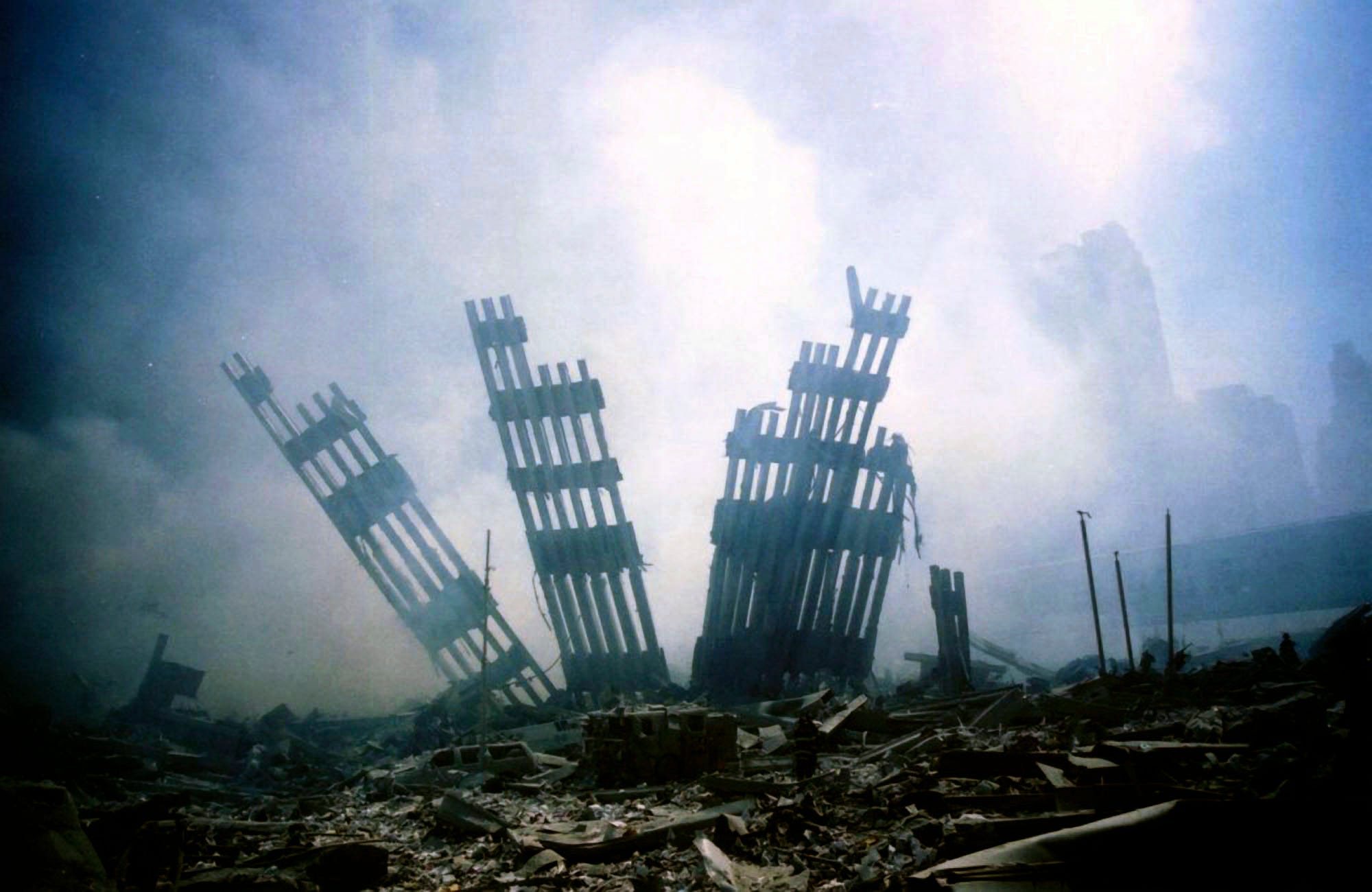
What survives the passage from memory into history is the part nobody argues about. No faction in American life disputes the firefighters and police officers who went up the stairs while everyone sane was coming down, and there is no partisan reading of Welles Crowther. 2,977 people were murdered that day, 343 of them firefighters and 71 of them police officers who died not choosing to be heroes, but choosing to do their jobs instead of running away. We still talk about them not because they suffered, since plenty of people suffer, but because ordinary men who had every reason to leave and live chose instead to spend the short remainder of their lives staying and dying so that others could leave and live.
The attack that morning was fueled by hate — hatred of this country and of Americans and of the way we live, by men who had fed on a hateful ideology until it festered in them. They spent their final seconds loving their hate. Almost everybody else spent their final seconds loving something real. They loved the people they were about to leave and said so on the phone. They loved the people they were carrying down the stairs. They loved the strangers blinded by debris and lost in the stairwells whose names they would never learn. Hate started the day. Love won the day. And time renders that to memory and history.
What happened was not merely heroism. It was the thing that is greater than all other things in time and space. “Greater love hath no man than this, that a man lay down his life for his friends.” Those men did it for people whose names they never learned. Crowther did not know the woman he carried, and the men on the stairs did not know who was above them. If you want to know what Christianity looks like when it stops being an argument and starts being real, it looks like a 24-year-old trader in a red bandana going back up the stairs as others went down.
We remember the unity that followed, too, but 25 years later, I wonder if we can admit the unity of late September 2001 was cheap. Everyone was frightened at the same time and grateful at the same time. Standing together when a building has just fallen on your neighbors requires no virtue at all. The unity worth something is the kind that survives disagreement, that holds when nothing is burning and we still can’t stand each other’s politics. We have always struggled with that one, and 25 years later we are further from it than we were on September 10th.
Unfortunately, we now have an algorithm in our lives and a class of people across party lines who make their living widening the gap between us because the algorithm rewards the clicks generated by angst, animosity, and contrarianism. You can find these malcontented souls driven by algorithmic profit in both parties, and inside every faction of both, and the only thing they reliably have in common is that peace between us would put them out of work. Every one of them is asking you to sort yourself into a smaller tribe, and then into a faction inside that tribe. Those who died on September 11th were not sorted. Cantor Fitzgerald lost 658 employees in a single morning, and nobody asked them who they had voted for before killing them. We dishonor them precisely to the degree that we let ourselves be divided by people whose entire business model is division.
The hard truth in Evelyn’s question is that we already know how to love our neighbor. We proved it on camera in front of the whole world. We simply treat it as an emergency measure — something we break the glass for when the sky falls, then put away by Thanksgiving before going back to despising each other over things that will not matter when time is rendered to history. Loving your neighbor was never meant to be a disaster protocol. It was meant to be the norm, including on a Tuesday 25 years ago, on a clear and perfect fall day, as people woke to God’s mercies made fresh for them again that morning.
I will still remember September 11th on the radio 30 years from now, and I hope by then we have figured out that remembering the heroes and the dead means imitating the heroes and honoring the dead rather than mourning them. This week, President Trump spoke about Welles Crowther and the beam pulled from the South Tower, and posthumously bestowed on him the Presidential Medal of Freedom. Crowther’s mother still has the red bandana. The rest of us have the harder inheritance, which is to be the kind of country Welles Crowther was willing to climb back up the stairs for. Again. And Again. And Again.