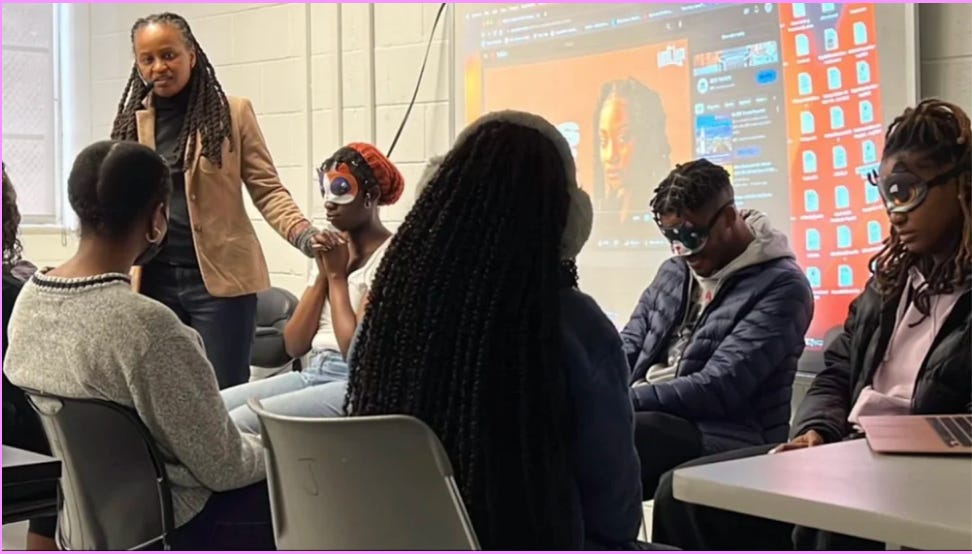
Good morning Y’all.
School is back in session. Whoot! Whoot!
Today, I’m opening up my classroom and inviting you Beautiful People to come listen to a lecture I delivered to my Multimedia Storytelling students. This is one that extends far beyond journalism.
As you listen, I want you to think about some critical questions: Who controls your senses? Do you take the time to pause and look closely at images? Do you have the ability to stop and listen for more than a few seconds? To think critically about what you see and hear? Is your attention constantly interrupted? Do you find that your emotions are constantly provoked when you’re scrolling social media? Do you feel like your eyes are being trained to constantly move from one visual stimulus to the next or from one spectacle to another before you’ve really had time to understand what you just witnessed?
Well, lemme tell Y’all somethin’ . . . powerful political forces in collaboration with creepy tech bros and professionals who understand developmental psychology and neuroscience are exploiting your senses and managing human attention.
There’s a great deal of talk in our current political moment about authoritarianism and what do we do to fight back against it. You’ll hear folks talking about propaganda, attacks on voting rights, policing, censorship, state violence. But authoritarianism is even more intimate because it also depends on harvesting your attention, sensory overload, distracting you, fragmenting your perception, the constant production of images, memes, villains and caricatures, outrage and spectacle, and exhausting the hell out of you. We’ve reached the stage where we’ve normalized things that once shocked us and far too many people are walking around apathetic, disengaged, and eventually stop noticing what power is doing.
So this is why I love teaching multimedia storytelling. The goal is to train young storytellers how to shoot videos, record audio, compose photographs, and build interactive stories for the web. Yes, they learn about these technologies of attention, but they also learn how to reengage with their human senses: how to see, hear, feel, control their own attention, become architects of story, and make meaning. You can’t tell powerful stories if you’re walking around with numb senses. I believe that digital storytelling is a tool of resistance that, at its best, can help restore attention and help folks sit with reality longer than the algorithm wants them to.
So, if you want to learn how to control your own perception and regain possession over your own mind, come go to class with me and my journalism students.
Listen here.
Thanks for reading and listening. If this audio lecture moved you or made you think, please consider becoming a paid subscriber. Your subscription keeps my Substack fueled and unfiltered. Paid subscriptions also help me support HBCU journalism students who need laptops, DSLR cameras, tripods, mics, lights, software, conference travel, reporting trips, and even food from our pantry. We appreciate your support!