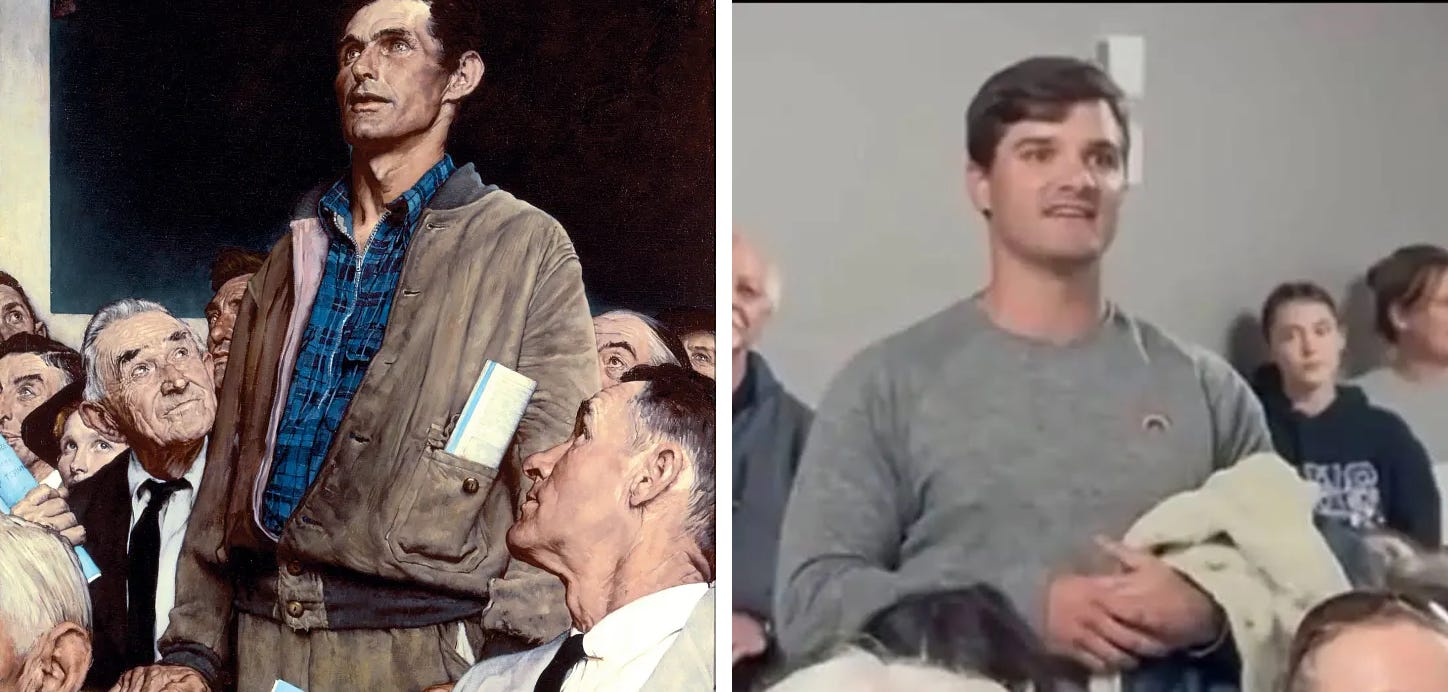
How did we go from Norman Rockwell’s celebration of the power of freedom of speech to the use of freedom of speech to spread lies about American citizens by a republican plant in a town hall with Abdul El-Sayed? The shift from public servants to publicly voted grifters largely results from neoliberalism and technofeudalism, with a soupcon of White misogyny in the face of shifting systems.
Back Then
In 1941, Franklin Roosevelt gave his speech about our four freedoms. Roosevelt guided the nation through the economic uncertainty of the Depression by strategically investing government funds in the populace. His New Deal focused on reinvigorating the United States through government action. Conservatives hated the program, but his immense popularity meant they largely had to comply.
FDR went from domestic uncertainty to foreign wars. Many factions in the United States wanted to remain neutral as war broke out around the world. A segment of Americans really agreed with Hitler that ridding the world of Jews would be a long-term good solution. Others felt the United States shouldn’t fight everyone else’s war. Roosevelt saw the plight of American allies as Germany gobbled up more and more of Europe, as a war against Western democracy. In his 1941 State of the Union address, he had 10 months before the attack on Pearl Harbor. Roosevelt wanted to remind Americans of the values underlying their society. His "Four Freedoms" speech, as it became known, discussed two freedoms enshrined in the Constitution and two he believed were emblematic of American Society. He discussed freedom of speech, freedom of religion, the freedom to work, and the freedom to health.
In 1942, after declaring war on Japan the day after the attacks on Pearl Harbor and then subsequently on Italy and Germany, the US created the Department of War Information to ensure the populace understood the ramifications of being in a war. In practice, though, the department largely used visual tools to win over the American public.
Norman Rockwell's series, paired with essays by Booth and Tarkington, translated the ideals of Roosevelt's speech into visual situations that would resonate with Saturday Evening Post readers.