Good morning and welcome back to Vittles. Today’s piece by Audrey Khew is the latest in our Cooking from Life strand, a series of essays that offer a window into how food and kitchen-life work for different people in different parts of the world. Audrey writes about processing the grief of miscarriage while trying to follow a traditional confinement diet, and the dish that helped to bring her back to herself.
On Monday we announced * Seasons*, a set of four fully illustrated pamphlets – spring soups, summer salads, autumn braises and winter bakes – each containing four recipes from some of the most exciting voices in contemporary British cookery. The set costs £15, and will ship on 26 November.
Gwendoline Christie roars when she laughs. Her laugh easily fills a space – just as she does. I remember this very clearly.
Years ago, just before Christmas, my husband and I were having a meal on a barge that was taking us around Little Venice. I had just informed the waitress, in hushed tones, that I was pregnant, and asked if they could make some adjustments to the set menu. After the first course, I went to the bathroom and noticed that I was spotting. As I walked back to the table, I realised that it was Christie’s laugh I’d been hearing.
I remember thinking, after I spoke to the waitress, that it was odd to share such intimate news with a complete stranger. But in an instant, I’d become a prevaricator, an imposter. Because I was no longer pregnant.
The grief from a miscarriage is an isolating experience. That I was mourning the loss of something abstract made everything more complex. I was, after all, grieving for something that was the size of a pea. I had only been six weeks pregnant, but was eagerly tracking the growth of the embryo through an app, anticipating its next milestone: when it would become the size of a blueberry.
When I miscarried, I had just returned to London from Malaysia, where I had celebrated the news of my pregnancy with my family. My mum had been full of tips about what to eat and what to avoid for a healthy pregnancy: she wanted me to snack on goji berries and walnuts, which would help with the early development of the foetus, and to avoid anything raw or cold – including salads and fruits – which she said would cramp the womb and weaken qi.
I’d found her to be a nag. It was, after all, my body. I wanted to continue being active and living my life as normally as possible; I had done my own research on what to eat and felt well informed.
When I called to tell her what had happened, her response was purely matter of fact: even though I had miscarried, she insisted that I should still observe a short confinement.
This stopped me in my tracks. I was convinced it must be some kind of cruel joke.
Postpartum confinement is a practice observed by various cultures around the world, including in Asia, Latin America and Africa. Although the exact contours vary by region, it generally involves a period of prescribed rest after childbirth – usually three to six weeks – with the aim of promoting healing. During this time, specific diets are recommended to nourish the mother’s body and boost the production and flow of breastmilk.
‘The fact that an abridged confinement of two weeks is recommended for those who miscarry is rarely spoken about, recalling the culture of silence and shame that surrounds miscarriage more broadly’
In Chinese communities, this recuperation period is known as 坐月子 (zuo yue zi), or ‘doing the month’, and has been practised for more than 2,000 years. According to the teachings of traditional Chinese medicine, a woman’s yin and yang are in a state of imbalance after childbirth. Confinement – generally for between thirty and forty days – helps to restore her qi and allow her to heal fully.
In Malaysia, most women still observe a confinement period after childbirth. The usual diet is similar to what my mother had suggested to me in early pregnancy: raw foods are to be avoided, and so are fruits like watermelon, pineapple and pears. Heat- or yang-generating dishes, such as sesame oil chicken, are encouraged. Traditionally the mother’s family prepared these special meals – helping to provide care for the newborn – but more recently confinement has become a thriving industry, with businesses offering everything from live-in nannies to meal delivery. I had searched for similar services in London in moments of idle fantasy.
The fact that an abridged confinement of two weeks is recommended for those who miscarry is rarely spoken about, recalling the culture of silence and shame that surrounds miscarriage more broadly. I learned from my mum that the same rituals were advised, with a broadly similar diet recommended. The only difference was that I was also encouraged to avoid pig’s trotters and green papaya, which are milk-boosting foods – a minor detail, but a painful one.
‘Cooking is usually an act of joy for me … but now I did not find solace by the stove. Instead, I fixated on how cooking is used as a metaphor for pregnancy – a bun in the oven, a dumpling on the way’
Like most Malaysian Chinese people, when I was growing up my family consulted medical doctors and traditional practitioners in tandem, but traditional Chinese medicine was not a normal part of my adult life in London. Without the convenience and familiarity of the herbal shops I frequented in Kuala Lumpur, or the guidance of my great uncle (a renowned sinseh in Klang), I felt lost.
There are various cookbooks for women in the diaspora navigating postpartum care, but their titles – things like Nourishing the New Mother and The First Forty Days – put me off. I couldn’t find any books specifically about post-miscarriage confinement, or even any that mentioned it. Instead, I asked a friend if she had bought any books for her own confinement after the birth of her baby daughter. She responded with photos from a book her mum had sent, containing instructions for drinks to be made daily – date tea, fried ginger rice tea, dang shen tea, black-bean-and-date tea – alongside dishes crucial for rebuilding red blood cells, such as village chicken with ginger and mugwort leaf omelette. Each recipe was a painful reminder that a gaggle of new mothers were eating these dishes, but I was not one of them. I oscillated between grief and anger at my situation.
I didn’t want to eat and had lost all interest in cooking, but after a few days, I forced myself to go to my local Chinese supermarket, where I bought some jujubes and goji berries to steep in hot water. This tea was all I could manage. Otherwise, I consumed very little: I didn’t have an appetite, and when I tried to eat I was unable to taste anything. I lived in my dressing gown, unable to get out of bed.
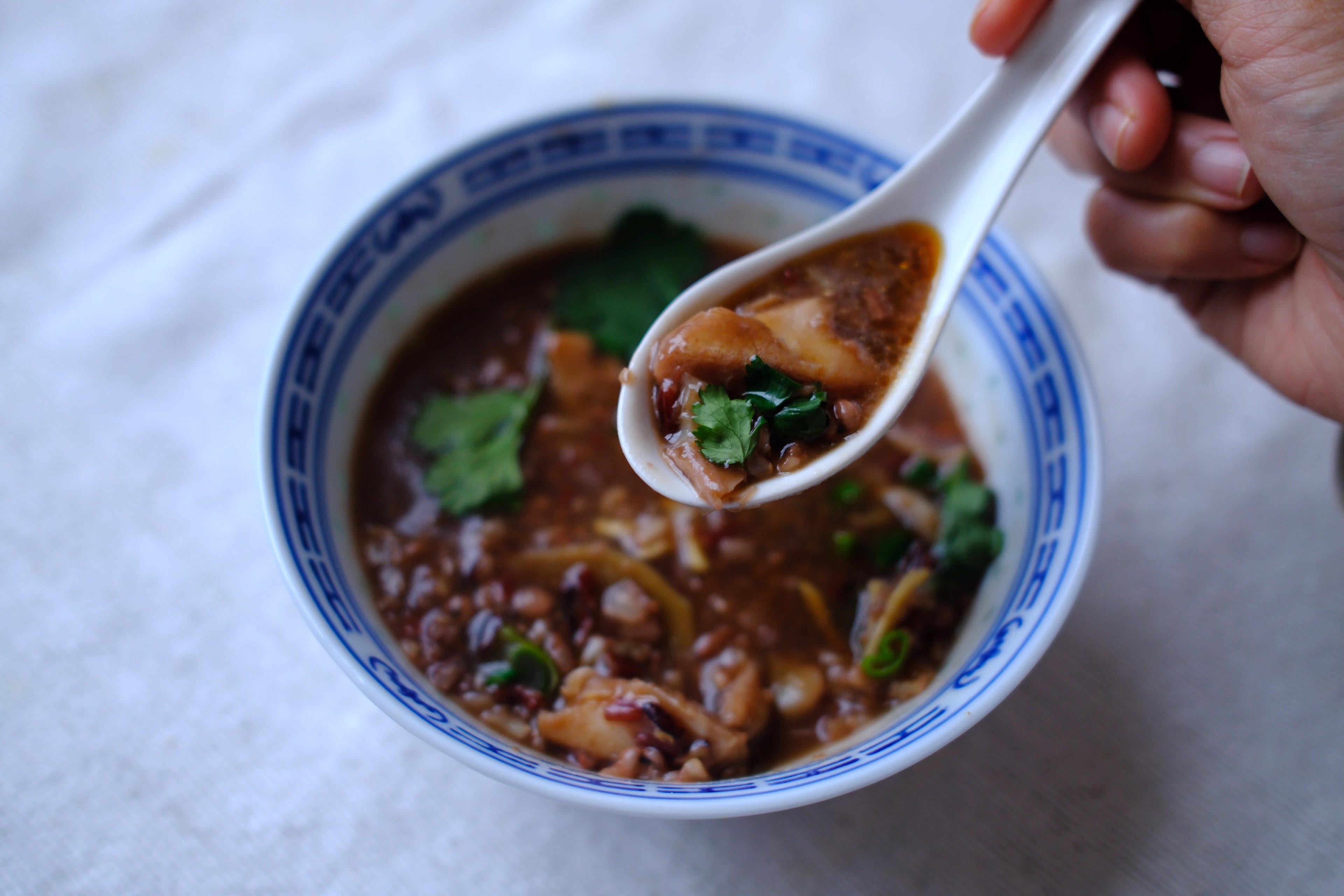
After about a week, a recipe from my friend’s book stirred something in me: five-grain rice fish congee. In The Year of Magical Thinking, Joan Didion recalls that in the first few weeks of grief after her husband died, she was brought ‘a quart container of scallion and ginger congee from Chinatown’ by a friend. ‘Congee I could eat,’ she writes. ‘Congee was all I could eat.’
Like Didion, the only food I could fathom stomaching was congee. It’s gentle, almost bland; it does not overwhelm the senses. The process of making congee is similarly meditative: it gives you space to think.
So, I forced myself to cook.
Cooking is usually an act of joy for me. I had previously been a believer in its therapeutic nature, but now I did not find solace by the stove. Instead, I fixated on how cooking is used as a metaphor for pregnancy – a bun in the oven, a dumpling on the way.
I made the congee begrudgingly. As I stirred the grains until they surrendered to the water, I thought of my mum. When I was unwell as a child, congee was what she would cook. Suddenly, I understood what I hadn’t been able to see before: her insistence that I nourished myself during the pregnancy and after the miscarriage stemmed from her longing to look after me.
Although I felt empty as I ate the congee, on a subconscious level I knew that I had to at least get my body back to a state of balance, even if I still wasn’t emotionally ready to process my loss. I called my mum to tell her what I’d cooked, knowing that it would ease the worry she’d been feeling, thousands of miles away.
This is a recipe for when you don’t want to cook but are in need of restoration. According to the book from which this recipe is adapted, congee minimises digestive strain so your body can focus its energy entirely on recovering from the massive amounts of energy expended by processing hormonal shifts. The fish is a source of clean protein that helps to repair the uterus, while the rice provides magnesium to support the nervous system.
*Serves 1Time *1 hr
50g five-grain rice (see notes)
5 dried lily bulbs (available in Chinese supermarkets), rehydrated in water for 20 mins
4 thin slices of fresh ginger
50g white fish (I use a white fish mix from The Upper Scale that includes cod, coley, haddock, hake and pollock)
salt and white pepper, to tastefor the marinade½ tbsp light soy sauce
½ tbsp sesame oil
¼ tsp salt
1 tsp cornstarch
coriander
spring onions, finely chopped
sesame oil
Wash the rice, then cook in 1L of water over a low heat for about 30 mins, stirring frequently.
Add the lily bulbs and ginger to the rice, then cook for another 15 mins.
Meanwhile, mix all the marinade ingredients with 1 tbsp water in a bowl. Add the fish to the bowl, then leave to marinate for 15 mins.
Add the marinated fish to the congee pot, turn up the heat to high, season and bring to the boil. Once boiling, turn the heat off, cover with a lid and leave to sit for 10 mins – this will help to thicken the congee.
Remove the lid and gently reheat the congee for a few minutes, then serve topped with ginger, coriander, spring onions and a drizzle of sesame oil.
This rice blend is made with white rice, brown rice, black glutinous rice, yellow millet (or barley), soy beans, red beans (or mung beans) and buckwheat (or Job’s tears). If you can’t find it in your local Chinese supermarket, you can try making your own blend.
Audrey Khewwrites about food and works at the British Fashion Council. You can find her essays inCake Zine,GoldenandToothsome. Her Substack,, explores food through the lens of art, fashion, film, TV and heritage. You can find her eating and cooking on Instagram as part of the collective[Happiness of Delicious Feeling][Sides and Notes].The full
Vittlesmasthead can be found[here].