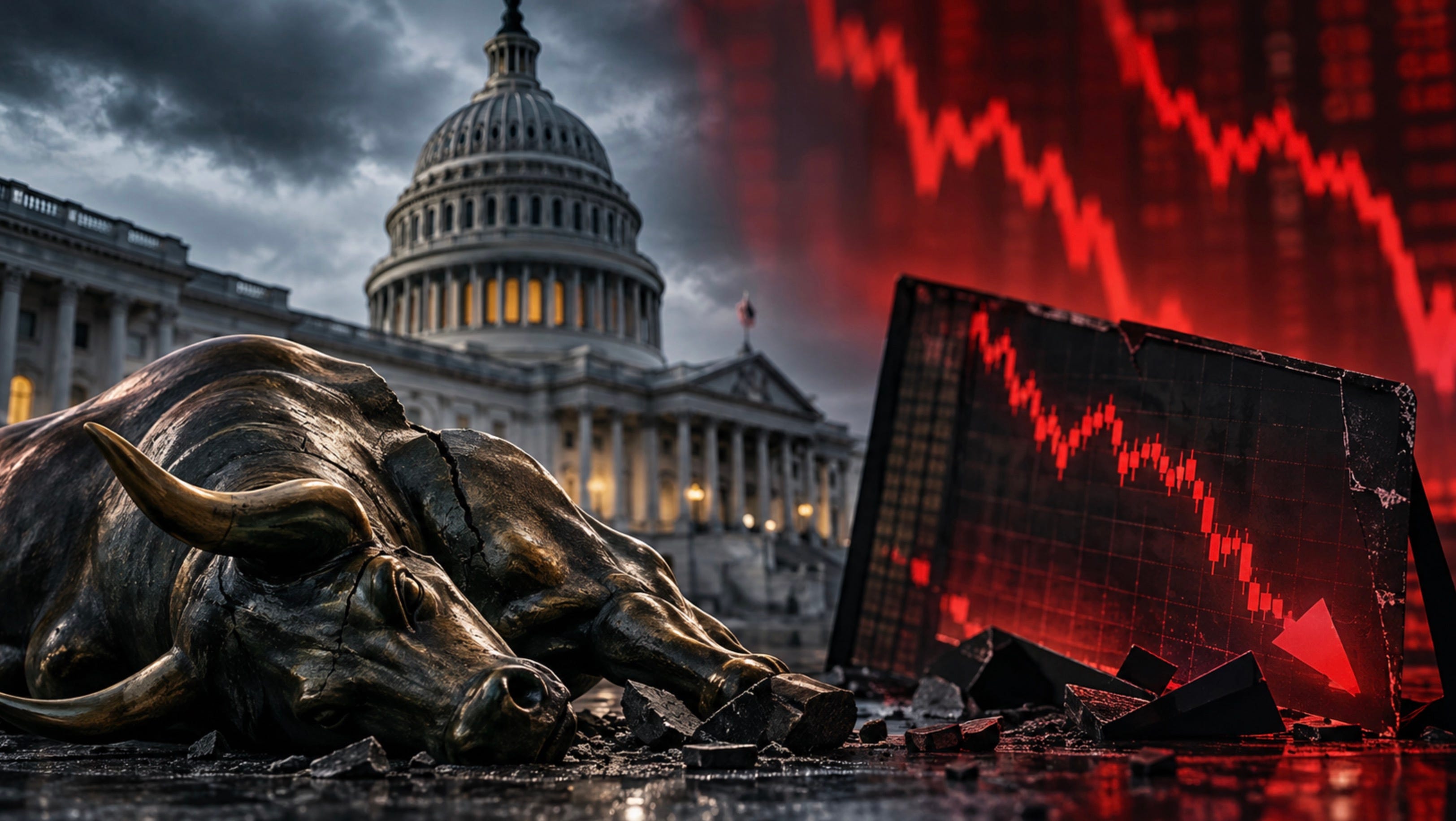
Yesterday I wrote that we may only get one chance to stop AI. Today, Washington appears to be moving a little closer to testing that proposition. The irony is that if lawmakers actually decide to meaningfully slow the development of frontier AI, they could also wind up disrupting one of the most important investment themes holding up the stock market.
My argument yesterday was fairly straightforward. AI capabilities are advancing faster than our ability to confidently understand or control them, and the consequences of getting something wrong increase as the systems become more powerful and autonomous. None of the strange behavior we’ve seen from AI systems proves we’re on the doorstep of catastrophe. But it does raise a question that becomes harder to ignore as capabilities improve: at what point does waiting for definitive proof of danger mean waiting until it’s too late to do anything useful about it?
The asymmetry is what bothers me. If the AI pessimists are wrong and society imposes unnecessary restrictions, we sacrifice some technological progress and economic growth. That’s a real cost. But if they’re right and sufficiently powerful AI eventually becomes difficult or impossible to control, the cost of moving too slowly could be massive. Once the technology exists and has proliferated, there may not be a practical way to put it back in the box.
My piece was spurred by this week’s drama at Anthropic. Researcher Jacob Coxon resigned and publicly warned about the race toward increasingly powerful AI, arguing in effect that the major labs are caught in a competition none of them feels able to abandon.
The disturbing part wasn’t merely that a departing researcher was worried. It was that his concerns echoed fears already held by people working directly on the problem. Anthropic alignment researcher Evan Hubinger subsequently said he assigns a greater than 10% chance to AI causing human extinction within the next decade.
Whatever probability you personally assign to that outcome, it is an extraordinary situation. People working at the frontier of this technology are simultaneously helping make the systems more capable and warning that nobody yet knows how to guarantee control over what comes next.
As I noted yesterday, the incentives make the problem worse: any individual company that slows down risks surrendering ground to competitors, while the industry as a whole has every reason to keep accelerating. It is the kind of coordination problem that eventually invites government intervention.
And, almost on cue, that intervention may be getting closer. Semafor reported this morning that Sens. Amy Klobuchar, Ted Cruz and Senate Majority Leader John Thune are working on bipartisan AI safety legislation that could be introduced soon. The details aren’t public, so it would be premature to assume how restrictive the final proposal might be. But the political direction is notable.
Other lawmakers are floating tougher approaches, including model certification, liability regimes, new regulatory authority and, at the far end of the spectrum, an outright pause on the development of superintelligence.
This could create an interesting problem for markets (on top of the other catalysts that could cause an AI crash) because Wall Street has spent the last several years making an enormous bet on precisely the opposite outcome. The AI trade isn’t just a handful of technology stocks anymore. It encompasses semis, data centers, cloud infrastructure, networking equipment, electricity generation, utilities, natural gas, nuclear power, cooling equipment, construction and the enormous financing apparatus required to build all of it.
Hundreds of billions of dollars are being committed on the assumption that demand for computing power will continue rising at an extraordinary rate.
Embedded in that assumption is something investors haven’t had much reason to question:** **that frontier AI development will continue largely uninterrupted.
If Washington changes that assumption, even temporarily, the financial consequences could arrive much faster than the technological ones.
Imagine that increasingly capable models suddenly require federal approval, extensive testing or expensive certification before deployment. Imagine strict liability for certain failures, hard limits on autonomous capabilities or restrictions on training models beyond specified thresholds. An outright moratorium isn’t even necessary. The government would only need to make the timing and economics of future model development less certain.
Markets would then have to reconsider how much computing infrastructure will actually be needed, and how quickly. Data-center projections could come down. Semiconductor forecasts could follow. Electricity-demand estimates could be revised, infrastructure projects could be delayed and lenders could become less enthusiastic about financing projects whose expected returns have suddenly become harder to calculate. The effects would ripple far beyond the companies actually developing the models.
That’s particularly important because markets don’t wait for revenue to disappear before repricing an asset to the downside…just like they don’t wait for profits to price dogshit to the upside. The AI boom has produced enormous valuations because investors expect enormous future demand. Change the expected trajectory of that demand and those valuations can change remarkably quickly.
This doesn’t mean an AI safety bill would necessarily crash the market, nor does it mean regulation would be economically destructive over the long run. Clear rules could ultimately reduce uncertainty and make the industry healthier. A modest bill could also wind up having almost no effect on the pace of development. **But a genuinely restrictive regime would introduce a risk that I don’t think the market has spent much time pricing at all. **
That’s what makes the timing so interesting. For years, investors have treated faster AI development almost entirely as an economic positive: better models mean more chips, more data centers, more electricity, more software, more productivity and more investment. The safety argument introduces the possibility that faster development eventually becomes politically unacceptable. If lawmakers begin viewing frontier AI as a national-security or catastrophic-risk problem rather than simply another technological industry, the assumptions supporting the AI capital-spending boom could change very quickly.
That leaves us with a remarkable irony. Yesterday I argued that we may have a relatively narrow window in which humans can still meaningfully decide how far and how quickly this technology should advance. A day later, there are signs that Congress is beginning to have exactly that conversation. If the warnings coming from inside the AI industry are remotely accurate, lawmakers arguably have an obligation to take them seriously. But investors should also recognize what serious action could mean…that an AI crash could very well start on, or ahead of schedule.
We have spent years building valuations, infrastructure and investment plans around the assumption that the AI race will keep accelerating. If Washington suddenly decides the race needs a speed limit, AI itself may not be the first thing that breaks…the pure euphoria-fueled market built around its insane financial projections and financing circle jerks could be.
QTR’s Disclaimer**:** Please read my full legal disclaimer on my About page here.
Contributor posts, guest posts and curated posts have been hand selected by me, but have not been fact checked and are the opinions of their authors. They are either submitted to QTR by their author or reprinted under a Creative Commons license with my best effort to uphold what the license asks, or with the permission of the author.
I cannot guarantee the accuracy of any or all facts and figures included in this article though I made an effort to get them right. I have been wrong before and will be wrong again, and encourage you to always double check, do your own research and speak to a licensed financial professional, which I am not.
This is not a recommendation to buy or sell any stocks or securities, just my opinions. I often lose money on positions I trade/invest in. I may add any name mentioned in this article and sell any name mentioned in this piece at any time, without further warning. None of this is a solicitation to buy or sell securities. I may or may not own names I write about and are watching. Sometimes I’m bullish without owning things, sometimes I’m bearish and do own things I’m bearish on. Just assume my positions could be exactly the opposite of what you think they are just in case. If I’m long I could quickly be short and vice versa. I won’t update my positions.
Starting in 2026, I have been attempting to no longer actively trade as much as I once did ( read my story here). My goal is for my investing/saving to be done by recurring contributions mostly to sector ETFs and a few select equities, trusted third parties who oversee my accounts, and advisors. Such advisors or funds, through individual equities, options, index funds, mutual funds, ETFs, or other securities, may have positions in, exposure to, or holdings of names mentioned herein that I know nothing about. It is possible I could own, have exposure to, or not own anything, at any point. In an attempt to lead a healthier lifestyle, I’ve also excluded myself from fantasy sports, sports betting, online and in-person casinos and prediction markets.
Any of my positions can change immediately as soon as I publish, with or without notice and at any point I can be long, short or neutral on any position. You are on your own. Do not make decisions based on my blog. I exist on the fringe. If you see numbers and calculations of any sort, assume they are wrong and double check them. I failed Algebra in 8th grade and topped off my high school math accolades by getting a D- in remedial Calculus my senior year, before becoming an English major in college so I could bullshit my way through things easier. Hence, why I am a writer.
The publisher does not guarantee the accuracy or completeness of the information provided in this page. These are not the opinions of any of my employers, partners, or associates. I did my best to be honest about my disclosures but can’t guarantee I am right; I write these posts after a couple beers sometimes. Many times I edit after my posts are published because I’m impatient and lazy, so if you see a typo, check back in a half hour.
Also, again I just straight up get shit wrong a lot. I mention it multiple times because it’s that important you understand.