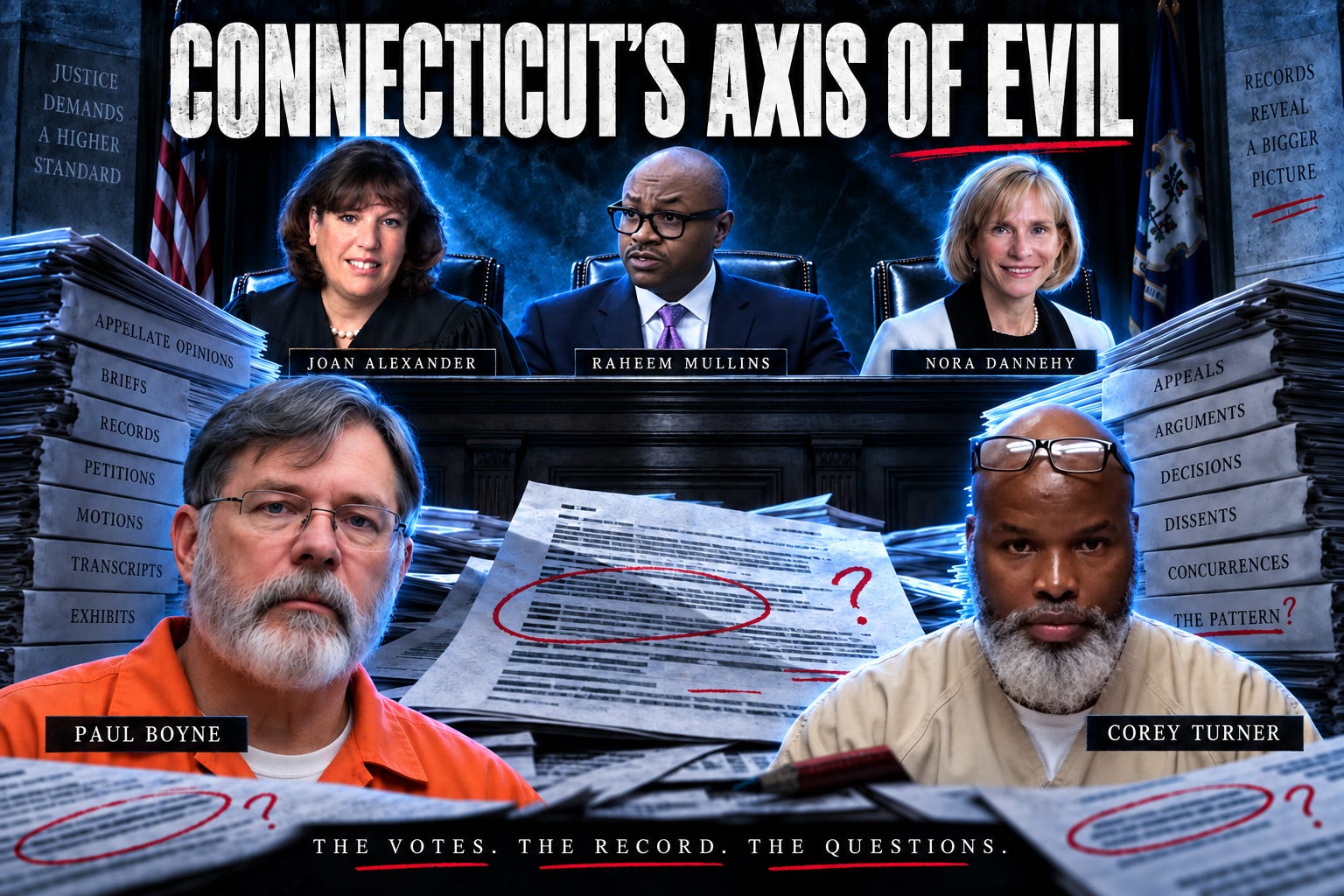
LUTHMANN NOTE: A court earns public confidence by making government answer difficult questions. For years, three former prosecutors voted as a hardened bloc on Connecticut’s highest court. Family Court Martyr Paul Boyne says they continue to serve a deeper political machine he calls the “Jewdiciary.” When judges resist further examination of a prosecutor’s dealings with a cooperating witness, their reasoning deserves scrutiny as exacting as anything imposed on a defendant. I want Connecticut’s voting record examined across the full docket, with the decisions, dissents, and consequences laid out where everyone can read them. Alexander’s move into administration also leaves the Corey Turner controversy deserving continued examination. Boyne’s explanation of that move remains his theory. The public can demand answers now. Judicial office carries authority over other people’s freedom, and that authority comes with an obligation to account for its use. This piece, “Connecticut’s Axis of Evil,” is written in the “classical style” of The Family Court Circus Blog, offense intended. Reader discretion advised.
Connecticut planted a prosecution caucus inside its Supreme Court. Chief Justice Raheem L. Mullins, Justice Nora R. Dannehy, and, until recently, former Justice and now Chief Court Administrator Joan K. Alexander are three former prosecutors who repeatedly voted together when criminal defendants asked the court to restrain police, enforce constitutional protections, punish prosecutorial misconduct, or examine what the state concealed. Mullins defended convictions in the Appellate Bureau. Alexander prosecuted homicide and arson cases (including the controversial prosecution of Corey Turner) and supervised the Statewide Prosecution Bureau. Dannehy spent nearly two decades at the U.S. Department of Justice and became Connecticut’s top federal prosecutor before Gov. Ned Lamont appointed her directly to the Supreme Court without a day of prior judicial experience. Connecticut calls that experience. A criminal defendant should call it what it is: the state’s prosecutorial establishment sitting in final judgment of itself.
Their opinions expose the arrangement. In * State v. Sharpe*, the Axis helped approve warrantless DNA extraction and testing from a discarded belt, treating a human genetic code like ordinary abandoned trash. In
Their purest formation appeared in * Moore v. Commissioner of Correction*. Darnell Moore alleged that the state failed to disclose an informal cooperation agreement with Samuel Gomez, a witness whose criminal charges were still pending when he testified. The Supreme Court majority ordered further factual findings concerning the New London state’s attorney’s office and its practices for rewarding cooperating witnesses. That was not exoneration, reversal, or even a finding of misconduct. It was an order to look behind the prosecutor’s denial. Alexander dissented, joined by Mullins and Dannehy. Every former prosecutor on Connecticut’s highest court voted against further investigation of the prosecution office. Four justices wanted facts. The Axis wanted the curtain closed.
Paul Boyne, imprisoned while challenging Connecticut’s use of “Jewdiciary Stalking Laws” against his speech, offers a darker explanation. He calls the state’s judicial establishment “Rabbinical” and claims the Axis serves an entrenched network of political patrons, judges, prosecutors, and advocacy interests “that don’t celebrate Easter.” Boyne describes what he called a “shadow Jew matrix behind the scenes” that “takes care of you and then your children” through a “big machine.” He tied Dannehy’s elevation to what he described as generations of Democratic Party patronage and demanded an answer from Mullins: “Why can Connecticut label speeches stalking and put somebody in jail?” Boyne’s theory is that the Axis does not merely favor prosecutors from professional instinct. It protects the ideological machinery that selected, elevated, and now depends upon them. “Jonathan Greeblatt and Joette Katz tell them what to do.”
Boyne’s “ethnic cabal” explanation raises institutional questions that cannot be dismissed merely because he expresses it with a flamethrower. Connecticut’s courts, prosecutors, political appointees, advocacy councils, and executive offices operate through recurring relationships. Dannehy served as Lamont’s general counsel before he nominated her. Alexander moved from prosecutor to criminal administrative judge to the Supreme Court. Mullins went from defending state convictions to leading the court that reviews them. The patronage pipeline is public. What remains concealed is who communicates with whom, which outside interests shape prosecution policy, and why the same three justices repeatedly form the state-protection bloc when constitutional restraints threaten convictions.
Alexander resigned from Connecticut’s Supreme Court effective August 1, 2026, to serve full time as chief court administrator, a position Mullins had appointed her to effective November 16, 2025. She had held both jobs concurrently. The official explanation was a transition to full-time administrative service. Boyne believes court leadership is preparing for fallout from her prosecution of Corey Turner. He describes his theory bluntly: “in order to set the blast perimeters, they moved her off the Supreme Court.” In Boyne’s telling, the administrative post provides a place to wait while misconduct allegations develop: perhaps Alexander emerges with her pension intact; perhaps she faces criminal scrutiny and removal in disgrace. Either way, she would no longer occupy a Supreme Court seat if the consequences he anticipates materialize. The underlying dispute is documented. Inside Investigator reported that Alexander used excerpts from Turner’s recorded conversation with his alibi witness to suggest he had influenced her testimony, then successfully opposed playing the recording for jurors. Turner’s attorney, Alex Taubes, argues that the omitted context undermined that accusation. Those allegations surfaced during Alexander’s 2022 confirmation hearing, where she defended the conviction and cited repeated judicial reviews rejecting Turner’s challenges.
Boyne’s own prosecution makes the “managerial interests” question radioactive. He contends Connecticut converted offensive political speech against judges and the crooked administration of justice into stalking, treated hostility toward Judaism as evidence of criminal purpose, and imprisoned him through a warrant-production system “fine-tuned” by police supervisors, inspectors, and prosecutors. His language is frequently ugly, and the state points to conduct extending beyond abstract criticism. But the First Amendment does not disappear because the speaker is offensive, hateful, or despised. If Connecticut criminalized protected expression by packaging viewpoint hostility as criminal evidence, then the Axis will eventually face a direct test: enforce the constitutional boundary or protect the same prosecutorial machinery from which all three emerged.
Connecticut should publish the voting audit and open the communications. Count every criminal and habeas decision since Dannehy joined the court. Identify every prosecutorial violation declared harmless, every police power expanded, and every divided case in which Mullins, Alexander, and Dannehy voted together. Then release the appointment records, judicial-policy communications, and contacts surrounding Boyne’s prosecution. Boyne calls the hidden power the “Jewdiciary.” The ethnic theory gets dismissed. But the Axis of Evil is already printed in the Connecticut Law Journal: three former prosecutors, three synchronized votes, and one state machine they almost never force to pay for breaking the rules.